Child nutrition · October 21, 2026
A daily lentil meal and eight weeks of feeding lessons in a Kenyan herding village: children's diets got far more varied, their weight barely moved, and half the comparison village stopped turning up
In Turkana, one of the hungriest corners of Kenya, children in one village got a cooked lentil, rice and vegetable meal six days a week while their caregivers sat through morning lessons on feeding and hygiene. By the end, the children were eating more meals and many more kinds of food at home. Their growth was another story, and so was the village they were compared with.
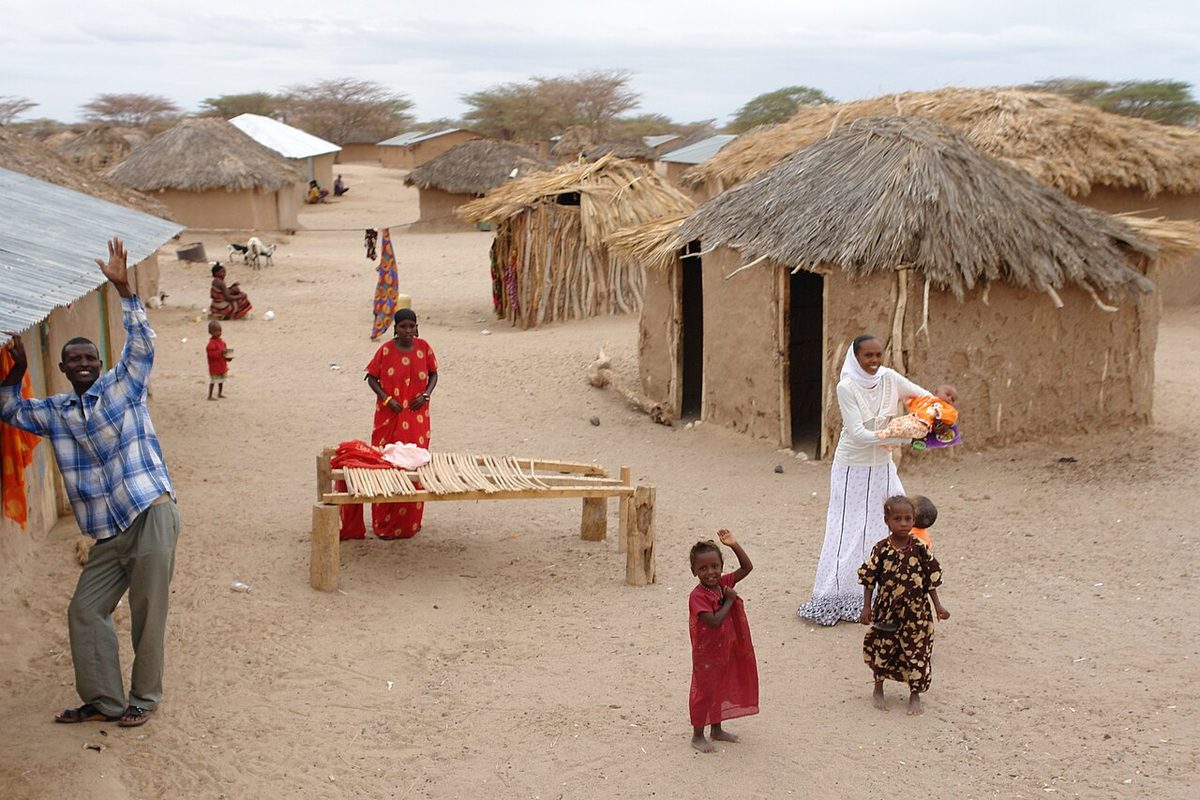
Turkana County in north-west Kenya is dry country where most families live by herding goats, sheep and camels. Child undernutrition there has hardly shifted in a decade: Kenya's 2022 health survey found 23% of Turkana children under five stunted, 22.6% wasted and 31.7% underweight, about the same as in 2014. A team from Texas Tech University in the US tested what happens when young children get a daily meal and their caregivers are taught how to feed them at the same time. Their paper appeared in Nutrients on 11 October.
The study ran from June to August 2023 in two villages 47 km apart. In Sopel, in Turkana East, 171 children aged 6 months to almost 5 years were served a cooked meal of Harvest Lentil Vegetable Blend, a dried mix of rice, lentils, carrots and onions, six days a week for eight weeks: 15 g of dry mix for babies under a year, 20 g for one-year-olds and 40 g (138 kcal) for older children. Their 145 caregivers came to lessons six mornings a week, 60 to 75 minutes each, on breastfeeding, what to feed a young child and how often, feeding a sick child, safe water, handwashing and using latrines. Most of the caregivers, 84.8%, could not read or write, so the lessons went through an interpreter, with pictures, repetition and teach-back. In Nayada, in Turkana Central, 147 children had the usual growth checks from community health workers, and families got a 1 kg bag of the food after each round of measurements. Children in both villages were dewormed first. Almost every household in both villages, 99.6%, was moderately or severely short of food.
What the children ate at home changed a great deal. At the start they averaged only 1.6 of 8 food groups a day, and just 1.8% of children in Sopel and 2.9% in Nayada met the World Health Organization's minimum for dietary variety. By the end, Sopel children ate about one more food group a day than Nayada children (0.98 more), had about three-quarters of a meal more each day (0.77), and had 8.4 times the odds of meeting the variety minimum and 5.7 times the odds of eating milk, meat or eggs. The diet questions were asked on Mondays, after a Sunday with no project meal, so the extra meals were ones the families gave themselves.
Their growth did not change in any way the study could show. Children in Sopel gained 0.49 kg over the eight weeks and those in Nayada 0.20 kg, but after adjusting for age, sex, caregivers' age and schooling and livestock owned, the difference was 0.36 kg, with a range running from a 0.09 kg loss to a 0.80 kg gain. Weight-for-age and weight-for-height scores leaned the same way, and the odds of wasting or underweight were a little lower in Sopel, but none of it was clear of chance. Weight gain was the outcome the study was sized for.
The bigger problem is who was still there at the end. In Nayada, 63 of 147 children (42.9%) missed the final weighing and 77 of 139 caregivers (55.4%) missed the final interview; in Sopel the figures were 29 of 171 (17.0%) and 37 of 145 (25.5%). The study had planned for 20% dropout and at least 144 children per group. When more than half of one group is missing and the other group is getting daily food, the families who stayed in each village may not be alike. The villages also differed from the start: 12.9% of Sopel children were stunted against 26.9% in Nayada, while wasting ran the other way (31.3% against 19.7%), and Sopel families were more likely to own livestock. Villages were not chosen at random, and the people collecting the data also ran the programme and knew which village was which.
The authors list most of these limits themselves, adding that diets came from a single 24-hour recall each time, answers could be shaded by what caregivers thought the educators wanted to hear, and two months may be too short to see growth. They conclude that the combined programme improved how children were fed, and call for longer studies of the blend. The research was funded by Breedlove Foods Inc., which the paper says had no role in the design, analysis or publication, and the authors declare no conflicts of interest.
Daily Harvest Lentil Vegetable Blend meal plus caregiver nutrition education vs usual care, 8 weeks, 318 children aged 6 to 59 months in two Turkana villages, Kenya (non-randomised, June to August 2023)
318 children, 284 caregivers
Enrolled: 171 children and 145 caregivers in the programme village, 147 and 139 in the comparison village
+0.98 food groups
Extra rise in daily dietary diversity score in the programme village vs comparison (95% CI 0.59 to 1.37); both started at 1.6 of 8 groups
OR 8.40
Odds of meeting the minimum dietary diversity at the end, programme vs comparison (95% CI 1.06 to 66.78); at the start 1.8% and 2.9% met it
OR 5.66
Odds of eating any milk, meat or eggs at the end (95% CI 2.32 to 13.77); at the start 31.0% vs 28.8%
+0.77 meals a day
Extra rise in daily meal frequency, recalled on days without the project meal (95% CI 0.35 to 1.20)
+0.36 kg
Adjusted difference in weight gain over 8 weeks, not significant (95% CI −0.09 to 0.80; p = 0.117); raw gains 0.49 kg vs 0.20 kg
OR 0.76 and 0.82
Odds of wasting and of underweight at the end, programme vs comparison, both not significant (95% CI 0.42 to 1.38 and 0.38 to 1.77)
42.9% vs 17.0%
Children missing at the final weighing, comparison vs programme village (63 of 147 vs 29 of 171); caregivers 55.4% vs 25.5%
Study: Ingabire-Gasana E, Appiah D, Niraula SR, Park O-H, Murimi M, 'Effectiveness of Supplemental Feeding Combined with Nutrition Education on Child Nutrition Outcomes in Kenya', Nutrients 2026, 18(20):3327, published 11 October 2026, doi 10.3390/nu18203327 (open access, CC BY). Department of Nutritional Sciences, Texas Tech University, and Texas Tech University Health Sciences Center, Lubbock, USA; recruitment with Share International Inc., a Turkana community organisation. Quasi-experimental controlled trial, June to August 2023: Sopel village (Turkana East, intervention) and Nayada village (Turkana Central, control), 47 km apart, allocated non-randomly; investigators and assessors not blinded. Intervention: cooked Harvest Lentil Vegetable Blend (rice, lentils, carrots, onions; per 100 g dry: 344 kcal, 18.3 g protein, 8.8 g fibre, 5.5 mg iron, 2.5 mg zinc, 0 mcg vitamin B12) Monday to Saturday for 8 weeks, 15 g dry (52 kcal) at 6 to 12 months, 20 g (69 kcal) at 13 to 23 months, 40 g (138 kcal) at 24 to 59 months; caregiver education six mornings a week, 60 to 75 minutes, four modules built on the Theory of Planned Behavior and UNICEF's infant and young child feeding counselling package. Control: routine growth monitoring, 1 kg of the food after each data collection. Both groups dewormed beforehand. Baseline: mean child age 33.3 months; stunting 12.9% vs 26.9% (p = 0.002), wasting 31.3% vs 19.7% (p = 0.02), underweight 23.4% vs 26.5%; livestock ownership 65.5% vs 51.4%. Diet by one 24-hour recall per time point, on Mondays after a non-feeding Sunday; minimum dietary diversity = at least 5 of 8 groups at 6 to 23 months, at least 4 (excluding breast milk) at 24 to 59 months. Analysis: linear mixed models (continuous outcomes, no imputation) and GEE with multiple imputation (categorical), adjusted for child age and sex, caregiver education and age, and livestock count. Lost to follow-up: 92 children and 114 caregivers. Sample size: 144 pairs per group for weight gain, assuming 20% attrition. Funded by Breedlove Foods Inc. (funder had no role, per the paper); no conflicts declared. Turkana prevalence figures from the Kenya Demographic and Health Survey 2022 as cited in the paper. '1.6 of 8' rounds the baseline means of 1.61 and 1.60.
- An odds ratio of 8.4 does not mean eight times as many children. When only 2 or 3 children in 100 meet a target at the start, a few more meeting it later gives a big ratio with a wide range: here anything from 1.06 to 66.78.
- The blend contains no vitamin B12 at all, since it is made only from plants. Milk, meat and eggs are the usual B12 sources for young children, and they are foods that herding families often have to hand.
- Caregivers who could not write gave consent with a thumbprint, after the consent form was read to them in Kiturkana, the local language.
- Turkana is Kenya's largest county by land area, about 77,600 square kilometres, and had about 927,000 people at the 2019 census.
- Effectiveness of Supplemental Feeding Combined with Nutrition Education on Child Nutrition Outcomes in KenyaNutrients, October 2026 · The study: full text, open access
- Indicators for assessing infant and young child feeding practices: definitions and measurement methodsWorld Health Organization and UNICEF, 2021 · The food groups and the minimum dietary diversity measure used in the study
- Turkana CountyWikipedia · Area and 2019 census population
- Turkana DSC08830Wikimedia Commons · The photo, CC BY 2.0 (Filiberto Strazzari)
General information, not medical advice. This was a short, non-randomised study in two villages with heavy dropout in the comparison group, so its findings on diet are uncertain, and it showed no clear effect on growth. If you are worried about a child's growth or eating, talk to a paediatrician, a child health clinic or a registered dietitian.
Analysis by NutroPractic from the sources listed. Written for general readers; it does not replace advice from your own doctor.
From our articles
Read, then eat a little better
Plain-language guides on nutrition and wellness, backed by research.

Women's health
Inositol for PCOS: the 40:1 ratio, trial doses, and food milligrams
Why do randomized trials in polycystic ovary syndrome prioritize the 40:1 myo to D-chiro inositol ratio? Here is the science behind the ovarian epimerase paradox, clinical ovulation and insulin metrics, and why cantaloupe cannot replace 4,000 mg trial powder.
21 Nov 2026

Everyday eating
Extra virgin olive oil polyphenols: the EU health claim, smoke point myths, and cooking stability
Does extra virgin olive oil degrade when cooked? What does the EU 5 mg polyphenol health claim require, how does oleocanthal act like ibuprofen, and why does oxidative stability matter more than smoke point in domestic frying? Here is the clinical and culinary data.
21 Nov 2026

Food and nutrition
L-theanine and caffeine: what cognitive trials measured on sustained attention, and milligrams in matcha vs green tea
Combining L-theanine with caffeine produces clean focus without caffeine jitters. Here is what randomized trials measured on attention-switching, EEG alpha brain waves, and the exact milligrams across ceremonial matcha, culinary powder, gyokuro, and sencha.
20 Nov 2026
Newsfeed for your website
Want this feed on your website?
Add it to any site with one copy-and-paste snippet. No sign-up, and it updates itself every hour.
Start with a virtual consultation
Tell Dr. Triveni what you want to change. You will leave with a clear next step, whether you are in Toronto, London, New York or Chennai.