Energy and fatigue · October 22, 2026
Tired all the time, but not ill: 6 grams of L-arginine a day eased fatigue in a Korean trial of 120 working adults. Half that dose did no better than a dummy drink
For eight weeks, adults in their 30s to 50s with nagging everyday fatigue drank sachets of the amino acid L-arginine or a look-alike placebo. The higher dose took about four more points off a 63-point fatigue scale than placebo did and lowered lactate after a treadmill run. Yet on average people were still tired enough at the end to qualify for the trial again.
Plenty of people are not ill but are tired most of the time, and supplements that promise energy are a big market with thin evidence. L-arginine is an amino acid the body uses to make nitric oxide, the signal that widens blood vessels, so the idea is that more of it means better blood flow to working muscles and faster clearing of waste such as lactate. Most earlier trials tested it in patients, for example after COVID, or in trained athletes. A trial published in Nutrients on 14 October tried it in ordinary working adults instead.
The team, led by Namju Lee and Byungkwon Kim with colleagues at Daejeon University and Songwon University, recruited 120 adults aged 30 to 59 in Daejeon between July and December 2024. To join, people had to score at least 27 on the Fatigue Severity Scale, nine statements rated 1 to 7, so totals run from 9 to 63. That is a lower bar than the 36 often used to mark clinically significant fatigue. Night-shift workers, people with major illness, uncontrolled diabetes or blood pressure, and the very fit and very unfit were left out. The average age was 44 and about four in five were women. They took a lemon-orange flavoured sachet twice a day for eight weeks, giving 3 g of L-arginine a day, 6 g a day, or none; neither they nor the study staff knew who had which.
At eight weeks, fatigue scores in the 6 g group had fallen by 6.41 points against 2.23 with placebo, a gap of about four points that held up after correcting for the number of comparisons. The 3 g group fell by 2.30, the same as placebo. Before and after the trial everyone ran for 30 minutes on a treadmill at 70% of their maximum fitness, and with 6 g a day blood lactate 15 minutes after the run was 0.39 mmol/L lower than with placebo, with less lactate overall across the half hour after. Sleep questionnaire scores improved a little at both doses, but those were exploratory results close to no effect. Resting nitrite, a marker of nitric oxide, did not change, which the authors put down to the 'arginine paradox': benefits without a measurable rise in the blood.
The size of the effect matters more than the p-value here. The 6 g group started at about 35 points and ended at 28.8, still above the trial's own entry threshold of 27, so on average people were less tired rather than no longer tired. The study was planned to detect a five-point difference, and the result fell a little short of that. The run was moderate: lactate rose only to about 2.2 to 2.8 mmol/L straight after it, and almost half the participants stayed under 2.0. Two other fatigue questionnaires showed no clear difference, the trial was registered only after it finished, and the choice of main analysis group and the correction for multiple comparisons were made after the fact, though the main result was the same either way.
The study was paid for by ARI BnC Co., Ltd., and the sachets were made and supplied free by Daesang Wellife, a Korean food company; the authors say neither had a role in the design, analysis or writing. Two people on 6 g reported mild heartburn or palpitations, judged unrelated, and there were no serious side effects in eight weeks. This was 120 mostly female Korean adults over two months, so it says little about longer use, men, or people with heart disease, where L-arginine has raised safety questions in the past. We read the full open-access paper.
L-arginine 3 g or 6 g a day vs placebo for eight weeks in adults with everyday fatigue (Daejeon, Korea)
120
Adults aged 30–59 with persistent fatigue randomised, 40 per group; 119 analysed
−6.41 vs −2.23
Change in Fatigue Severity Scale (9–63 points) at week 8, 6 g/day vs placebo
−2.30
Change with 3 g/day: no different from placebo (p = 0.935)
28.8
Average score in the 6 g group at week 8, still above the entry threshold of 27
−0.39 mmol/L
Blood lactate 15 minutes after a 30-minute treadmill run, 6 g/day vs placebo
2 of 39
Mild side effects on 6 g/day at week 4 (heartburn, palpitations), none on placebo; no serious events
Study: Kang E-B, Hong S-B, Yoon N, Lee N, Kim B, 'Effects of Oral L-Arginine on Everyday Persistent Fatigue, Sleep, and Post-Exercise Lactate Recovery in Community-Dwelling Working-Age Adults: A Double-Blind, Placebo-Controlled Randomized Trial', Nutrients 2026, 18(20), 3375, published 14 October 2026, doi 10.3390/nu18203375, open access (CC BY 4.0). Conducted at Cheongchun Hospital, Daejeon; IRB approved 15 May 2024; registered retrospectively with CRIS (KCT0012357) on 30 July 2026. 139 screened, 120 randomised 1:1:1; full analysis set 119 (LOCF for missing values), per-protocol 114. Entry: FSS total ≥27, VO2max between the 25th and 85th percentiles of Korean norms. Age 44.2, 43.9 and 44.1 years; women 75.0%, 82.5% and 79.5% (placebo, 3 g, 6 g). Baseline FSS 34.23, 36.60, 35.23. Primary endpoint FSS change at week 8: 6 g −6.41 ± 8.02 v. placebo −2.23 ± 6.02, p = 0.012, Holm-adjusted p = 0.024; 3 g −2.30, p = 0.935. Week 4: 6 g −3.87 v. −1.18, p = 0.006. CIS total improved at 6 g (nominal p = 0.029) but not after Holm adjustment; MFS and fatigue VAS showed no consistent difference. PSQI total, baseline-adjusted: 3 g −1.19 (95% CI −2.06 to −0.33), 6 g −0.89 (−1.77 to −0.02), nominal p values, exploratory. Lactate at 15 min recovery, 6 g v. placebo: −0.39 mmol/L (−0.61 to −0.17), Holm-adjusted p = 0.002; total lactate AUC −1278 mmol/L·s (−2197 to −359), Holm-adjusted p = 0.041. Resting plasma nitrite unchanged. Sample size assumed a 5-point FSS difference (SD 7). Funding: ARI BnC Co., Ltd. (grant 2024-DSAR-003); products supplied free by Daesang Wellife Co., Ltd. The 'about four points' is our subtraction of the two mean changes.
- The Fatigue Severity Scale asks people to rate nine statements about how fatigue affects things like motivation, exercise and work from 1 to 7, so the lowest possible total is 9 and the highest 63.
- The authors open by noting that South Koreans worked an average of 1,901 hours per employed person in 2022, 149 hours more than the OECD average of 1,752.
- The 6 g dose came as two 20 g liquid sachets a day, each holding 3 g of L-arginine, flavoured with lemon-orange and sweetened with sucralose; the placebo sachets had the same packaging and flavouring.
- Fitness was measured only once, before the trial, so the week 8 treadmill run was set at the same workload as at the start to compare recovery under identical conditions.
- The 'arginine paradox' is the observation that extra L-arginine can raise nitric oxide production even when cells should already have plenty of it, one reason blood nitric oxide markers may not move.
- Effects of Oral L-Arginine on Everyday Persistent Fatigue, Sleep, and Post-Exercise Lactate Recovery in Community-Dwelling Working-Age Adults: A Double-Blind, Placebo-Controlled Randomized TrialNutrients (MDPI) · The paper, open access
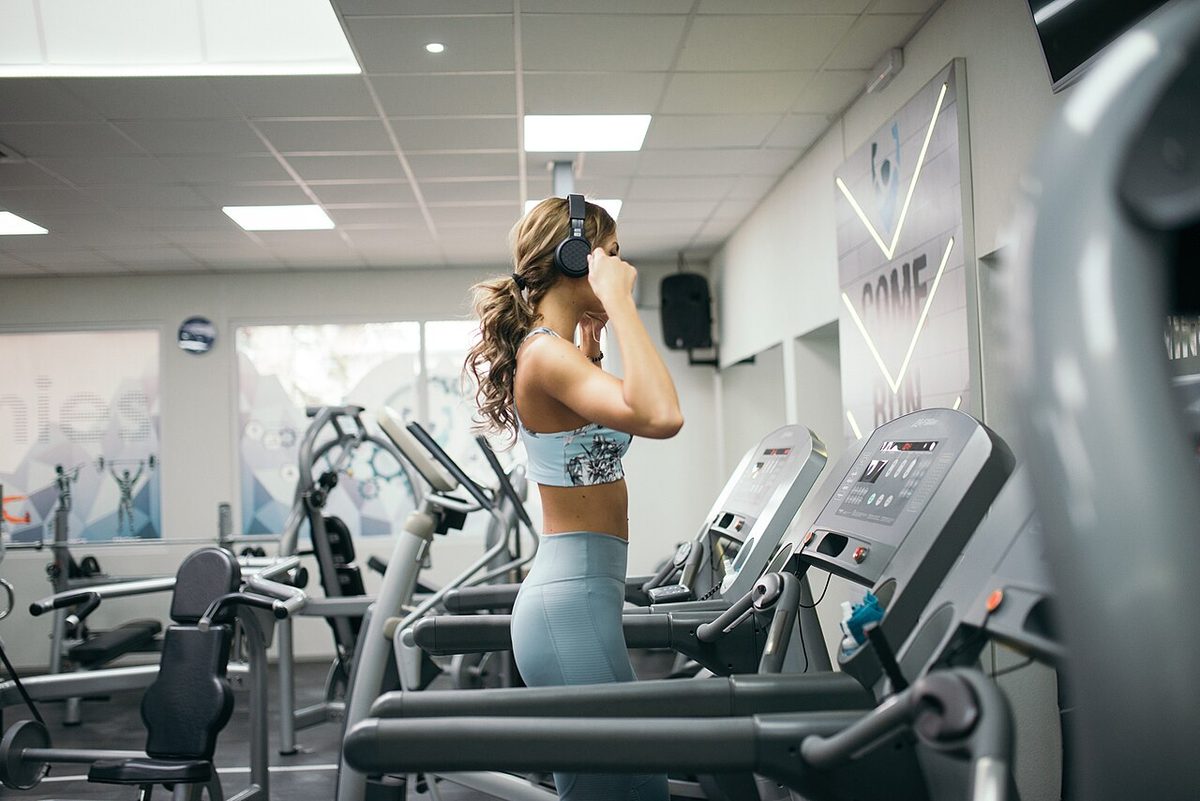
- Woman in the gym listening to the music and running on treadmillWikimedia Commons · The photo, CC BY 2.0
General information, not medical advice. This was a small, eight-week, company-supported trial in healthy working adults, and the higher dose reduced fatigue without ending it. Fatigue that lasts can have medical causes such as anaemia, thyroid problems, sleep disorders or depression, so see your doctor if you are tired most of the time. Talk to your doctor or pharmacist before taking L-arginine, especially if you have heart disease, low blood pressure or take blood pressure medicines.
Analysis by NutroPractic from the sources listed. Written for general readers; it does not replace advice from your own doctor.
From our articles
Read, then eat a little better
Plain-language guides on nutrition and wellness, backed by research.

Women's health
Inositol for PCOS: the 40:1 ratio, trial doses, and food milligrams
Why do randomized trials in polycystic ovary syndrome prioritize the 40:1 myo to D-chiro inositol ratio? Here is the science behind the ovarian epimerase paradox, clinical ovulation and insulin metrics, and why cantaloupe cannot replace 4,000 mg trial powder.
21 Nov 2026

Everyday eating
Extra virgin olive oil polyphenols: the EU health claim, smoke point myths, and cooking stability
Does extra virgin olive oil degrade when cooked? What does the EU 5 mg polyphenol health claim require, how does oleocanthal act like ibuprofen, and why does oxidative stability matter more than smoke point in domestic frying? Here is the clinical and culinary data.
21 Nov 2026

Food and nutrition
L-theanine and caffeine: what cognitive trials measured on sustained attention, and milligrams in matcha vs green tea
Combining L-theanine with caffeine produces clean focus without caffeine jitters. Here is what randomized trials measured on attention-switching, EEG alpha brain waves, and the exact milligrams across ceremonial matcha, culinary powder, gyokuro, and sencha.
20 Nov 2026
Newsfeed for your website
Want this feed on your website?
Add it to any site with one copy-and-paste snippet. No sign-up, and it updates itself every hour.
Start with a virtual consultation
Tell Dr. Triveni what you want to change. You will leave with a clear next step, whether you are in Toronto, London, New York or Chennai.