Student eating · October 26, 2026
Fifteen international students in Pavia, from India, Iran, Peru and eight other countries, got six one-to-one food lessons over six months. Their planet-friendly diet score rose from 75 to 83 out of 140, and olive oil was the one food that clearly moved
Moving abroad changes what's on your plate. A University of Pavia pilot coached newcomers on the Mediterranean diet and on eating with a smaller footprint. Scores went up within three months and held, but the only single change that passed the statistics test was the oil in the kitchen; legumes and nuts crept up without proof.
Students who move to another country for a degree tend to lose their home food habits faster than they pick up good new ones: dormitory kitchens, tight budgets, unfamiliar shops and a lot of stress. A team at the University of Pavia in northern Italy, with colleagues from the University of Milan and the University of São Paulo, wanted to know whether a small amount of personal coaching could steer international students towards the local Mediterranean diet and, at the same time, towards the low-impact "planetary health" diet proposed by the EAT-Lancet Commission. Their pilot study, part of a project called MeditEat, was published in Frontiers in Nutrition on 23 October.
Seventeen students signed up and 15 finished, 11 women and 4 men with an average age of about 30, from India, Iran, Guatemala, Turkey, Jordan, Germany, Peru, Brazil, Mexico, Myanmar and Portugal. Almost half lived in university dormitories, and 9 of the 15 had been on a weight-loss diet before. At the start they rated their knowledge of their home country's dietary guidelines at 6.0 out of 10, but of Italy's at just 2.4, and they scored their stress at 6.5 out of 10.
Each student had six one-to-one sessions in English over six months, three in person and three online, covering the Italian Mediterranean diet pyramid, legumes, nuts, spices and dairy, meat and sweets, food labels and water, physical activity, and seasonal, sustainable shopping. Everyone who finished went to all six. Diet was measured with a 110-item food questionnaire at the start, at three months and at six months, and scored on a version of the Planetary Health Diet Index with a top score of 140.
The average score rose from 75.4 at the start to 82.8 at three months and stayed at 82.9 at six months, an increase of 7.5 points that was statistically significant, with almost all of the gain arriving in the first three months. Of the 15 parts of the score, only vegetable oils changed significantly: that component went from 2.1 to 4.3 out of 10 at three months and 3.7 at six months, which the authors link to the coaching on using olive oil. Nuts (4.1 to 5.1) and legumes (a median of 3.1 to 5.0) drifted upwards and grains drifted down, but none of those changes could be told apart from chance.
This is a pilot with no comparison group, so it can't show that the lessons caused the change; students who volunteer for a nutrition project may already be keen to eat better, and simply being measured can change what people report. Fifteen people is very few, no power calculation was done, the food questionnaire was designed for Italian food and may miss dishes from home, and everything was self-reported. The index stands in for environmental impact rather than measuring it, and no blood tests were taken. Weight and body fat were measured at each visit, but only the starting values are reported. The paper also has small inconsistencies, such as an average age of 30.1 in the text and 30.9 in its table, and 11 countries listed against "ten" in a figure caption. The work was funded by Italy's recovery plan (EU NextGenerationEU) through the ON Foods network; the authors report no conflicts, and one was an editorial board member of the journal. We read the full open-access paper.
MeditEat pilot: Planetary Health Diet Index in 15 international students, University of Pavia (Frontiers in Nutrition, 23 October 2026)
75.4 → 82.9
Average planet-friendly diet score out of 140, start to six months (p = 0.01)
2.1 → 3.7
Vegetable oils score out of 10, start to six months, the only part that changed significantly (4.3 at three months)
3.1 → 5.0
Legumes score out of 10 (median), start to six months; not statistically significant
15 of 17
Students who finished, and all 15 attended every session
2.4 vs 6.0
Self-rated knowledge of Italy's dietary guidelines against their home country's, out of 10, at the start
11
Home countries, from India and Iran to Guatemala and Myanmar
Source: Lopes Neri LC, Shivanandappa K, Fiorini S, Marchioni D, Rondanelli M, Ferraris C, Martini D, 'Promoting alignment with Mediterranean and planetary health diet principles among international students: an exploratory pilot study of the MeditEat project', Frontiers in Nutrition 2026;13, published 23 October 2026, doi 10.3389/fnut.2026.1946581, open access (CC BY). Non-randomised, single-arm pilot at the University of Pavia, Italy; ethics approval 9 April 2024. Six individual sessions over six months (in person at T0, T3 and T6, online at T2, T4 and T5). Diet by a 110-item Italian food frequency questionnaire at T0, T3 and T6, scored with a modified Planetary Health Diet Index (15 components, maximum 140; the animal fat component of the original 150-point index was dropped). Total PHDI 75.4 ± 13.8, 82.8 ± 12.2 and 82.9 ± 13.6 (repeated-measures ANOVA p = 0.01, generalised eta squared 0.071; Holm post hoc T0 vs T3 and T0 vs T6 p = 0.03, T3 vs T6 p = 0.96). Vegetable oils 2.1 ± 1.1, 4.3 ± 2.8, 3.7 ± 2.3 (p = 0.004). Nuts 4.1, 4.9, 5.1 (p = 0.57); legumes median 3.1, 4.0, 5.0 (p = 0.74); cereals median 8.4, 8.1, 6.0 (p = 0.13). Baseline: MEDI-LITE Mediterranean diet score mean 6.5 of 18 (range 5-8), BMI mean 24.9, body fat mean 32.0%, stress 6.5 of 10, homesickness 5.0 of 10. Follow-up MEDI-LITE, weight and body composition are not reported. The paper gives mean age as 30.1 ± 5.9 in the text and 30.9 ± 6.2 in Table 1. Funding: Italian NRRP Mission 4 Component 2 Investment 1.3, project PE00000003 ON Foods (EU NextGenerationEU). The 7.5-point gain is our subtraction.
- The Planetary Health Diet Index the study used was built in Brazil from the diets of 14,779 adults in the ELSA-Brasil cohort, whose average score was 60.4 out of 150. One of its authors, Dirce Marchioni of the University of São Paulo, also worked on this pilot.
- The diet the index measures comes from the EAT-Lancet Commission's 2019 report in The Lancet, which set out one way of eating meant to be healthy for people and within the planet's limits.
- UNESCO added the Mediterranean diet to its list of the Intangible Cultural Heritage of Humanity in 2010, and widened the listing in 2013 to seven countries: Croatia, Cyprus, Greece, Italy, Morocco, Portugal and Spain.
- At the start, the students' Mediterranean diet score (MEDI-LITE) averaged 6.5 out of 18, and nobody scored above 8.
- Promoting alignment with Mediterranean and planetary health diet principles among international students: an exploratory pilot study of the MeditEat projectFrontiers in Nutrition · The study, open access, published 23 October 2026, with the full tables
- Development and Validation of an Index Based on EAT-Lancet Recommendations: The Planetary Health Diet IndexNutrients · The original 150-point index and the 14,779 ELSA-Brasil participants (May 2021)
- Food in the Anthropocene: the EAT-Lancet Commission on healthy diets from sustainable food systemsThe Lancet · The 2019 planetary health diet
- Mediterranean dietUNESCO Intangible Cultural Heritage · The 2013 listing for seven countries, which replaced the 2010 one for four
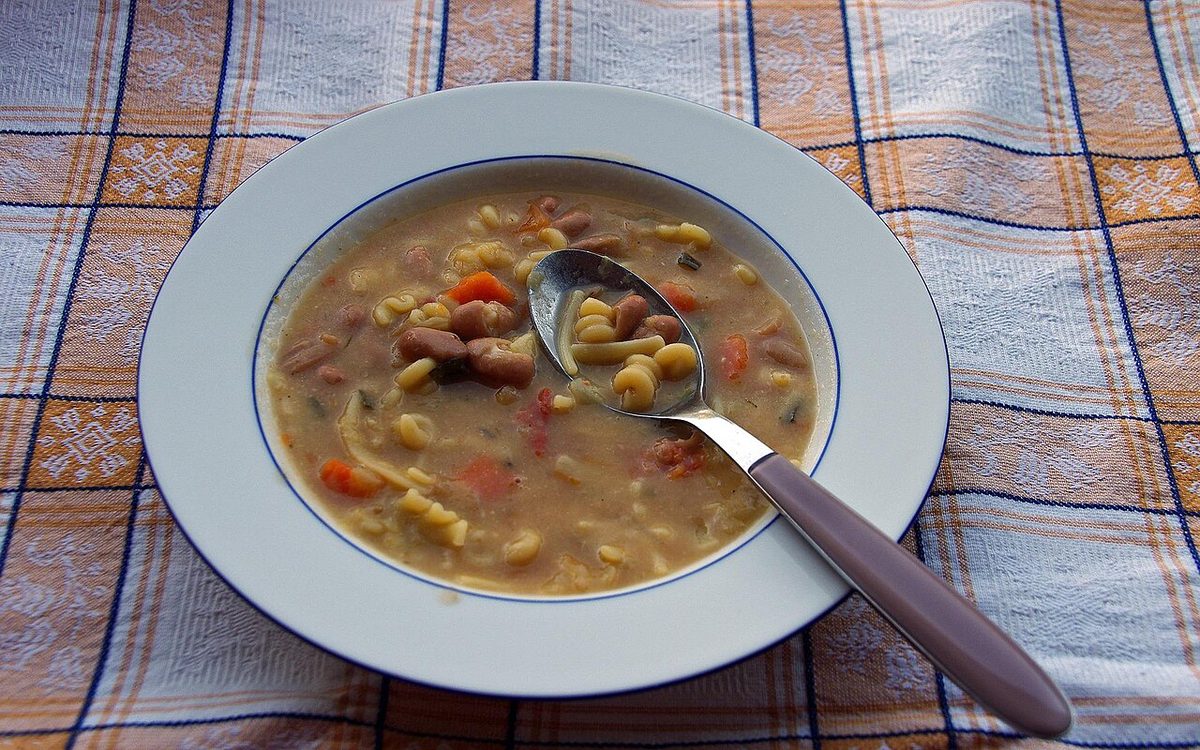
- Pasta e fagioli - minestraWikimedia Commons · The photo, CC0
General information, not medical advice. This was a small pilot without a comparison group and does not show that diet coaching causes lasting change. If you have a health condition, food allergies or a history of restrictive dieting, talk to your doctor or a registered dietitian before changing how you eat.
Analysis by NutroPractic from the sources listed. Written for general readers; it does not replace advice from your own doctor.
From our articles
Our guides on this subject
Plain-language guides on nutrition and wellness, backed by research.

Everyday eating
Extra virgin olive oil polyphenols: the EU health claim, smoke point myths, and cooking stability
Does extra virgin olive oil degrade when cooked? What does the EU 5 mg polyphenol health claim require, how does oleocanthal act like ibuprofen, and why does oxidative stability matter more than smoke point in domestic frying? Here is the clinical and culinary data.
21 Nov 2026
Heart health
Cooking oils: olive, seed oils, ghee and coconut, and what the trials actually compared
Olive oil is praised, seed oils are called toxic and ghee is said to be back. What PREDIMED compared, where the seed-oil argument from the Sydney and Minnesota trials comes from and why most evidence points the other way, what butter, ghee and coconut oil do to LDL, what smoke points tell you, how often to reuse frying oil, and where mustard and rice bran oil fit.
19 Oct 2026

Women's health
Inositol for PCOS: the 40:1 ratio, trial doses, and food milligrams
Why do randomized trials in polycystic ovary syndrome prioritize the 40:1 myo to D-chiro inositol ratio? Here is the science behind the ovarian epimerase paradox, clinical ovulation and insulin metrics, and why cantaloupe cannot replace 4,000 mg trial powder.
21 Nov 2026
Newsfeed for your website
Want this feed on your website?
Add it to any site with one copy-and-paste snippet. No sign-up, and it updates itself every hour.
Start with a virtual consultation
Tell Dr. Triveni what you want to change. You will leave with a clear next step, whether you are in Toronto, London, New York or Chennai.