Food allergy · October 21, 2026
Rice-based formula for babies with cow's milk allergy: four trials, 321 infants, and two of them pointing in opposite directions
When a baby is allergic to cow's milk and can't be fully breastfed, parents are often offered a formula made from broken-down rice protein instead of broken-down milk protein. A new review gathered every randomised trial of it. There are only four, the two that asked whether children outgrow the allergy sooner disagree, and the review's authors say nobody can yet tell whether rice formula is better, worse or the same.
Cow's milk allergy is one of the most common food allergies in babies and toddlers. The treatment is to keep cow's milk protein out of the diet while making sure the child still grows. Breastfeeding goes on where it can; when it can't, the usual choice is an extensively hydrolysed formula, in which milk protein has been cut into small pieces by enzymes, or an amino acid formula. A third option sold in several European countries is hydrolysed rice formula: rice protein broken down the same way and topped up with amino acids such as lysine, because rice protein is short of them. A team from six Polish universities and institutes, led by the Medical University of Warsaw, set out to see what the randomised trials say about it. Their review appeared in Nutrients on 19 October.
They searched three medical databases and two trial registries up to 26 May 2026 and kept only randomised trials in children with a confirmed cow's milk allergy. Four qualified, with 321 children between them, from 16 to 108 per trial, all in Spain, France, Belgium or Italy and recruited between 2001 and 2019. Two compared rice formula with milk-based hydrolysed formula, and two compared it with soy formula (one of those also with a casein hydrolysate). The rice formulas were not all the same product, and two of the four trials did not say how far the protein had been broken down or which amino acids had been added.
The main question was whether children on rice formula outgrow their allergy sooner. Only two trials measured it, and they disagree. In a trial across six clinics in Spain, France and Belgium, 26 of 36 babies on rice formula (72%) became tolerant to cow's milk within a year, against 22 of 41 (54%) on milk-based hydrolysed formula. In a Madrid trial, 18 of 41 on rice formula were tolerant by their first birthday against 21 of 40 on the milk-based formula, leaning the other way, and by age two the two groups were level (31 of 41 and 31 of 40). Neither result was clear of chance, neither trial was large enough to answer the question, and the reviewers rated both at high risk of bias: in the first the milk challenge that confirmed tolerance was not blinded and the numbers of children did not add up across the report, and in the Madrid trial most children were judged still allergic by a doctor's opinion rather than a feeding test. The certainty of the evidence was graded very low.
Growth looked much the same on rice formula as on the milk-based hydrolysate in both trials that compared them. Against soy, one Milan trial found babies on rice formula gained 0.34 more on the weight-for-age score between 6 and 12 months, but that advantage disappeared once the statistics were corrected for the number of comparisons made; a 16-baby trial found no difference at all. Allergic reactions to the formulas were rare: no baby on rice formula had an immediate reaction, against one baby on milk-based formula in each of the two trials that checked. In the Milan trial, 6 of 36 babies left the rice group and 4 of 35 the casein group because they would not take the formula, while 5 of 37 left the soy group after becoming sensitised to soy.
Rice can carry arsenic, so the reviewers looked for that too. Only one trial measured it, and urine levels were similar on the two formulas (2.24 against 2.30 micrograms per litre), though the paper did not say whether that was total or the more harmful inorganic arsenic. The reviewers say this does not show long-term safety.
Their conclusion is that the trials cannot show whether rice formula is equivalent, better or worse than milk-based hydrolysed formula or soy, and they call for larger, independently funded trials that test each product separately. Guidelines already differ: European paediatric gastroenterologists (ESPGHAN) list rice formula as an alternative, the World Allergy Organization suggests either it or milk-based hydrolysate as a first choice on very low-certainty evidence, and the European allergy network GA2LEN makes no recommendation either way. The two trials on outgrowing the allergy were funded by or linked to a rice formula maker. The review had no outside funding, and seven of its eight authors report paid work as speakers, consultants or investigators for baby formula companies. It was written to support a position paper from the Polish Society for Paediatric Gastroenterology, Hepatology and Nutrition.
Hydrolysed rice formula vs other specialised formulas for infants and young children with confirmed cow's milk allergy: systematic review of 4 randomised trials, 321 children (no pooled estimate)
4 trials, 321 children
Randomised trials found, 16 to 108 children each, in Spain, France, Belgium and Italy, recruited 2001 to 2019
72% vs 54%
Became tolerant to cow's milk within 12 months, rice vs milk-based hydrolysed formula, six-clinic trial (26/36 vs 22/41; RR 1.35, 95% CI 0.95 to 1.91)
44% vs 53%
Tolerant at 12 months of age, rice vs milk-based hydrolysed formula, Madrid trial (18/41 vs 21/40; RR 0.84, 95% CI 0.53 to 1.32)
31/41 vs 31/40
Tolerant at 24 months of age in the Madrid trial (RR 0.98, 95% CI 0.77 to 1.24)
16.3 vs 20.4 months
Median age at tolerance, rice vs milk-based formula, six-clinic trial (p = 0.18)
Very low
GRADE certainty of the evidence on outgrowing the allergy; both trials at high risk of bias
+0.34
Extra weight-for-age z-score gain, rice vs soy formula, 6 to 12 months (n = 62; p = 0.019 before, 0.090 after correction for multiple comparisons)
0 vs 2
Immediate allergic reactions to the study formula, rice vs milk-based hydrolysate, two trials combined (0/50 vs 1/55 and 0/46 vs 1/46)
Study: Szajewska H, Jarocka-Cyrta E, Stróżyk A, Horvath A, Jedynak-Wąsowicz U, Liber A, Rachtan-Janicka J, Kwiecień J, 'Hydrolyzed Rice Formula for the Management of Cow's Milk Allergy in Infants and Young Children: A Systematic Review of Randomized Controlled Trials', Nutrients 2026, 18(20):3429, published 19 October 2026, doi 10.3390/nu18203429 (open access, CC BY). Medical University of Warsaw, University of Warmia and Mazury, Jagiellonian University, Institute of Mother and Child, Warsaw University of Life Sciences and Medical University of Silesia, Poland. PROSPERO CRD420261445267. Searched MEDLINE, Embase and CENTRAL to 26 May 2026, plus ClinicalTrials.gov and WHO ICTRP; randomised trials only, children 0 to 36 months with confirmed cow's milk allergy (IgE, non-IgE or mixed). Trials: Lemoine et al. (6 clinics, Spain, France, Belgium, 2014 to 2019, blinded formula, 105 randomised, rice vs casein-based hydrolysate, 12 months; funded by Laboratoires Modilac and Laboratorios Ordesa); Reche et al. (Madrid, 2004 to 2006, open-label, 92 randomised, 81 completed, rice vs casein-whey hydrolysate, follow-up to about 24 months; unconditional grant from Ordesa, three co-authors employees); Agostoni et al. (Milan, 2001 to 2005, unblinded, 108 randomised to soy, casein hydrolysate or rice, plus 52 breastfed reference infants, 6 months); D'Auria et al. (Milan, 2001, 16 infants with atopic dermatitis, rice vs soy, 6 months). Tolerance figures for Lemoine are available-case (77 of 105). No pooling because of differences in population, comparator and outcome timing; risk of bias by RoB 2, certainty by GRADE (tolerance only). Growth vs milk-based hydrolysate: weight-for-length z-score group effect p = 0.28, other measures all p ≥ 0.22 (Lemoine); Reche reported growth only in graphs. Urinary arsenic 2.24 vs 2.30 µg/L (p = 0.48), measured in Lemoine only. Two further trials of a rice formula with added human milk oligosaccharides (NCT06633289, NCT06633250) have no results yet. The review had no external funding; several authors declare speaker, consultant, investigator or advisory roles with Danone/Nutricia, Nestlé, Mead Johnson/Reckitt, Ausnutria, HiPP, BioGaia and others. Percentages are calculated from the paper's counts.
- A formula counts as hypoallergenic if at least 90% of children with cow's milk allergy tolerate it, shown with 95% confidence. None of the four trials in this review was designed to test that.
- Rice protein is low in some of the amino acids babies need, chiefly lysine and threonine, so rice formulas have them added. The trials in this review used different top-ups: lysine and tryptophan in one, lysine and threonine in another, and none reported in the other two.
- Two trials of a newer rice formula with two human milk sugars (2'-FL and LNnT) added are listed in a trial registry. One has finished with 43 children; neither has published results.
- Many babies outgrow a cow's milk allergy: in the Madrid trial about three in four children in both groups could take cow's milk by their second birthday.
- Hydrolyzed Rice Formula for the Management of Cow's Milk Allergy in Infants and Young Children: A Systematic Review of Randomized Controlled TrialsNutrients, October 2026 · The review: full text, open access
- Types of formulaNHS · Which formulas suit babies with cows' milk allergy, and why comfort formula does not
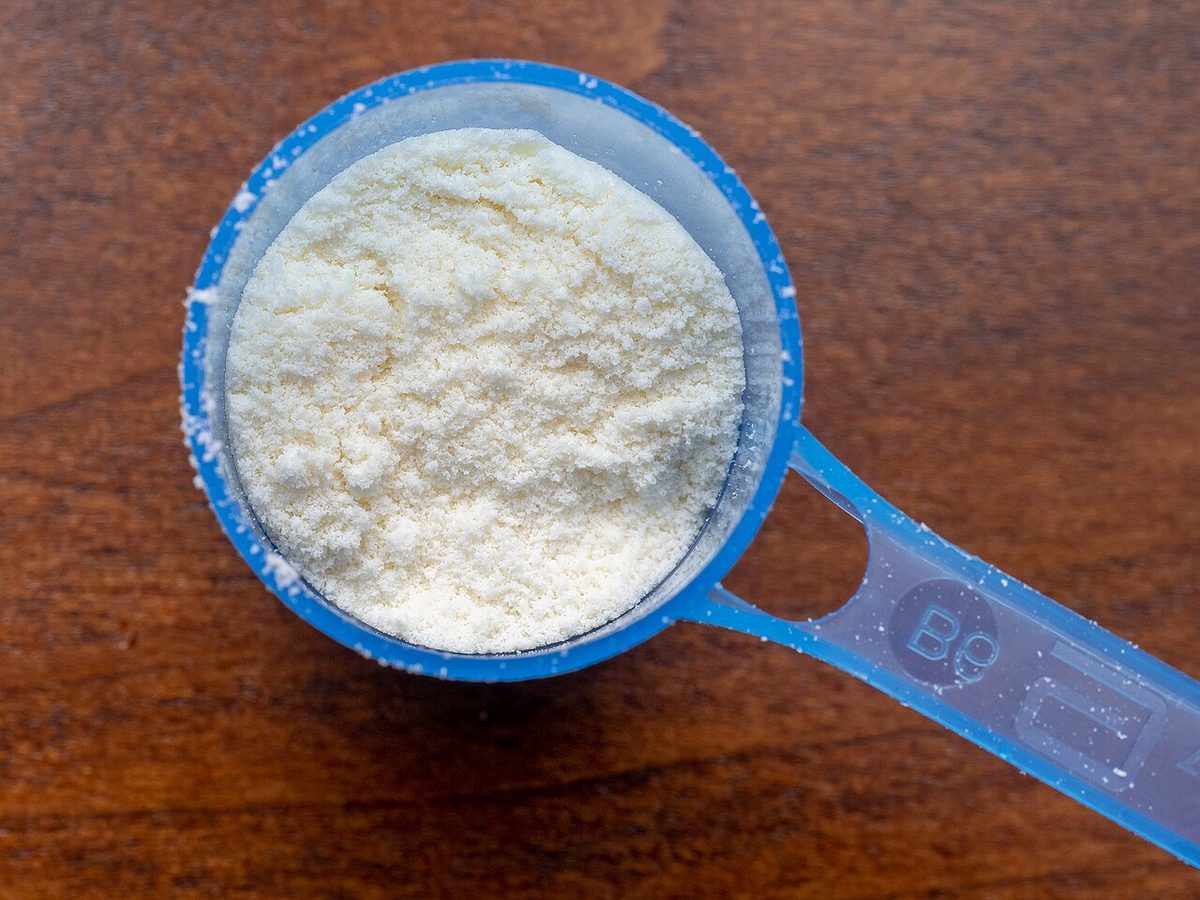
- Baby Formula PowderWikimedia Commons · The photo, CC BY 2.0 (ajay_suresh)
General information, not medical advice. This review found only four small trials and could not say whether rice formula is better, worse or the same as other specialised formulas. Don't change or start a formula for a baby with a suspected milk allergy without talking to your paediatrician, GP or a paediatric dietitian.
Analysis by NutroPractic from the sources listed. Written for general readers; it does not replace advice from your own doctor.
From our articles
Our guides on this subject
Plain-language guides on nutrition and wellness, backed by research.
Indian kitchen
Dal and pulses in an Indian kitchen: protein, soaking, gas and blood sugar
A katori of dal gives about 6 to 10 g of protein, depending on how much raw dal goes in. What India's food tables and the ICMR-NIN 2024 guidelines say about rice with dal, how much soaking, sprouting and pressure cooking cut phytate and the sugars behind the gas, the GI of chana dal and rajma, raw rajma safety, and a worked plate for diabetes.
25 Oct 2026

Women's health
Inositol for PCOS: the 40:1 ratio, trial doses, and food milligrams
Why do randomized trials in polycystic ovary syndrome prioritize the 40:1 myo to D-chiro inositol ratio? Here is the science behind the ovarian epimerase paradox, clinical ovulation and insulin metrics, and why cantaloupe cannot replace 4,000 mg trial powder.
21 Nov 2026

Everyday eating
Extra virgin olive oil polyphenols: the EU health claim, smoke point myths, and cooking stability
Does extra virgin olive oil degrade when cooked? What does the EU 5 mg polyphenol health claim require, how does oleocanthal act like ibuprofen, and why does oxidative stability matter more than smoke point in domestic frying? Here is the clinical and culinary data.
21 Nov 2026
Newsfeed for your website
Want this feed on your website?
Add it to any site with one copy-and-paste snippet. No sign-up, and it updates itself every hour.
Start with a virtual consultation
Tell Dr. Triveni what you want to change. You will leave with a clear next step, whether you are in Toronto, London, New York or Chennai.