Healthy ageing · November 1, 2026
The eating plan made in hospital often never makes it home. A review of 13 trials asks what actually helps older patients after discharge
In one Australian audit, only 1 in 10 hospital stays by malnourished older patients ended with nutrition advice in the discharge summary. A new review lines up the trials that tried to fix that gap with home visits, phone calls, free food and supplement drinks. Most people ate better. Fewer clearly stayed out of hospital.
An older person who leaves hospital underweight or eating too little goes home tired, often less mobile, and sometimes alone. In hospital someone noticed the problem: a screening score, a dietitian visit, maybe a supplement drink on the tray. The question in a mini review published on 22 October in Frontiers in Nutrition is simple. What happens to that care once the patient is through the front door?
The record is not encouraging. The authors, from two hospitals in Ningbo, China, gathered audits from routine care. In an Australian group of 42 older medical patients at nutritional risk, six (14%) were seen by a dietitian after discharge and eight (19%) got practical nutrition help at home. A second Australian audit of 345 admissions of malnourished older patients found nutrition recommendations in the electronic discharge summary for 35 of them (10%), and dietitian follow-up recorded within six months for 79 (23%). In a US chart review of 76 malnourished adults, five (6.6%) had written instructions to keep taking supplement drinks. The authors note that missing paperwork does not prove no advice was given, but the next doctor or nurse cannot act on advice they never see.
They then compared 13 randomised trials that tried to carry the care home. The picture is mixed in a consistent way: eating, weight or strength often improved, while readmissions, disability and deaths mostly did not move. In a Danish trial of 208 people aged 75 and over who lived alone, dietitian home visits cut 90-day readmissions (hazard ratio 0.4), but the visits lasted 45 minutes against 15 for the phone calls, whose result was inconclusive, and 88 of the 208 had a broken hip. Another Danish package of a plan, a starter food box, electronic messages to the local council and follow-up raised the share of people meeting at least three-quarters of their energy and protein needs at 16 weeks to 82%, against 61%, yet six-month readmissions were the same. A Swedish trial of 671 people found no survival difference over a median 4.1 years. In the US NOURISH trial of 652 patients, a high-protein supplement did not reduce the main combined result of death or readmission, although deaths at 90 days were lower (4.8% against 9.7%).
Part of the problem is plain follow-through. In a Scottish trial, reported adherence to the supplement drink was 38% (50% for the lower-calorie control drink); in another Danish study, the parts of the plan actually delivered ranged from none to 61%; in a French home-visit programme, 42% of 351 older adults completed every planned visit. From all this the authors sketch a six-step loop: check goals, food access and who can help at home; send a handover the next service can use; get that service to confirm it has taken the patient on; make early contact; agree who acts if eating slips; and audit the whole thing. They are clear that this is a proposal, not a tested pathway. It is also a focused narrative review rather than a systematic one, with no formal risk-of-bias grading, searches limited to PubMed and Europe PMC, and study selection the authors say was AI-assisted and not double-checked. For families, the practical point stands without the framework: ask before discharge who will check on eating at home, and when.
Nutrition care for malnourished older patients after hospital discharge: audits and trials compared in a mini review (Frontiers in Nutrition, 22 October 2026)
10%
Admissions of malnourished older patients with nutrition recommendations in the electronic discharge summary (35 of 345, Australian audit)
23%
Same audit: admissions with dietitian follow-up recorded within six months (79 of 345)
6 of 42
Older patients at nutritional risk seen by a dietitian after discharge in another Australian group (14%)
6.6%
Malnourished adults in a US chart review with written instructions to keep taking supplement drinks (5 of 76)
13
Randomised trials of hospital-to-home nutrition care compared in the review
82% vs 61%
People meeting at least 75% of energy and protein needs at 16 weeks with a Danish follow-up package versus usual care; readmissions did not differ
38%
Reported adherence to the supplement drink in a Scottish trial of 253 discharged older adults (50% for the control drink)
A narrative mini review, not a systematic review or meta-analysis: searches ran to 14 September 2026 in PubMed and Europe PMC, trials were chosen for relevance, and no pooled figures were calculated. Audit figures come from single hospitals and depend on what was written down. The six-step framework is the authors' proposal and has not been tested.
- Being 'at nutritional risk' and being malnourished are not the same thing: the first is a screening flag that calls for a fuller assessment, the second is a diagnosis made after it.
- Oral nutritional supplements are the small milk-shake-style drinks, often 200 to 300 kcal a bottle, that hospitals give people who cannot eat enough at meals.
- Hand-grip strength, measured by squeezing a dynamometer, is one of the quickest checks of how muscle is holding up after an illness, and it is a common outcome in these trials.
- In the Danish trial of people living alone, every participant got a discharge diet plan from a nurse specialist; what was tested was the dietitian follow-up after they got home.
- Implementing continuity of nutrition care from hospital to home for older medical inpatients with malnutrition or nutritional risk: nursing contributions, barriers, and practice gapsFrontiers in Nutrition, 22 October 2026 · Open-access mini review (CC BY): audit figures, Table 1 comparing 13 randomised trials, the proposed six-step loop and the limitations.
- Full text on the journal siteFrontiers · Sections 3 to 5 and Table 1 with each trial's size, comparison, results and the authors' critical reading.
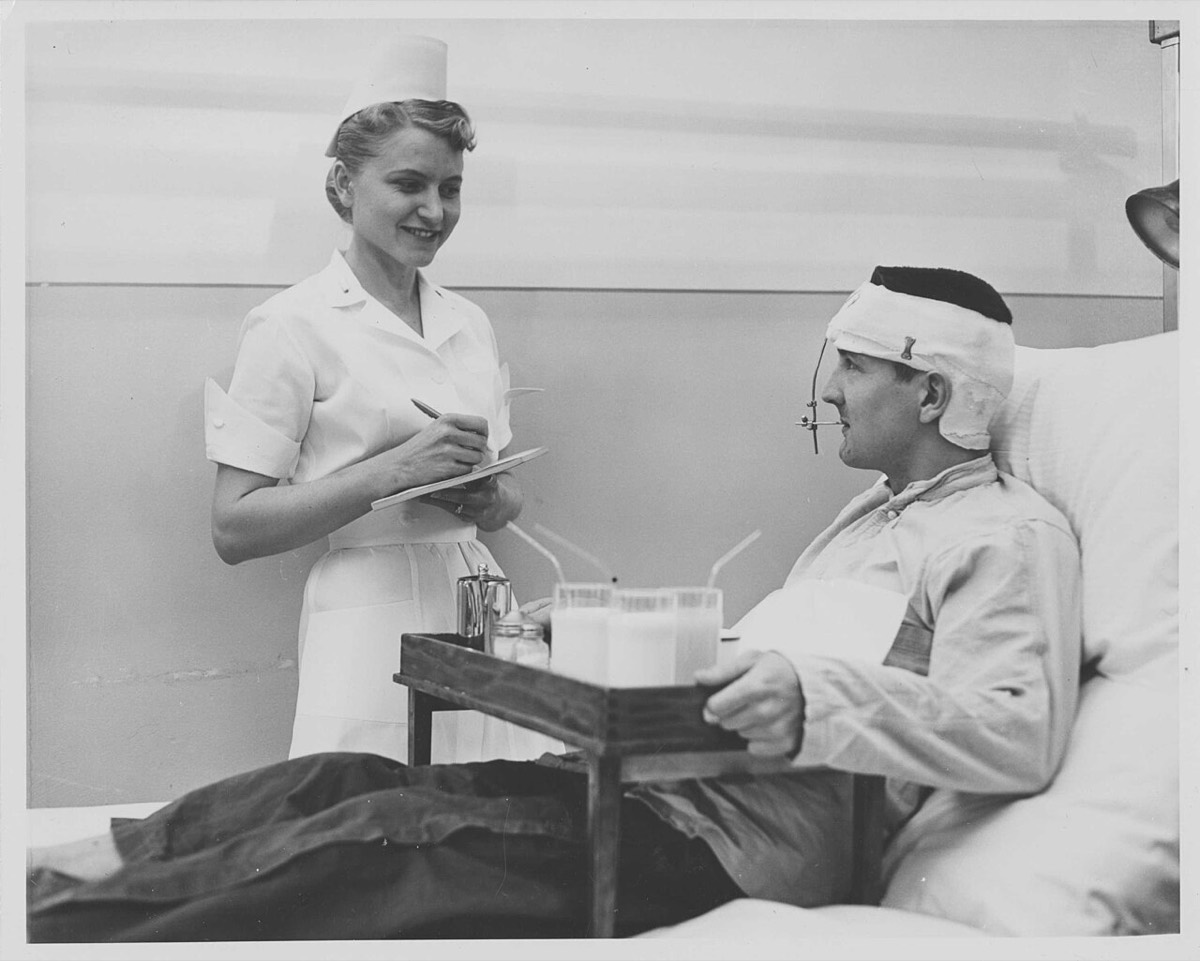
- Dietitian treating patient (NCP 006082)Wikimedia Commons · 1957 photograph from the National Museum of Health and Medicine, CC BY 2.0, used as a general illustration.
General information, not medical advice. This review summarises studies of older adults leaving hospital with malnutrition or at nutritional risk; it does not test any single plan. If you or a relative is being discharged and eating has been a problem, ask the hospital team for a written nutrition plan and who will follow it up, and talk to your doctor or a registered dietitian before starting or stopping supplement drinks.
Analysis by NutroPractic from the sources listed. Written for general readers; it does not replace advice from your own doctor.
From our articles
Our guides on this subject
Plain-language guides on nutrition and wellness, backed by research.
Healthy ageing
Creatine beyond the gym: what it does for older adults and women, and what it doesn't
Across 22 trials, adults in their late fifties to seventies who took creatine while doing resistance training gained about 1.4 kg more lean mass than those who trained without it. Two two-year trials found it did nothing for bone density after menopause. Where the evidence is solid, where it's early (memory, short nights), how much to take, and who should leave it alone.
10 Oct 2026
Women's health
Eating through menopause: what changes for your bones, muscle and heart, and what to put on the plate
Around the final period, bone density at the spine drops by about 2% a year and LDL cholesterol jumps within a year or two. Hot flushes get the attention, but these quieter changes are where food and strength training do the most. Targets for protein, calcium and vitamin D, an honest look at soy, and a week you can start on Monday.
8 Oct 2026
Weight-loss medicines
Eating on Ozempic, Wegovy or Mounjaro: protein first, so the weight you lose isn't your muscle
GLP-1 medicines shrink your appetite, and with it often your protein. In the big trials a quarter to more than a third of the weight lost was lean mass. What the 2025 joint nutrition advisory recommends, the arithmetic for your own target, and four small plates that get there.
8 Oct 2026
Newsfeed for your website
Want this feed on your website?
Add it to any site with one copy-and-paste snippet. No sign-up, and it updates itself every hour.
Start with a virtual consultation
Tell Dr. Triveni what you want to change. You will leave with a clear next step, whether you are in Toronto, London, New York or Chennai.