Toddler feeding · November 2, 2026
A local woman with three days of training called once a month for nine months. Toddlers in rural Ethiopia ate more varied meals, but eggs and meat rose just as much without her
Among 802 mothers in West Gojjam, meeting all four feeding marks rose from 10.7% to 24.0% with the home visits and stayed near 8.5% without them. Yet three in four counselled toddlers still fell short, the answers came from the mothers themselves, and this paper does not say whether the children grew any better.
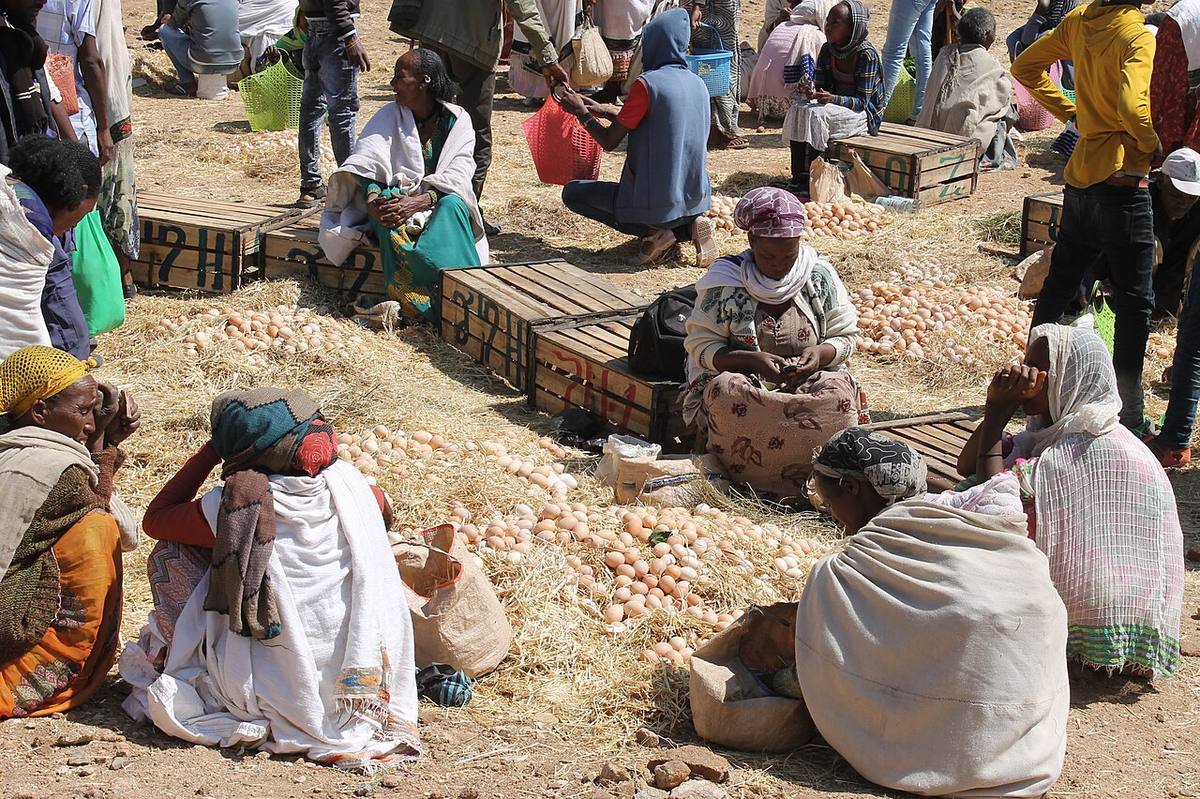
At around six months, breast milk stops being enough on its own, and stunting that sets in over the next year and a half is hard to undo. In rural West Gojjam, in Ethiopia's Amhara region, the paper cites stunting of 35.5% to 39.2% among young children. Advice already reaches mothers there at clinic visits. So a team working with Bahir Dar University tried something closer to home, and reported the results in PLOS One on 29 October: a monthly visit from a local woman, for nine months, on a weekend or a religious holiday, lasting 40 to 60 minutes.
The visitors were 30 team leaders from the Women's Development Army, the network of women who link households with Ethiopia's Health Extension Program and who normally work unpaid. Each had a three-day course and a one-day refresher four months later, and looked after 13 or 14 mothers. At each visit she asked what the child had been eating, picked two or three things to work on, and went through an illustrated guide the mother kept. The talk was built on the Health Belief Model, which holds that people change when they think a problem could reach them, think it matters, and believe they can do something about it. Thirty rural communities were randomised, 15 each way, covering 802 mothers of babies aged 6 to 8 months. The other 15 got routine advice during antenatal, postnatal and immunisation visits, with no guide and no follow-up.
The main measure was strict: solids started on time, five of eight food groups the day before, enough meals, and some egg or flesh food, all four together. It rose from 10.7% to 24.0% of mothers with the visits (94 of 391) and sat still in the comparison group, 8.5% to 8.6% (33 of 385). That 13.2-point gap is a shade above the 12 points assumed in the trial's sample-size sums. The adjusted odds ratio was 2.49, which the paper words as nearly 2.5 times more likely, though it is a comparison of changes in odds and not a simple ratio of chances. Dietary variety went from 14.0% to 41.7% against 13.5% to 26.2%, and a minimum acceptable diet from 13.5% to 37.9% against 13.2% to 20.3%.
The eggs and meat are where the story turns. The share of children eating them climbed from 27.7% to 49.9% with the visits and from 19.7% to 38.7% without, and the difference in those rises was nothing to rely on (odds ratio 1.10, 95% CI 0.72 to 1.70). Some of the climb on both sides may just be babies becoming toddlers who eat more, though that is our reading. The authors suggest counselling alone cannot fix what a household can afford or get hold of, and point to norms and household decisions as well. A similar split shows up in the mothers' answers: knowledge jumped (odds ratio 6.61), while the shift in attitudes fell just short of significance (1.45, 95% CI 0.99 to 2.12).
Hold the good news loosely on a few counts. Everything was recalled by mothers, over one day of eating, and those who had spent nine months being told what to feed may have reported accordingly; the authors raise this too. With only 30 clusters, the authors say they could not apply the usual small-sample correction, and the variety and meal results, whose intervals start at 1.04 and 1.01, were not adjusted for multiple comparisons, so treat them as supporting evidence. The groups also differed in ways the model did not adjust for: 55.4% of babies with the visits were boys against 43.9%, and 17.0% of those mothers were first-timers against 24.2%. And the question that matters most stays open. The trial registry lists children's length and weight as a secondary outcome, and this paper, which covers one objective of the trial, reports none. Even taken at face value, 76% of counselled children still missed the mark. What the trial fairly shows is that a modest, local, repeated conversation seems to shift what mothers say they feed, as far as a household's food supply allows.
Monthly home counselling vs routine advice on feeding children aged 6 to 23 months, cluster-randomised trial, West Gojjam, Ethiopia, 2023 to 2024 (PLOS One, 29 October 2026)
802
Mothers of babies aged 6 to 8 months, in 30 rural communities (401 each way; 776 had follow-up data)
10.7% to 24.0%
Met all four feeding marks, with home visits, start to end (94 of 391 at the end)
8.5% to 8.6%
Met all four feeding marks, routine advice (33 of 385 at the end)
2.49
Adjusted odds ratio for the main outcome, group by time (95% CI 1.40 to 4.42)
41.7% vs 26.2%
Reached five of eight food groups at the end, visits vs routine advice (odds ratio 1.75, 95% CI 1.04 to 2.93)
82.4% vs 70.6%
Had enough meals at the end, visits vs routine advice (odds ratio 1.62, 95% CI 1.01 to 2.61)
37.9% vs 20.3%
Minimum acceptable diet at the end, visits vs routine advice (odds ratio 2.13, 95% CI 1.26 to 3.59)
+22.2 vs +19.0
Percentage-point rise in egg or flesh food, visits vs routine advice (odds ratio 1.10, 95% CI 0.72 to 1.70)
6.61 vs 1.45
Odds ratios for mothers' knowledge vs attitudes (attitudes 95% CI 0.99 to 2.12)
76%
Counselled children still missing at least one of the four marks at the end (our subtraction)
Figures were read in the open-access paper; the start and end percentages are from its Table 4 and the odds ratios from Tables 5 and 6. The paper's Table 3 gives slightly different baseline figures (10.6% vs 8.2%) because those are averages across clusters. The paper reports no growth results and no cost figures, and it treats the percentage-point differences as descriptive, basing its statistical tests on the odds ratios. Three things we noticed. The comparison group's main measure stayed flat even though every part of it we can see rose, and the paper gives no end figure for timely introduction of solids that might explain this. The paper's secondary outcomes (variety, meals, acceptable diet, egg or flesh food) are not listed as secondary outcomes in the trial registry, which lists child nutritional status, though they overlap with the parts of the registered primary outcome. And the dates do not quite fit: a mother enrolled in June 2023 and assessed in December 2024 is about 18 months from the start, beyond the paper's 9 to 15, and a baby aged 8 months in June 2023 would be about 26 months by then, beyond its 16 to 23 (our arithmetic). On the same dates, the earliest mothers would have finished their nine months of visits at least six months before they were assessed. The stunting figures are the paper's own citations, which we did not check separately. The paper reports no specific funding.
- Worldwide, fewer than one-third of children aged 6 to 23 months (30.8%) reached minimum dietary diversity between 2018 and 2024, according to the World Health Organization.
- The WHO's guide is 2 to 3 meals a day at 6 to 8 months and 3 to 4 meals a day from 9 to 23 months, with 1 to 2 extra snacks as required, alongside continued breastfeeding.
- Ethiopia's Women's Development Army leaders come from selected model families, trained by health extension workers to share what they know with the households around them. The Health Extension Program itself dates from 2003.
- An earlier cluster-randomised trial in the same zone, cited in this paper, reported rate ratios of 3.0 for dietary diversity, 2.4 for meal frequency and 2.7 for acceptable diet with a behaviour change communication programme.
- Training for the visitors in this trial covered thick and enriched porridges, iron and vitamin A-rich foods, hygiene and feeding during and after illness. The WHO likewise advises increasing food consistency and variety gradually as a child grows.
- Household wealth showed up in the results on its own: higher wealth went with higher odds of meeting all four marks (odds ratio 1.19) and of a minimum acceptable diet (1.13).
- Ethiopia set out in its 2015 Seqota Declaration to end stunting among children under two by 2030, the paper notes. The WHO estimates 150 million children under 5 worldwide were stunted in 2024.
- Effect of nutrition counseling on complementary feeding practices among mothers with children aged 6-23 months in West Gojjam Zone, Northwest Ethiopia: A cluster-randomized controlled trialPLOS One, 29 October 2026 · The paper's DOI. Open access under CC BY.
- Full text of the paper (PMC13718931)PubMed Central, US National Library of Medicine · Methods, baseline table, start and end percentages, odds ratios and limitations.
- Effects of Complementary Feeding Counseling on Appropriate Complementary Feeding Practices and Child Undernutrition (NCT05871346)ClinicalTrials.gov · The registered primary outcome and the child nutritional status secondary outcome.
- Infant and young child feeding: fact sheetWorld Health Organization · Global dietary diversity figure, stunting estimate and the guiding principles on meals, snacks and consistency.
- Ethiopia HawzienMarket 04Wikimedia Commons · CC BY 4.0 photograph by Charliefleurene, used as a general illustration.
General information, not medical advice. This trial tested one counselling programme in rural Ethiopia and relied on what mothers reported, and this paper does not report on children's growth. For advice on starting solids, or if you are worried about how your child is eating or growing, talk to your paediatrician or health worker.
Analysis by NutroPractic from the sources listed. Written for general readers; it does not replace advice from your own doctor.
From our articles
Our guides on this subject
Plain-language guides on nutrition and wellness, backed by research.
Children's nutrition
Feeding a teenage athlete: energy, iron, calcium and the sports drink question
Teenage athletes are growing and training at the same time, and under-eating (REDs) is found in up to 80% of female and 70% of male athletes in studies. A worked energy example for a 15-year-old footballer, protein and carbohydrate targets, iron and calcium in the growth spurt, when sports drinks help and when they are dessert, and the supplements to skip.
20 Oct 2026
Gut health
Gluten-free without coeliac disease: who actually benefits, and what the blinded gluten challenges found
In blinded trials only 16% of people who said gluten made them ill reacted to gluten rather than placebo, and in Oslo fructans caused more bloating than gluten. Who really needs to avoid it, how to get tested before you stop, how much gluten is in a slice of bread or a roti, and what gluten-free food costs (159% more in the UK) and lacks.
1 Nov 2026
Diabetes
Fenugreek, cinnamon and turmeric for blood sugar: what the trials in an Indian kitchen measured
Fenugreek seed at 5-10 g a day lowered HbA1c by about 0.85 points in pooled trials, and in a 3-year Hyderabad study 23% went on to diabetes against 55%. Cinnamon trims fasting glucose by 15-25 mg/dL, but a teaspoon of cassia tops the coumarin limit. Curcumin: about 0.3-0.4 points, and rare liver injury from capsules. Doses in teaspoons, and a fair way to test it at home.
1 Nov 2026
Newsfeed for your website
Want this feed on your website?
Add it to any site with one copy-and-paste snippet. No sign-up, and it updates itself every hour.
Start with a virtual consultation
Tell Dr. Triveni what you want to change. You will leave with a clear next step, whether you are in Toronto, London, New York or Chennai.