Fitness and fuelling · October 25, 2026
Five hard gym sessions a week: by their food logs, 24 of 30 recreational CrossFit-style athletes in South Carolina weren't eating enough to cover the training. Over two weeks, nothing showed it, and their own metabolism suggests some of those calories never made it into the logs
Researchers at the University of South Carolina followed 30 everyday athletes, aged about 31, through ten coached high-intensity sessions. By the usual sports-science yardstick, 80% were running low on fuel. Yet the under-fuelled group recovered, slept and kept their bones just like the rest, and most of them had a perfectly normal resting metabolism. The authors' own caution: people tend to under-record what they eat.
Sports scientists have a simple sum for whether an athlete is eating enough to train: take the calories eaten in a day, subtract the calories burned in exercise, and divide what is left by the kilograms of lean body mass. Below 30 kilocalories per kilogram of lean mass is called low energy availability, and the International Olympic Committee treats it as the root of a syndrome it calls Relative Energy Deficiency in Sport, or REDs, which over time can disturb hormones, periods, bone strength, mood and performance. Most of the research is on elite runners, dancers and team players. A study published in Frontiers in Nutrition on 23 October asked how everyday gym-goers who do high-intensity functional training, the CrossFit style of mixed lifting, gymnastics and conditioning circuits, measure up.
The team at the University of South Carolina recruited 30 people from a local gym: 18 women and 12 men aged 18 to 40, average 31, who had trained at least five times a week for six months or more, for fitness rather than competition. For two weeks they did the same coach-led programme, a session every weekday and rest at weekends. On each training day they logged everything they ate in a nutrition app and wore an armband that estimates calories burned. A DXA scan measured their lean mass and bone density, a handheld device measured their resting metabolism, and before and after every session they rated how recovered they felt and how hard the workout was.
By the food logs, average energy availability came out at about 25 kcal per kilogram of lean mass, and 24 of the 30 fell below the 30 line: 15 of the 18 women and 9 of the 12 men. The women logged about 1,500 to 1,700 kcal a day, the men about 2,200. Yet across almost everything else measured, the 24 looked like the other 6. They rated their sessions about as hard, felt about as recovered before training, slept the same 6.8 hours a night, and scored no worse on a standard sleep quality questionnaire. Their bones were, if anything, denser than average for their age, as they were across the whole group. And only 4 of the 24 had the slowed resting metabolism that a body short of fuel often settles into; the group's average was 10% above what their lean mass predicted.
The authors take that last result seriously. The men's logged intake, about 2,176 to 2,193 kcal a day, was below their own measured resting metabolism of about 2,297 kcal, the energy the body burns lying still, before a single workout. That is hard to keep up for long without losing weight, and it points to food that never made it into the logs, a well-known problem when people know their eating is being watched. The armband can also misjudge burn in mixed, intermittent exercise; it put the average session at only about 310 to 370 kcal. So some of the 80% is likely real under-fuelling and some is measurement, and the study cannot say how much of each.
The one link that did show up was not about food: people who slept longer felt more recovered before training. The authors call it exploratory, since many comparisons were run and none were corrected for. Some cautions apply to all of it. Thirty volunteers from one gym is small, and with only 6 people in the well-fuelled group the study could only have spotted very large differences. Food was logged on training days only, so weekend eating that might make up the gap was missed. And two weeks is a snapshot: the IOC model expects the damage from under-eating to build over months, which this design could not see. The study had no outside funding and the authors declare no conflicts of interest.
Energy availability in 30 recreational high-intensity functional training athletes over two weeks, South Carolina (published 23 October 2026)
24 of 30
Athletes below 30 kcal per kg of lean mass a day by food logs (15 of 18 women, 9 of 12 men)
24.9
Average energy availability, kcal per kg of lean mass a day (the low line is 30)
4 of 24
Low-availability athletes whose resting metabolism was slowed (ratio under 0.90); none of the other 6
2,184 vs 2,297
Men's logged daily intake against their measured resting metabolism, kcal (average of both weeks; a sign of under-recording)
6.8 h
Average nightly sleep in both groups; longer sleepers felt more recovered (exploratory)
No difference
Recovery, workout effort, sleep quality and bone density, low vs adequate energy availability
Source: Vlattas G, Wang X, Ortaglia A, Hong S, Torres-McGehee T, 'Low energy availability in recreational high-intensity functional training athletes: associations with health and performance outcomes', Frontiers in Nutrition 2026;13:1953641, published 23 October 2026 (received 30 July, accepted 7 October), doi 10.3389/fnut.2026.1953641, open access (CC BY). University of South Carolina. Two-week prospective observational study; 30 recreational HIFT athletes (18 women, 12 men; 31.2 ± 8.2 years; at least 5 sessions a week for 6 months or more), all completed. Ten standardised coach-led sessions, Monday to Friday. Energy intake from training-day food logs (FoodProdigy, ESHA Food Processor); exercise energy expenditure from a SenseWear armband; fat-free mass and bone density by DXA; resting metabolic rate by MedGem indirect calorimetry against the Cunningham equation. Low energy availability: under 30 kcal per kg fat-free mass per day. Mean EA 24.9 ± 9.7 (women 25.1, men 24.9). Logged intake women 1,513 (week 1) and 1,713 (week 2) kcal, men 2,176 and 2,193 kcal; measured RMR women 1,762, men 2,297 kcal; exercise energy expenditure per session 311 (week 1) and 369 (week 2) kcal. RMR ratio 1.10 ± 0.19; 4 of 24 LEA and 0 of 6 non-LEA under 0.90 (Fisher p = 0.56). LEA vs non-LEA: session RPE 15.7 vs 16.5 (p = 0.17), perceived recovery 6.4 vs 6.5, total quality recovery 13.6 vs 14.1, sleep 6.8 vs 6.8 h, PSQI 6.4 vs 6.0, BMD Z-score 1.9 vs 1.5 (all p > 0.05). Sleep duration vs total quality recovery Spearman rho 0.46, p = 0.01, uncorrected. With 24 vs 6, the study had 80% power only for effects of d = 1.33 or more. No external funding; no conflicts of interest declared. The 2,184 kcal figure is our average of the two weekly means.
- The International Olympic Committee coined 'Relative Energy Deficiency in Sport' in 2014, widening the older 'Female Athlete Triad' (low energy, missed periods, weak bones) to cover men too and more of the body, from hormones and gut to mood and immunity. Its 2023 update shortened the name to REDs.
- The equation used here to predict resting metabolism, from Cunningham in 1980, is simple: 500 kcal plus 22 kcal for every kilogram of lean body mass. A woman with 49 kg of lean mass, the study's average, comes out at about 1,580 kcal a day.
- Dietitians check food logs against resting metabolism for exactly the reason this study ran into: when someone who is not losing weight reports eating less than their body burns at rest, the log is usually missing something.
- Low energy availability in recreational high-intensity functional training athletes: associations with health and performance outcomesFrontiers in Nutrition · The study, open access, published 23 October 2026; figures from its full text and tables
- 2023 International Olympic Committee's (IOC) consensus statement on Relative Energy Deficiency in Sport (REDs)British Journal of Sports Medicine · The framework and the 30 kcal per kg lean mass benchmark the study used
- The IOC consensus statement: beyond the Female Athlete Triad, Relative Energy Deficiency in Sport (RED-S)British Journal of Sports Medicine · The 2014 statement that introduced the term
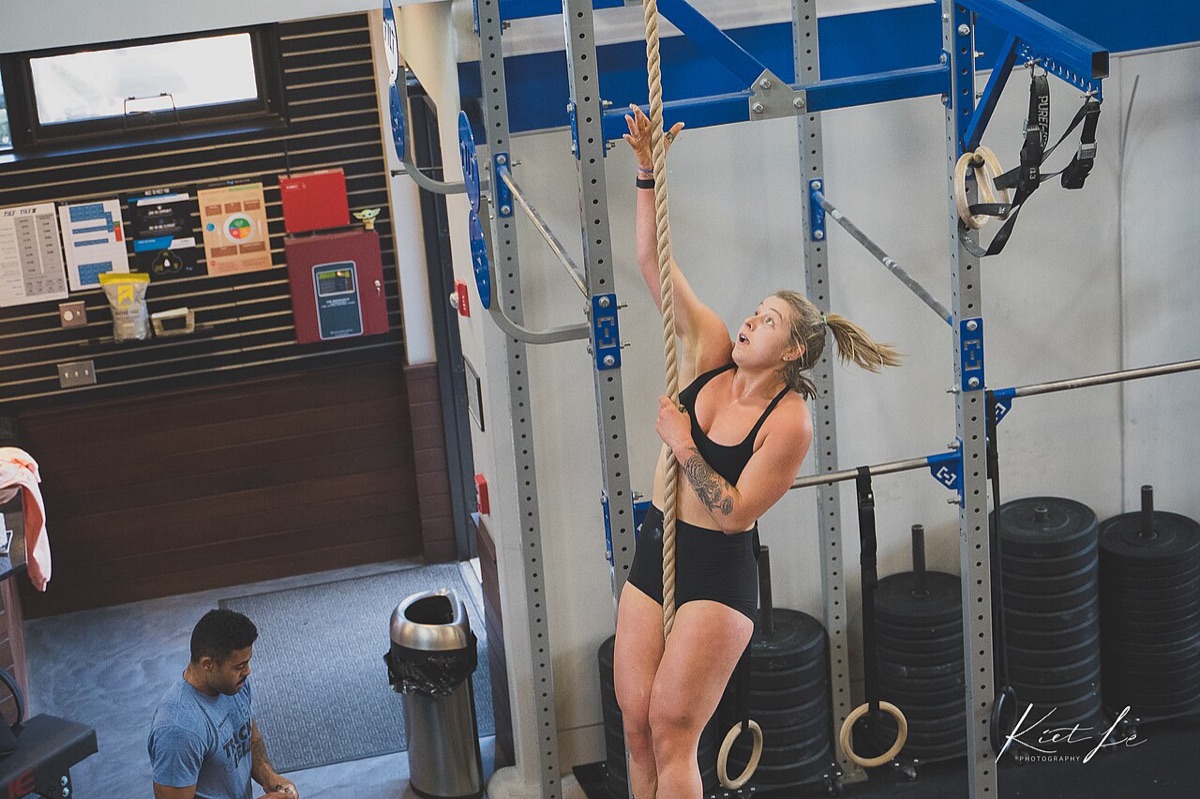
- Rope climb in CrossFit workout (Kiet Le, 2021)Wikimedia Commons · The photo, CC BY 2.0
General information, not medical advice. If you train hard and notice constant tiredness, frequent injuries, missed or irregular periods, or weight loss you didn't plan, talk to a doctor or a registered dietitian who works with athletes.
Analysis by NutroPractic from the sources listed. Written for general readers; it does not replace advice from your own doctor.
From our articles
Read, then eat a little better
Plain-language guides on nutrition and wellness, backed by research.

Women's health
Inositol for PCOS: the 40:1 ratio, trial doses, and food milligrams
Why do randomized trials in polycystic ovary syndrome prioritize the 40:1 myo to D-chiro inositol ratio? Here is the science behind the ovarian epimerase paradox, clinical ovulation and insulin metrics, and why cantaloupe cannot replace 4,000 mg trial powder.
21 Nov 2026

Everyday eating
Extra virgin olive oil polyphenols: the EU health claim, smoke point myths, and cooking stability
Does extra virgin olive oil degrade when cooked? What does the EU 5 mg polyphenol health claim require, how does oleocanthal act like ibuprofen, and why does oxidative stability matter more than smoke point in domestic frying? Here is the clinical and culinary data.
21 Nov 2026

Food and nutrition
L-theanine and caffeine: what cognitive trials measured on sustained attention, and milligrams in matcha vs green tea
Combining L-theanine with caffeine produces clean focus without caffeine jitters. Here is what randomized trials measured on attention-switching, EEG alpha brain waves, and the exact milligrams across ceremonial matcha, culinary powder, gyokuro, and sencha.
20 Nov 2026
Newsfeed for your website
Want this feed on your website?
Add it to any site with one copy-and-paste snippet. No sign-up, and it updates itself every hour.
Start with a virtual consultation
Tell Dr. Triveni what you want to change. You will leave with a clear next step, whether you are in Toronto, London, New York or Chennai.