GLP-1 drugs · October 22, 2026
Do the diabetes and weight-loss jabs protect the ageing brain? Five trials, 13,711 people at risk of Alzheimer's: on overall thinking scores the drugs made no difference, and the one bright memory result came from 24 people
Large health-record studies keep finding fewer dementia diagnoses in people who take GLP-1 drugs, the family that includes Ozempic and Trulicity. An Italian team went looking for the proof that only randomised trials can give, in people with type 2 diabetes or early memory trouble. What they found was mostly an absence, and a lesson in how thin the evidence still is.
Type 2 diabetes roughly doubles the risk of Alzheimer's disease, and mild cognitive impairment (MCI), the stage where memory slips are measurable but daily life still works, raises it further. So when studies of health records began to show fewer dementia diagnoses among people taking GLP-1 receptor agonists, the injectable drugs first made for diabetes and now famous for weight loss, hopes rose that they might also protect the brain. The drugs reach the brain, GLP-1 receptors sit in the hippocampus and cortex, and in animals they calm inflammation and improve memory. But record studies can't rule out that the people prescribed these drugs were healthier to begin with. Only randomised trials can.
A review published in Nutrients on 9 October set out to pool every randomised trial that tested a GLP-1 drug against a placebo or another treatment in adults at raised risk of Alzheimer's (type 2 diabetes or MCI) and reported scores on thinking tests. The team, from universities in Rome, Naples and Ancona, screened 1,966 records and found just five trials with 13,711 people, average age 64.5, followed for anywhere from 4 months to more than 5 years. One was enormous: REWIND, in which 9,901 people with type 2 diabetes took weekly dulaglutide (Trulicity) or a placebo for a median of more than five years. Another, the US GRADE trial, gave liraglutide or other diabetes drugs to 3,721 people. The other three were tiny: two of exenatide in people with MCI but no diabetes (27 and 31 people) and one of liraglutide in 36 people with diabetes.
On global thinking, measured with the 30-point screening tests doctors use (the MMSE or the MoCA), three trials could be combined. The result was as close to zero as these analyses get: an effect size of 0.01, with a margin of error running from slightly negative to slightly positive. The authors rated this the most certain finding in the paper. It also rests almost entirely on REWIND, which carried 99.3% of the statistical weight; drop it and the two small exenatide trials alone give an answer so uncertain it could mean harm or benefit. For attention and processing speed, two trials pooled gave another near-zero result with very wide error bars.
Everything else came from single trials. The one finding that looked like a benefit, better delayed memory with liraglutide, came from a 16-week Chinese study in which 24 people had usable scores, 12 on the drug. Executive function from the same trial leaned towards benefit without reaching significance, and verbal fluency in one of the exenatide trials leaned the other way. Detailed memory scores from GRADE and from one exenatide trial were never published, and the authors say their requests for the data went unanswered. They also note that none of the five trials was designed mainly to test thinking, and that no single test was named in advance as the main outcome of the review, so the domain-by-domain results are exploratory.
The review fits a wider pattern. In the evoke and evoke+ trials, published this year in The Lancet, oral semaglutide (the drug in Ozempic and Wegovy, in tablet form) taken for three years by about 3,800 people with early Alzheimer's did not slow their decline. The authors suggest the drugs may come too late once the brain is already losing cells, and that the open question is people at risk who have no symptoms yet, which would need trials built for that purpose. The review had no outside funding and the authors declare no conflicts of interest. For now, the honest reading is that GLP-1 drugs have good reasons to be prescribed for diabetes, weight and the heart, and that protecting memory isn't yet one of them.
Randomised trials of GLP-1 drugs and thinking scores in adults with type 2 diabetes or mild cognitive impairment (searched to 1 January 2026)
5 trials, 13,711
Randomised trials and people found: exenatide (2 small trials, MCI, no diabetes), liraglutide (2) and dulaglutide (1); 4 trials had usable data
g = 0.01
Effect on global thinking (MMSE or MoCA), 3 trials, 8,654 people; 95% CI -0.06 to 0.09, p = 0.515; high certainty of little or no effect
99.3%
Share of the global thinking result carried by one trial, REWIND (dulaglutide vs placebo in type 2 diabetes)
g = 0.07
Effect on attention and processing speed, 2 trials, 8,592 people; 95% CI -2.16 to 2.31, low certainty
g = 1.10
Delayed memory with liraglutide, a single 16-week trial with 24 people analysed; 95% CI 0.27 to 1.93, moderate certainty
28.4 months
Average follow-up across the five trials (range 4 to 64 months); average age 64.5
Study: Abbatecola AM, Migliara G, D'Agostino F, Veronese N, Giuliani A, Caponnetto S, Corbi G, Signoriello E, Antonelli Incalzi R, Paolisso G, 'Impact of GLP-1 Receptor Agonists on Cognitive Performance in Adults at Risk of Alzheimer's Disease: A Systematic Review and Meta-Analysis of Randomized Controlled Trials', Nutrients 2026, 18(20), 3312, published 9 October 2026, doi 10.3390/nu18203312 (open access, CC BY; read in full). Registered on PROSPERO (CRD420261301187). PubMed, Web of Science and Scopus to 1 January 2026: 3,319 records, 1,966 after duplicates, 16 read in full, 5 included. Trials: Mullins 2019 (exenatide vs placebo, MCI, 18 months, 27 people), Dei Cas 2024 (weekly exenatide vs no treatment, MCI, 8 months, 31), Cheng 2022 (liraglutide vs other diabetes drugs, 4 months, 36), GRADE (Luchsinger 2025, liraglutide vs other diabetes drugs, 48 months, 3,721; no usable scores), REWIND (Cukierman-Yaffe 2020, dulaglutide vs placebo, 64 months, 9,901). The sample sizes in the paper's table add to 13,716; the paper reports 13,711. Effects are Hedges' g (positive favours the drug; by convention about 0.2 is small, 0.5 medium, 0.8 large), random-effects REML with Knapp-Hartung. Without REWIND, global thinking g = -0.21 (95% CI -2.68 to 2.27). Single-trial estimates: executive function g = 0.61 (-0.18 to 1.40, 24 people), verbal fluency g = -0.55 (-1.26 to 0.15, 31 people). Certainty by GRADE. No funding; no conflicts of interest declared.
- Exenatide, the drug in the two memory-impairment trials, is a lab-made copy of exendin-4, a hormone found in the saliva of the Gila monster, a venomous lizard of the US Southwest.
- The MMSE and the MoCA both score out of 30 and take about ten minutes. Doctors use them to screen for problems, which is why they can miss small changes in one kind of thinking, the reason this review also looked at memory, attention and fluency separately.
- The Digit Symbol Substitution Test, used in REWIND for attention, gives you a key pairing numbers with symbols and counts how many boxes you can fill in correctly in a set time, often 90 or 120 seconds.
- In the evoke and evoke+ trials of oral semaglutide in early Alzheimer's, about 1,850 and 1,950 people were split between the drug and a placebo for 156 weeks. Neither trial showed a slower decline.
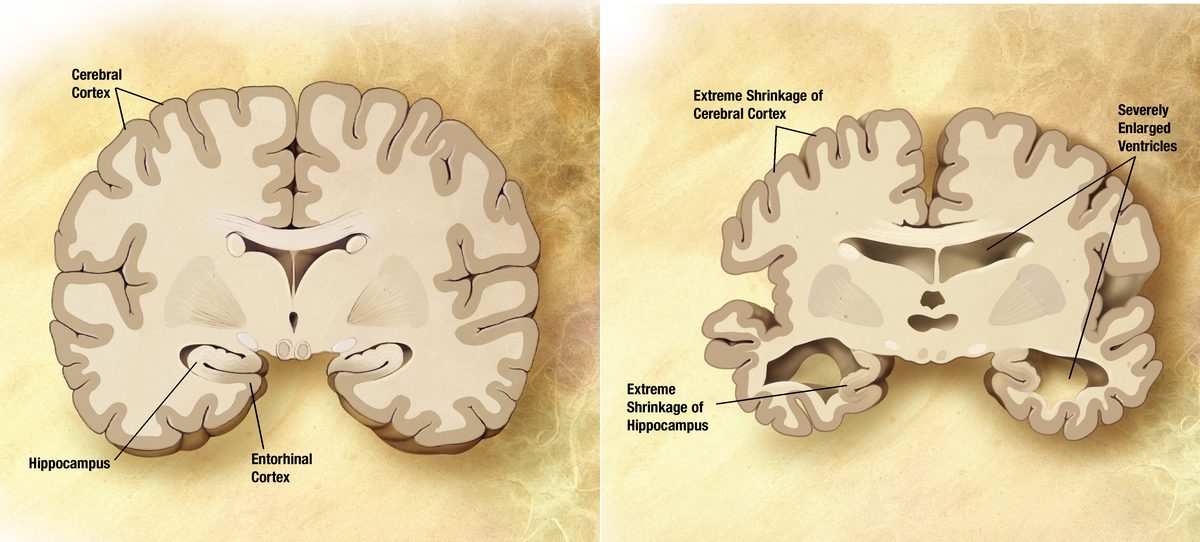
- The drawing shows why prevention is the hope: by the severe stage of Alzheimer's the hippocampus, the brain's memory hub, has shrunk so much that a drug that protects brain cells has little left to protect.
- Impact of GLP-1 Receptor Agonists on Cognitive Performance in Adults at Risk of Alzheimer's Disease: A Systematic Review and Meta-Analysis of Randomized Controlled TrialsNutrients, October 2026 · The paper: full text, open access
- Effect of dulaglutide on cognitive impairment in type 2 diabetes: an exploratory analysis of the REWIND trialThe Lancet Neurology, 2020 · The trial that carried 99.3% of the weight for global thinking
- Enhancement of Impaired Olfactory Neural Activation and Cognitive Capacity by Liraglutide, but Not Dapagliflozin or Acarbose, in Patients With Type 2 Diabetes: A 16-Week Randomized Parallel Comparative StudyDiabetes Care, 2022 · The small trial behind the single memory result
- Efficacy and safety of oral semaglutide 14 mg (flexible dose) in early-stage symptomatic Alzheimer's disease (evoke and evoke+): two phase 3, randomised, placebo-controlled trialsThe Lancet, 2026 · Semaglutide did not slow early Alzheimer's
- Alzheimer's disease brain comparisonWikimedia Commons · The illustration, public domain (US National Institute on Aging)
General information, not medical advice. These are prescription medicines with their own benefits and side effects, and no GLP-1 drug is approved to prevent or treat memory loss. If you are worried about your memory or thinking about one of these drugs, talk to your doctor.
Analysis by NutroPractic from the sources listed. Written for general readers; it does not replace advice from your own doctor.
From our articles
Our guides on this subject
Plain-language guides on nutrition and wellness, backed by research.

Women's wellness and nutrition
Creatine for women: cognitive performance, menstrual cycle phases, and bone density beyond muscle building
Creatine is widely stereotyped as a bodybuilding supplement for men, but female physiology tells a very different story. Women exhibit 70% to 80% lower endogenous creatine stores, reduced dietary intake, and cyclical fluctuations in brain creatine kinase across the follicular and luteal phases. Robust clinical trials demonstrate that 3 to 5 grams of daily creatine monohydrate enhances cognitive performance during sleep deprivation, augments clinical response in unipolar depression, preserves femoral neck bone geometry in postmenopausal women, and causes cellular intracellular hydration rather than subcutaneous bloating.
13 Nov 2026
Diabetes
Type 2 diabetes remission through weight loss: what the DiRECT trial showed, and who it works for
Almost half of the people in one UK trial put their type 2 diabetes into remission in a year by losing weight. After five years it was 13%. What the trial did, why the amount of weight lost mattered more than the method, who it suits, and how to try it without hurting yourself.
11 Oct 2026
Healthy ageing
Creatine beyond the gym: what it does for older adults and women, and what it doesn't
Across 22 trials, adults in their late fifties to seventies who took creatine while doing resistance training gained about 1.4 kg more lean mass than those who trained without it. Two two-year trials found it did nothing for bone density after menopause. Where the evidence is solid, where it's early (memory, short nights), how much to take, and who should leave it alone.
10 Oct 2026
Newsfeed for your website
Want this feed on your website?
Add it to any site with one copy-and-paste snippet. No sign-up, and it updates itself every hour.
Start with a virtual consultation
Tell Dr. Triveni what you want to change. You will leave with a clear next step, whether you are in Toronto, London, New York or Chennai.