Food and mood · November 13, 2026
A high-free-sugar eating pattern tracked with new bipolar diagnoses — but only 192 cases occurred
The 124,191-person cohort found a 34% higher relative risk per standard-deviation increase, an association that still needs interventional testing.
Researchers analysed 124,191 UK Biobank participants who had no bipolar-disorder diagnosis at baseline and completed at least two 24-hour diet recalls. They used a statistical method to derive patterns tied to energy density, saturated fat, free sugars and fibre density.
Two patterns emerged: one high in fibre and low in energy density, and another high in free sugars. During follow-up, hospital and death records identified 192 new bipolar-disorder diagnoses.
Each one-standard-deviation increase in the high-free-sugar pattern was associated with a 34% higher relative risk of a bipolar diagnosis: hazard ratio 1.34, with a 95% confidence interval from 1.12 to 1.61. The association was approximately linear. The high-fibre, low-energy-density pattern showed no clear monotonic relationship.
This is a prospective association, not proof that sugar caused bipolar disorder. The small number of cases relative to the cohort, diet-reporting error, unmeasured confounding and possible early changes before diagnosis all matter. The result is a reason for further research, not a reason to blame people for a serious psychiatric condition.
UK Biobank prospective diet-pattern analysis (10 November 2026)
124,191
Adults without bipolar disorder at baseline
≥2
24-hour diet recalls per participant
192
New bipolar-disorder cases
1.34
Hazard ratio per 1-SD higher sugar-pattern score
1.12–1.61
95% confidence interval
Prospective observational cohort. A relative-risk association cannot establish causation, and the outcome count was small compared with the full cohort.
- Free sugars include sugars added to food and drinks plus those in honey, syrups and unsweetened fruit juices.
- A standard deviation describes distance from the cohort average; it is not a fixed number of teaspoons of sugar.
- A hazard ratio is a relative comparison over follow-up, not an individual's absolute probability of illness.
- Bipolar disorder has complex genetic, biological and environmental contributors; diet is not a standalone explanation.
- High free sugar dietary pattern, not high fiber-low energy density pattern, predicts increased bipolar disorder risk: Evidence from 124,191 participantsJournal of Affective Disorders / PubMed · Primary prospective-cohort abstract with the dietary-pattern method, case count and hazard ratio. Published 10 November 2026.
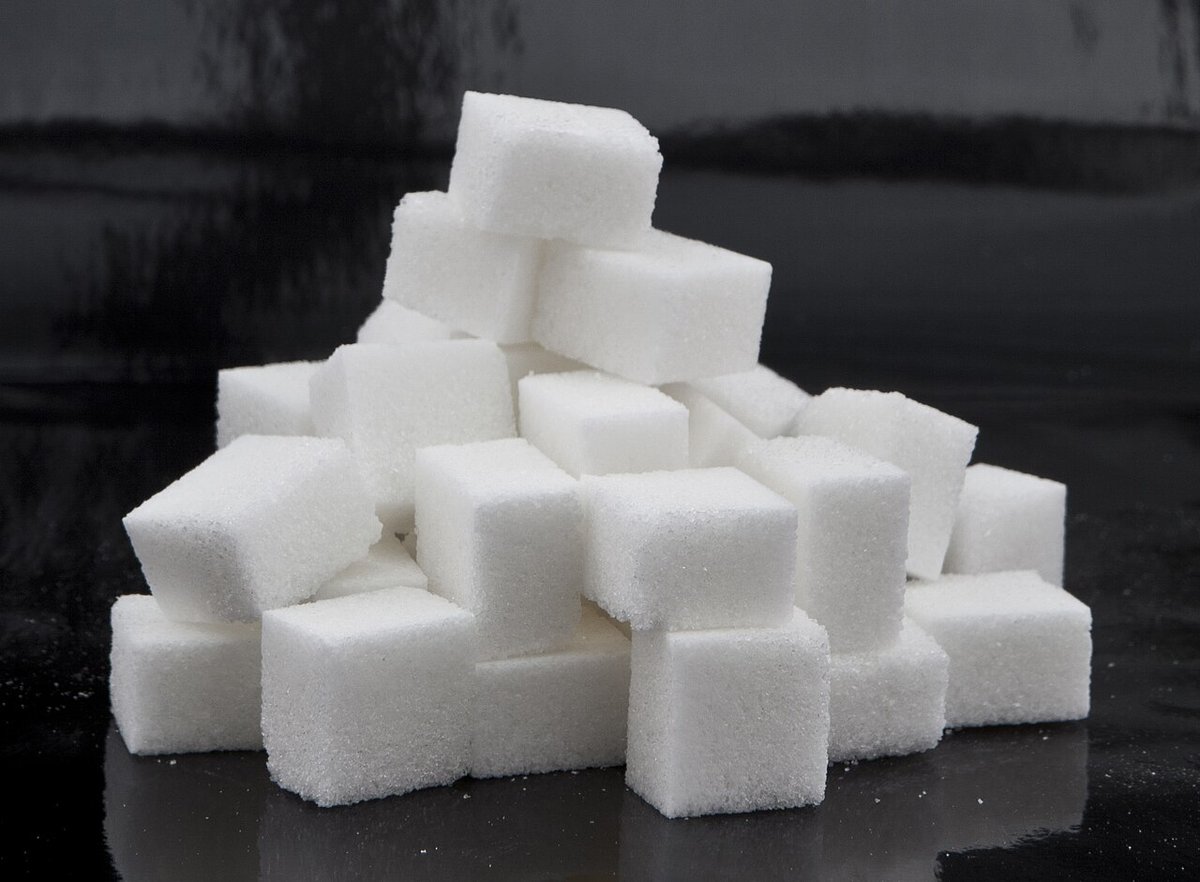
- Sugar cubesWikimedia Commons · David Pacey, CC BY 2.0. General free-sugar illustration only.
General information, not mental-health or dietary treatment advice. Seek qualified care for symptoms of mania, depression or major changes in sleep, energy or behaviour.
Analysis by NutroPractic from the sources listed. Written for general readers; it does not replace advice from your own doctor.
From our articles
Read, then eat a little better
Plain-language guides on nutrition and wellness, backed by research.

Women's health
Inositol for PCOS: the 40:1 ratio, trial doses, and food milligrams
Why do randomized trials in polycystic ovary syndrome prioritize the 40:1 myo to D-chiro inositol ratio? Here is the science behind the ovarian epimerase paradox, clinical ovulation and insulin metrics, and why cantaloupe cannot replace 4,000 mg trial powder.
21 Nov 2026

Everyday eating
Extra virgin olive oil polyphenols: the EU health claim, smoke point myths, and cooking stability
Does extra virgin olive oil degrade when cooked? What does the EU 5 mg polyphenol health claim require, how does oleocanthal act like ibuprofen, and why does oxidative stability matter more than smoke point in domestic frying? Here is the clinical and culinary data.
21 Nov 2026

Food and nutrition
L-theanine and caffeine: what cognitive trials measured on sustained attention, and milligrams in matcha vs green tea
Combining L-theanine with caffeine produces clean focus without caffeine jitters. Here is what randomized trials measured on attention-switching, EEG alpha brain waves, and the exact milligrams across ceremonial matcha, culinary powder, gyokuro, and sencha.
20 Nov 2026
Newsfeed for your website
Want this feed on your website?
Add it to any site with one copy-and-paste snippet. No sign-up, and it updates itself every hour.
Start with a virtual consultation
Tell Dr. Triveni what you want to change. You will leave with a clear next step, whether you are in Toronto, London, New York or Chennai.