Food and social media · October 23, 2026
Recipe clips several times a day, mukbangs to unwind, ChatGPT to fact-check: 53 young adults in Jamaica and the UK explain how food videos get past their guard, and why most of the healthy-eating ones stay on the screen
An Oxford team ran 12 focus groups with 18 to 25 year olds who watch food videos every week. They spot sponsored posts, read the comments for bots and drop dietitians who launch their own protein powder. Yet a McRib advert still tempts a pescatarian, and healthy eating is something they plan to start later, when they have the money.
There are more than a billion food videos on TikTok, and the people watching most of them are young. Studies have looked at what food content does to children and teenagers, but much less at people aged 18 to 25, who lean on their phones for health information and, in many countries, eat worse than older adults. A team at the University of Oxford and the University of the West Indies wanted to hear from them directly, and to compare two very different places: the United Kingdom, a high-income country that already restricts online promotion of foods high in fat, sugar and salt, and Jamaica, whose obesity strategies expired in 2018 and 2020 and are due for renewal. The study was published in the Journal of Medical Internet Research on 19 October.
Between August and November 2024 one researcher led 12 focus groups of 90 minutes, six in each country, online and in person, with people who had lived there at least five years and watched food videos every week. Sixty people took part, but seven in the first two online UK groups were judged to be impostors (vague answers, cameras off, unfamiliarity with UK supermarkets, emails sent from other time zones), and their words were removed before analysis. That left 53: 31 in Jamaica and 22 in the UK, about two thirds of them women. Recipe videos were the clear favourite, with 45% watching them several times a day; 'what's in my fridge' videos were the least watched.
The participants were far from passive. They trained their feeds by liking what they wanted and tapping 'not interested' on what they didn't; one started a fresh account to reset the algorithm. They watched to relax (mukbangs and eating sounds came up in both countries), to learn recipes and to see other cultures. And they ran quick credibility checks: is it sponsored, does the brand turn up in the comments, are the comments bots? A dietitian who spent years calling out health claims lost one viewer the moment she launched a protein powder. Some UK participants said TikTok had replaced Google for searching, and one now checks claims with ChatGPT, which the authors note is itself a possible source of error. Two influencers, one telling people to skip fruit and one telling them to eat it, left one participant asking how anyone knows who to listen to.
Knowing an advert is an advert did not always blunt it: a pescatarian admitted a McRib promotion made her want to eat meat again, though she didn't. Videos did change some habits, from one person going vegan after a YouTuber's video to a Jamaican participant who stopped eating beef for a month after a clip of it cooked rare. But healthy eating was mostly filed under later, when they would be older, settled and able to afford it. The researchers draw a 'journey of influence' with three points where help could come in: what reaches the feed, how content is judged, and whether it fits real life. This is a qualitative study of 53 volunteers, so it tells us how people think rather than how many think it; the authors also say removing the impostors' words could not undo their effect on the conversation in those UK groups. It was funded by Bloomberg Philanthropies through a fellowship that paid the lead author's PhD costs, and the authors declared no conflicts. We read the full article.
How young adults in Jamaica and the United Kingdom engage with food videos on social media (qualitative focus group study)
12 groups, 53 people
Focus groups of 18 to 25 year olds, 6 per country: 31 in Jamaica, 22 in the UK
7
Suspected impostors in the first two online UK groups, whose contributions were removed before analysis
45%
Watched recipe videos several times a day, the most-watched type
47%
Seldom or never watched 'what's in my fridge' videos, the least-watched type (our sum of 30% and 17%)
64%
Women among the 53 participants (34); 18 men and 1 nonbinary person
3
Points where the authors see room to help: exposure, evaluation, and fitting advice to real life
Study: Parks S, Albury C, Renzella J, Kaur A, Soares-Wynter S, Rayner M, Scarborough P, 'Engagement and Influence of Food-Related Videos on Social Media Within the Dietary Realities of Young Adults in Jamaica and the United Kingdom: Qualitative Cross-National Study', Journal of Medical Internet Research 2026;28:e89720, published 19 October 2026, doi 10.2196/89720, open access (CC BY 4.0). Nuffield Department of Population Health and Nuffield Department of Primary Care Health Sciences, University of Oxford; Caribbean Institute for Health Research, University of the West Indies, Kingston. Ethics: Oxford MS IDREC R82824/RE001 and UWI Mona CREC-MN.0226; protocol registered on the Open Science Framework. Eligibility: aged 18 to 25, at least five years living in Jamaica or the UK, weekly viewing of food videos on video-based platforms; purposive and snowball recruitment. 12 semistructured focus groups, 90 minutes, 4 to 7 people each, August to November 2024, on Microsoft Teams or at community centres, churches and seminar rooms; pilot in July 2024; topic guide reviewed by young people's advisory groups in both countries. Participants received vouchers worth £30 (UK) or J$6,000 (Jamaica). 60 attended (29 UK, 31 Jamaica); 7 UK participants excluded as suspected impostors, after which remaining online UK participants were screened by a short one-to-one call. Analysed sample (Table 1): aged 18 to 20, 24 (45.3%); 21 to 23, 13 (24.5%); 24 to 25, 16 (30.2%); female 34 (64.2%), male 18 (34.0%), nonbinary 1 (1.9%); urban 34 (64.2%; UK 95.5%, Jamaica 41.9%); full-time students 31 (58.5%). Viewing (Table 2, % of 53): recipe videos several times a day 45.3%; taste test and reaction videos 28.3%; health or diet videos 26.4%; 'what's in my fridge' seldom 30.2% and never 17%. Reflexive thematic analysis with framework analysis and constant comparison; four themes (balancing algorithms with personal curation; watching for relaxation, amusement and learning; evaluating content through inquiry and strategy; food choices formed where online meets offline) under one higher-order theme, 'a journey of influence'. Internet use cited by the authors: 96% in the UK, 83% in Jamaica. Limitations stated by the authors: online and in-person formats may have differed; removing impostors' contributions could not remove their influence on others; a smaller UK sample than planned; findings transferable but not generalisable. The moderator knew 10 participants beforehand (6 UK, 4 Jamaica). Funding: Bloomberg Philanthropies through the Vital Strategies Healthy Food Policy Fellowship (PhD costs of the lead author); the funder had no role. Conflicts of interest: none declared. Data not shared, as participants did not consent.
- A mukbang is a video of someone eating, often a very large amount, while talking to the camera or saying nothing at all; the word comes from the Korean for 'eating' and 'broadcast'.
- Researchers who pay people to join online studies increasingly meet 'impostor participants': here the warning signs included vague answers, cameras that wouldn't stay on, unfamiliarity with UK supermarkets and emails time-stamped from other time zones.
- In this study, an influencer saying plainly that a video was not sponsored counted as a 'green flag' for trust, while a brand account showing up in the comments under a supposedly unsponsored review was a giveaway.
- Jamaican participants described a strong pull towards Jamaican food and often used it as the yardstick for judging dishes from elsewhere, while UK participants spoke of many food cultures, Pakistani, Irish and others, rather than one national cuisine.
- Engagement and Influence of Food-Related Videos on Social Media Within the Dietary Realities of Young Adults in Jamaica and the United Kingdom: Qualitative Cross-National StudyJournal of Medical Internet Research · The paper, open access
- Full text in PubMed Central (PMC13679865)U.S. National Library of Medicine · Same article, with Tables 1 and 2
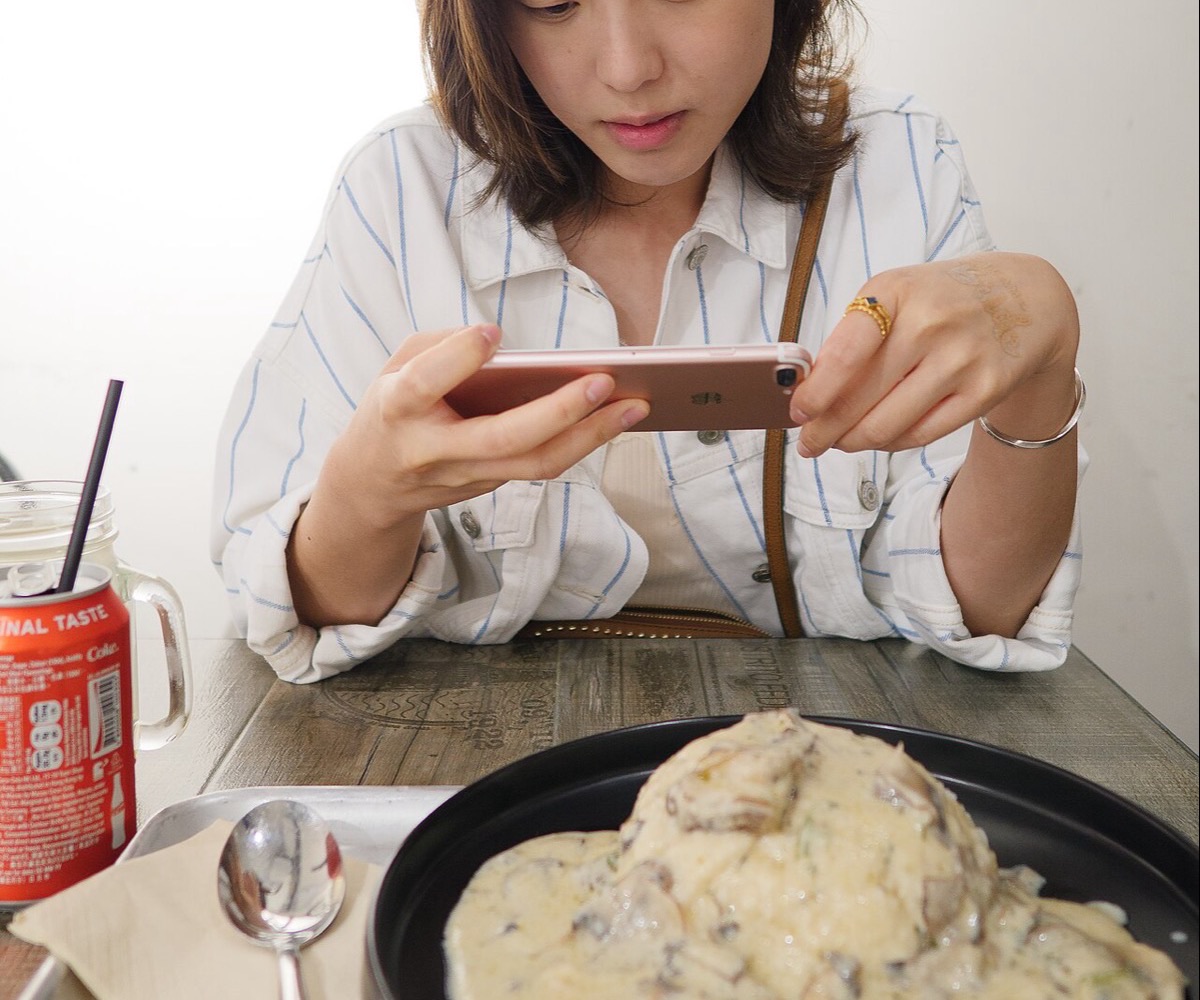
- A woman holding a iPhone before food in Cheung Chau 01Wikimedia Commons · The photo, CC BY 2.0 (Pingz Man)
General information, not medical advice. This is a small qualitative study of what volunteers said, not a measure of how food videos change diets. Nutrition advice in videos, from influencers or anyone else, can be wrong or tied to products for sale; if you are thinking of a big change to how you eat, such as cutting out a food group, talk to a doctor or a registered dietitian first.
Analysis by NutroPractic from the sources listed. Written for general readers; it does not replace advice from your own doctor.
From our articles
Read, then eat a little better
Plain-language guides on nutrition and wellness, backed by research.

Women's health
Inositol for PCOS: the 40:1 ratio, trial doses, and food milligrams
Why do randomized trials in polycystic ovary syndrome prioritize the 40:1 myo to D-chiro inositol ratio? Here is the science behind the ovarian epimerase paradox, clinical ovulation and insulin metrics, and why cantaloupe cannot replace 4,000 mg trial powder.
21 Nov 2026

Everyday eating
Extra virgin olive oil polyphenols: the EU health claim, smoke point myths, and cooking stability
Does extra virgin olive oil degrade when cooked? What does the EU 5 mg polyphenol health claim require, how does oleocanthal act like ibuprofen, and why does oxidative stability matter more than smoke point in domestic frying? Here is the clinical and culinary data.
21 Nov 2026

Food and nutrition
L-theanine and caffeine: what cognitive trials measured on sustained attention, and milligrams in matcha vs green tea
Combining L-theanine with caffeine produces clean focus without caffeine jitters. Here is what randomized trials measured on attention-switching, EEG alpha brain waves, and the exact milligrams across ceremonial matcha, culinary powder, gyokuro, and sencha.
20 Nov 2026
Newsfeed for your website
Want this feed on your website?
Add it to any site with one copy-and-paste snippet. No sign-up, and it updates itself every hour.
Start with a virtual consultation
Tell Dr. Triveni what you want to change. You will leave with a clear next step, whether you are in Toronto, London, New York or Chennai.