Food labels · October 25, 2026
7,401 Italians were asked one question at a street health check: do you read food labels? Those who always did had better heart scores, yet most of the rest still thought they ate well
Doctors from Rome's Gemelli hospital set up free check-ups in squares and shopping centres across Italy, took a drop of blood from each visitor and asked about their shopping habits. Seven in ten said they always read labels. Those people ate more fruit and vegetables, moved more, smoked less and weighed a little less. The catch: nobody can tell which came first.
Turning a packet over to read the back takes a few seconds. Is that habit a sign of a healthier heart? A study published in Nutrients on 22 October looked at it in 7,401 Italian adults, using the American Heart Association's Life's Essential 8: a 0 to 100 score built from diet, exercise, smoking, sleep, weight, blood pressure, cholesterol and blood sugar.
The data come from Look-Up 8+, a screening campaign run by Fondazione Policlinico Gemelli and the Università Cattolica del Sacro Cuore in Rome. Teams set up in city squares, shopping malls and community events in several regions, and anyone over 18 could walk in. Each visitor answered an interviewer's lifestyle questions, had weight, height and blood pressure measured, and gave a fingertip drop of blood for cholesterol and glucose. During 2025 the questionnaire also asked about food labels, with four answers: I always read them carefully, sometimes, never, or I'm not interested. Because only 172 people said never and 50 said not interested, the researchers compared those who always read labels with everyone else.
Most people said always: 74.5% of women and 65.6% of men. The always group looked healthier on almost every habit. Among men, 58.6% of label readers ate at least three portions of fruit and vegetables a day against 42.2% of the rest; among women, 70.4% against 54.6%. Regular exercise (at least 30 minutes, twice a week) was more common too: 71.3% against 62.8% in men and 67.1% against 56.4% in women. Fewer readers smoked, and their average BMI was lower by 0.6 in men and 0.7 in women. Their heart score averaged 66.7 against 62.2 in men and 67.6 against 64.4 in women. After allowing for age, sex and years of education, always reading labels went with about twice the odds of eating enough fruit and vegetables (odds ratio 2.07), 31% higher odds of a BMI under 25 and lower odds of a poor heart score below 40 points (odds ratio 0.63).
Some things did not differ. Blood pressure and cholesterol were about the same in both groups, for men and for women: 63.9% of male readers had high blood pressure against 65.7% of the rest, a gap too small to rule out chance. Diabetes and sleep problems were a little more common in men who didn't always read labels, with no difference in women. The authors suggest habits may shift before the numbers a doctor measures do. Perhaps the most telling result is in their Figure 1: among people who didn't always read labels, nearly 70% still described their own diet as healthy.
The limits are real, and the authors list most of them. This is a snapshot, so it can't say whether reading labels makes people healthier or whether people who already look after themselves are the ones who read labels; label readers here also had about a year more schooling. Label reading, diet and exercise were all self-reported to an interviewer, which invites the answer that sounds good. Diet was measured simply, mostly by fruit and vegetable portions. Visitors to a free health stand are not a random sample of Italy. And a few figures in the paper don't line up: the text says readers' heart scores were at least 10 points higher in every age group, while the overall averages differ by 3 to 5 points, and the confidence interval printed for the adjusted 0.63 (0.54 to 0.83) is lopsided. We report the paper's tables as published. The study had no external funding and the authors declare no conflicts of interest.
Food label reading and heart health in 7,401 Italian adults (Look-Up 8+, Nutrients, published 22 October 2026)
74.5% / 65.6%
Women / men who said they always read food labels
70.4% vs 54.6%
Women eating 3+ portions of fruit and veg a day: always readers vs the rest (men 58.6% vs 42.2%)
66.7 vs 62.2
Men's average Life's Essential 8 heart score out of 100, readers vs the rest (women 67.6 vs 64.4)
2.07
Adjusted odds ratio for eating enough fruit and veg if you always read labels
0.63
Adjusted odds ratio for a poor heart score (below 40) if you always read labels
Nearly 70%
People who didn't always read labels who still called their diet healthy
Source: Martone AM, Levati E, Calvani R, Tosato M, Galluzzo V, Ciciarello F, Salini S, Cacciatore S, Marzetti E, Landi F, 'Food Label Reading and Cardiovascular Health Profiles Across Adulthood: Findings from the Look-Up 8+ Study', Nutrients 2026, 18(21), 3463, published 22 October 2026 (received 22 July, accepted 14 October), doi 10.3390/nu18213463, open access (CC BY). Fondazione Policlinico Universitario Agostino Gemelli IRCCS and Università Cattolica del Sacro Cuore, Rome; University of Florida. Cross-sectional; walk-in screening in public places in several Italian regions; 7,492 adults assessed between 1 January and 31 December 2025, 91 excluded for missing blood pressure, cholesterol or glucose, 7,401 analysed (3,291 men, 4,110 women; mean age 54.4 ± 15.0). Label reading asked by interviewer: always / sometimes / never (172) / not interested (50); 'always' compared with all others. Always readers: men 2,158 of 3,291, women 3,061 of 4,110. Table 1, readers vs others: healthy diet (3+ portions of fruit and/or vegetables a day) men 58.6% vs 42.2%, women 70.4% vs 54.6%; physical activity (30+ min, 2+ days a week) men 71.3% vs 62.8% (the text says 71.6%), women 67.1% vs 56.4%; smoking men 17.5% vs 22.3%, women 16.9% vs 19.3%; BMI men 25.3 vs 25.9, women 23.4 vs 24.1; hypertension men 63.9% vs 65.7% (p 0.18), women 43.8% vs 41.4% (p 0.09); total cholesterol no difference; diabetes men 10.1% vs 12.1% (p 0.04), women no difference; sleep disorder men 26.7% vs 31.0% (p 0.01), women no difference; Life's Essential 8 (computed from point-of-care field measures) men 66.7 ± 12.8 vs 62.2 ± 12.8, women 67.6 ± 12.9 vs 64.4 ± 13.2 (all p < 0.001). Education 15.3 vs 14.4 years in men, 15.0 vs 14.1 in women. Logistic regression adjusted for age, sex and education (Table 2): poor heart score (LE8 < 40) OR 0.63, printed 95% CI 0.54–0.83 (unadjusted 0.58, 0.51–0.65); healthy diet OR 2.07 (1.82–2.35); BMI < 25 OR 1.31 (1.15–1.51). The authors say Figure 2 shows a gap of at least 10 LE8 points at all ages, largest in midlife, which we could not reconcile with the 3–5 point gaps in Table 1. Figure 1: nearly 70% of less frequent or non-readers perceived their diet as healthy. No external funding; Italian Ministry of Health Ricerca Corrente acknowledged; no conflicts of interest declared.
- Life's Essential 8 was published by the American Heart Association in 2022. It replaced the older Life's Simple 7 and added sleep as the eighth measure of heart health.
- In January 2025 the US FDA proposed a 'Nutrition Info box' for the front of most packaged foods, rating saturated fat, sodium and added sugars as Low (5% of the daily value or less), Med or High (20% or more). It was a proposal, open for comments until May 2025.
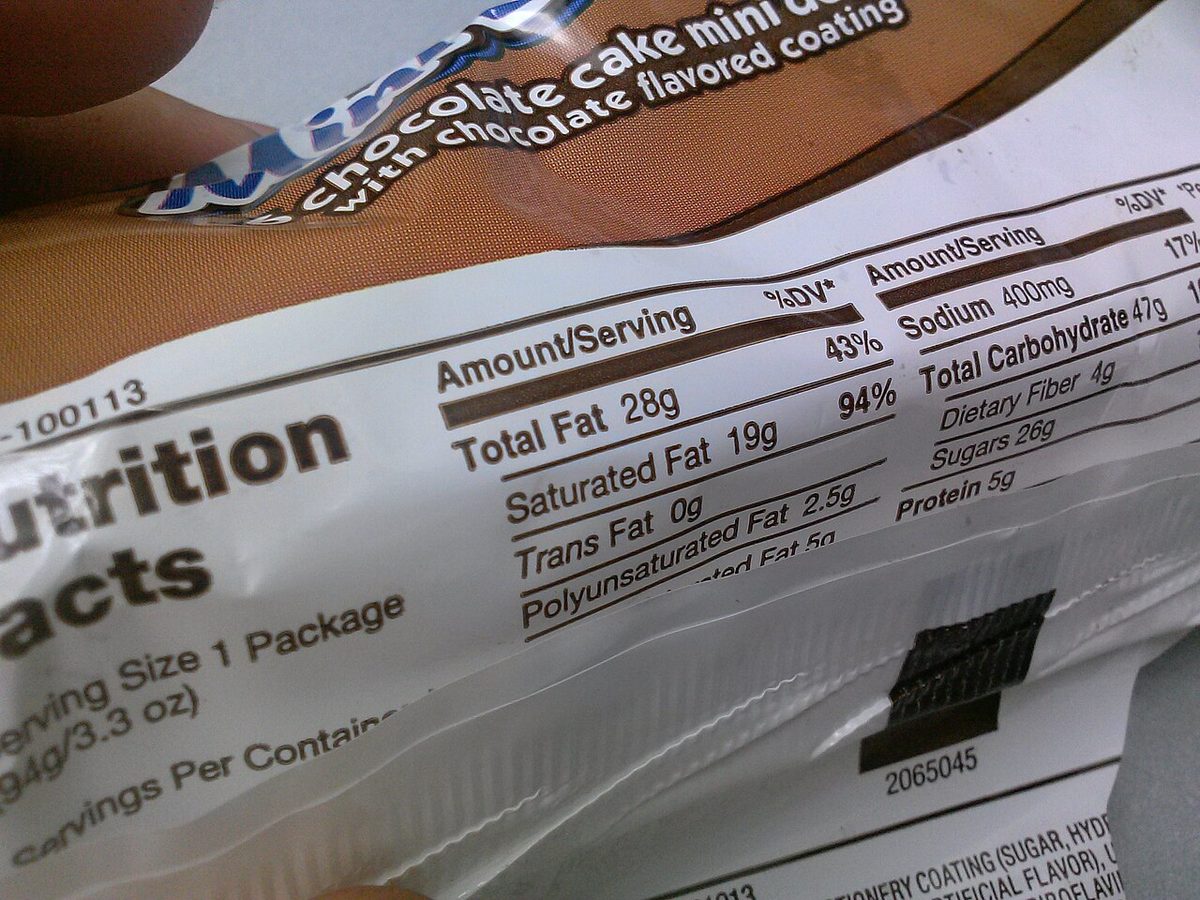
- The percentages on a US Nutrition Facts label are shares of a day's value for one serving, not for the whole shop. On the snack cake in our photo, a single 94 g package carries 19 g of saturated fat: 94% of the daily value in one go.
- Food Label Reading and Cardiovascular Health Profiles Across Adulthood: Findings from the Look-Up 8+ StudyNutrients (MDPI) · The study, open access, published 22 October 2026; figures from its full text and tables
- Life's Essential 8: Updating and Enhancing the American Heart Association's Construct of Cardiovascular HealthCirculation · The 2022 presidential advisory behind the heart health score
- Food Labeling: Front-of-Package Nutrition Information (proposed rule)Federal Register / US FDA · The FDA's January 2025 proposal for a front-of-pack Nutrition Info box
- Nutrition Facts label with 94% saturated fat per servingWikimedia Commons · The photo, CC0
General information, not medical advice. A food label tells you what is in a product, not what is right for you: if you have high blood pressure, diabetes, high cholesterol or a heart condition, ask your doctor or a registered dietitian which numbers on the label matter most for you.
Analysis by NutroPractic from the sources listed. Written for general readers; it does not replace advice from your own doctor.
From our articles
Read, then eat a little better
Plain-language guides on nutrition and wellness, backed by research.

Women's health
Inositol for PCOS: the 40:1 ratio, trial doses, and food milligrams
Why do randomized trials in polycystic ovary syndrome prioritize the 40:1 myo to D-chiro inositol ratio? Here is the science behind the ovarian epimerase paradox, clinical ovulation and insulin metrics, and why cantaloupe cannot replace 4,000 mg trial powder.
21 Nov 2026

Everyday eating
Extra virgin olive oil polyphenols: the EU health claim, smoke point myths, and cooking stability
Does extra virgin olive oil degrade when cooked? What does the EU 5 mg polyphenol health claim require, how does oleocanthal act like ibuprofen, and why does oxidative stability matter more than smoke point in domestic frying? Here is the clinical and culinary data.
21 Nov 2026

Food and nutrition
L-theanine and caffeine: what cognitive trials measured on sustained attention, and milligrams in matcha vs green tea
Combining L-theanine with caffeine produces clean focus without caffeine jitters. Here is what randomized trials measured on attention-switching, EEG alpha brain waves, and the exact milligrams across ceremonial matcha, culinary powder, gyokuro, and sencha.
20 Nov 2026
Newsfeed for your website
Want this feed on your website?
Add it to any site with one copy-and-paste snippet. No sign-up, and it updates itself every hour.
Start with a virtual consultation
Tell Dr. Triveni what you want to change. You will leave with a clear next step, whether you are in Toronto, London, New York or Chennai.