Food allergy · October 23, 2026
One in six Romanian adults said they had a food allergy. Only about one in three of those said a test had confirmed it, and fewer than half of the 500 knew that adrenaline, not an antihistamine, is the first treatment for anaphylaxis
Two studies from Timișoara set what people believe about food allergy against what testing shows. In a survey of 500 adults, 17.6% reported a food allergy but only 6.6% had one confirmed by an allergy test. Most knew a severe reaction can kill; far fewer knew what to do about it, and one in three had never heard of an adrenaline auto-injector.
Ask a room of adults whether they have a food allergy and many more hands go up than allergy tests would justify. European studies have found the same gap for years: self-reported food allergy runs far above the roughly 1% confirmed by an oral food challenge, the test in which a doctor feeds the suspect food in rising doses under watch. The gap matters at both ends. People who wrongly believe they are allergic can cut milk, wheat or eggs out of their own or their children's diets without need, and people who really are allergic may not be ready for a severe reaction. A team led from the Victor Babeș University of Medicine and Pharmacy in Timișoara looked at both ends in two studies, published together in Nutrients on 10 October.
The first was a look back at the records of 4,404 people assessed at one hospital allergy service from 2020 to 2024. Of them, 185 (4.2%) had a positive skin prick test or blood IgE test to at least one food. The positives were heavily concentrated in small children: 13% of the 590 children aged five and under who were assessed, against under 3% of everyone older. One in three of the food-sensitized patients with a recorded severity score had no active symptoms when they were seen. The authors are careful about what this means. A positive skin or blood test shows sensitization, not allergy; some sensitized people eat the food without trouble. And because the records could not show who had actually been tested for foods, the 4.2% is a share of everyone who came to the clinic, not a prevalence figure.
The second study was a 27-question survey of 500 adults recruited online, in public places and in doctors' waiting rooms. 88 of them (17.6%) said they had a food allergy. Only 33 said it had been confirmed by allergy testing; 37 said a doctor had diagnosed it from symptoms alone, and 18 had decided it for themselves. Across the whole sample, that is 6.6% with a test-confirmed allergy against 17.6% self-reported, a gap of 11 percentage points. Fruit and vegetables, milk and tree nuts were the foods named most often.
Knowledge was patchy. The average score on a 10-point quiz was 5.08. 70% knew anaphylaxis can be fatal, but only 48% named adrenaline as the first drug to give, and a third had never heard of an adrenaline auto-injector; 38% said they knew how to use one. Faced with a severe reaction such as trouble breathing or a swelling face, 16% said they would take an antihistamine and stay at home and 12% would wait to see if it got worse. Only 15% always read food labels for allergens, and 20% never did; people who reported an allergy were more careful, with 31% always checking. The internet and social media edged out doctors as the main source of allergy information (33% against 29%).
Education made the biggest difference: scores rose step by step from 2.9 for people who left school earliest to 7.2 for those with postgraduate degrees, and people with health-sector training averaged 7.6. The authors list the limits plainly: one clinic, a convenience sample that drew partly on waiting rooms and so probably over-represents people with health problems, a questionnaire not validated beforehand, and self-reported test confirmation that nobody checked against records. Their conclusion is that food allergy is labelled more readily than it is verified, while readiness for a severe reaction is thin, and they call for easier access to proper testing and allergy information pitched at people with less schooling. The university paid the publication fee and the authors declare no conflicts. We read the full open-access paper.
Food allergy in Romania: 4,404 allergy-clinic patients (2020–2024) and a survey of 500 adults
17.6% vs 6.6%
Survey adults reporting a food allergy vs reporting one confirmed by allergy testing
33 of 88
Self-reported food allergies said to be confirmed by a test; 18 were self-diagnosed
70% vs 48%
Knew anaphylaxis can be fatal vs named adrenaline as the first-line treatment
33.4%
Had never heard of an adrenaline auto-injector; 38.2% said they could use one
15.4%
Always read food labels for allergens; 20.0% never do
13.0% vs 2.8%
Clinic patients with a positive food test: children aged 0–5 vs everyone older
Study: Iovin V-C, Lighezan D, Neamțu A-A, Porr C, Căpraru A-M, Sarău C, Jugănaru I, Muntean A, Bugi M-A, Panaitescu C, 'Food Allergen Sensitization in a Five-Year Allergy Clinic Cohort and Food Allergy Knowledge, Attitudes and Behaviours in Romanian Adults: Two Observational Studies', Nutrients 18(20):3324, published 10 October 2026, doi 10.3390/nu18203324, open access (CC BY). Study 1: retrospective records of one hospital allergy service, 1 January 2020 to 31 December 2024, 4,404 unique patients (55.1% female, mean age 29.1); food sensitization = positive skin prick test and/or specific IgE to at least one food, in 185 (4.2%, 95% CI 3.6–4.8); 0–5 years 77/590 (13.05%) vs 2.83% in all older patients (OR 5.15); adjusted OR for 0–5 vs 18–30 years 4.61. The food-tested subset could not be identified, so these are proportions of patients assessed, not prevalences; individual foods were not recorded; IgE tests do not detect non-IgE food allergy. 34.1% of food-sensitized patients with a recorded severity score had no active symptoms (score missing for 11%). Study 2: convenience sample of 500 adults (59.4% women, mean age 46.7, 62.2% urban, 8.0% with health-sector training), online and printed questionnaire, 27 items, 10-point knowledge score not validated beforehand (Cronbach's alpha 0.58). Self-reported food allergy 88 (17.6%, 95% CI 14.5–21.2); test-confirmed 33 (6.6%, 95% CI 4.7–9.1); gap 11.0 points (95% CI 8.5–14.0). Knowledge score mean 5.08 (SD 2.06). Severe-reaction scenario: 67.2% chose emergency call or adrenaline, 16.0% antihistamine and stay home, 12.4% wait, 4.4% did not know. Mean score by education: 2.88 lower secondary, 4.30 upper secondary, 5.57 post-secondary, 6.11 university, 7.15 postgraduate; health-sector training 7.60 vs 4.86. Regression (n = 492, R² 0.44): +0.89 points per education step, +2.34 for health-sector training. Ethics approvals from the Pius Brînzeu County Emergency Clinical Hospital and the Victor Babeș University, Timișoara. Funding: publication fee paid by the Victor Babeș University; no conflicts declared.
- A positive skin prick or blood test means the immune system has made IgE antibodies to a food, not that eating it will cause a reaction. The reference test is an oral food challenge: eating the food in rising doses under medical supervision.
- EU food law (Regulation 1169/2011) requires 14 allergen categories to be declared on labels, among them milk, egg, peanuts, nuts, gluten-containing cereals, fish, crustaceans, soy, sesame, celery, mustard, lupin, molluscs and sulphites.
- The NHS advice for anaphylaxis is to use an adrenaline auto-injector if there is one, call an ambulance, lie down rather than stand, and use a second injector if there is no improvement after 5 minutes.
- Testing in a clinic is driven by symptoms, so a small child with a suspected food reaction is far more likely to be tested for foods than an adult with hay fever. That is one reason the study's authors say its age pattern should not be read as a population rate.
- In the survey, 71% of adults said they would like education on food allergy, and 48% would go first to their family doctor rather than an allergist.
- Food Allergen Sensitization in a Five-Year Allergy Clinic Cohort and Food Allergy Knowledge, Attitudes and Behaviours in Romanian Adults: Two Observational StudiesNutrients (MDPI) · The paper, open access
- AnaphylaxisNHS · What to do in a severe allergic reaction
- Regulation (EU) No 1169/2011 on the provision of food information to consumersEUR-Lex · Annex II lists the 14 allergens that must be declared
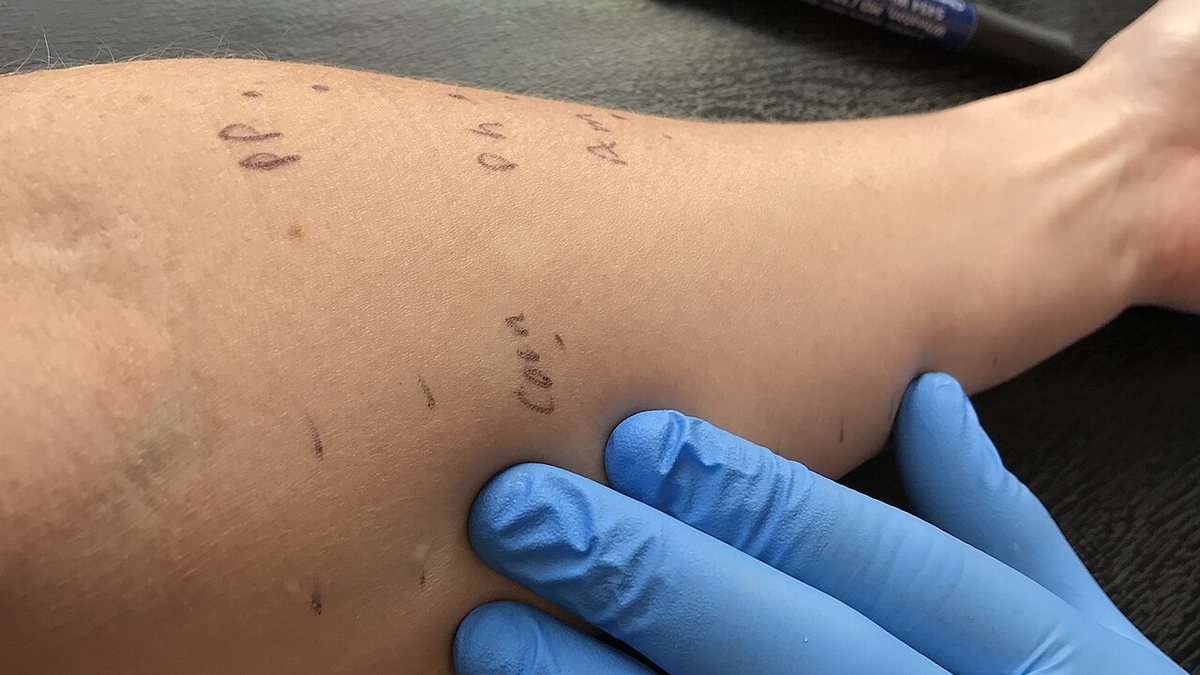
- Skin Test for Food AllergyWikimedia Commons · The photo, CC BY 2.0 (NIAID)
General information, not medical advice. If you think you or your child has a food allergy, see a doctor for proper testing before cutting foods out, especially staples like milk or wheat for a child. If you have been prescribed an adrenaline auto-injector, carry it and learn how to use it. In a severe reaction, use adrenaline and call emergency services; antihistamines alone do not treat anaphylaxis.
Analysis by NutroPractic from the sources listed. Written for general readers; it does not replace advice from your own doctor.
From our articles
Read, then eat a little better
Plain-language guides on nutrition and wellness, backed by research.

Women's health
Inositol for PCOS: the 40:1 ratio, trial doses, and food milligrams
Why do randomized trials in polycystic ovary syndrome prioritize the 40:1 myo to D-chiro inositol ratio? Here is the science behind the ovarian epimerase paradox, clinical ovulation and insulin metrics, and why cantaloupe cannot replace 4,000 mg trial powder.
21 Nov 2026

Everyday eating
Extra virgin olive oil polyphenols: the EU health claim, smoke point myths, and cooking stability
Does extra virgin olive oil degrade when cooked? What does the EU 5 mg polyphenol health claim require, how does oleocanthal act like ibuprofen, and why does oxidative stability matter more than smoke point in domestic frying? Here is the clinical and culinary data.
21 Nov 2026

Food and nutrition
L-theanine and caffeine: what cognitive trials measured on sustained attention, and milligrams in matcha vs green tea
Combining L-theanine with caffeine produces clean focus without caffeine jitters. Here is what randomized trials measured on attention-switching, EEG alpha brain waves, and the exact milligrams across ceremonial matcha, culinary powder, gyokuro, and sencha.
20 Nov 2026
Newsfeed for your website
Want this feed on your website?
Add it to any site with one copy-and-paste snippet. No sign-up, and it updates itself every hour.
Start with a virtual consultation
Tell Dr. Triveni what you want to change. You will leave with a clear next step, whether you are in Toronto, London, New York or Chennai.