Food allergy · October 25, 2026
Babies with a food allergy were a little lighter for their length at five months, and 25 of their 30 mothers had cut foods from their own plates. 73 breastfed babies in Chongqing, weighed and measured up to their first birthday
Paediatricians at a children's hospital in Chongqing followed exclusively breastfed babies with and without a food allergy. The allergic babies started out somewhat lighter for their length, but the gap did not widen over the following months. Their mothers were far more likely to be avoiding milk, fish, shellfish or eggs themselves, usually on a doctor's advice, for a median of two months.
When a breastfed baby reacts to a food, the usual first step is to change the mother's diet, since traces of what she eats reach her milk. That can mean months without milk, eggs, fish or wheat for her, and some worry it could leave either of them short of something. Researchers at the Children's Hospital of Chongqing Medical University in China set out to watch how such babies grow. Their study was published in Frontiers in Nutrition on 23 October.
Between November 2024 and November 2025 they enrolled 73 full-term babies aged four to six months who were fed only breast milk and had no other serious illness. Thirty had a food allergy and 43 did not. The allergy was diagnosed the way it usually is in breastfed babies, without a formal food challenge: the mother left out the suspected food for two to four weeks, the baby's symptoms eased, and when foods went back one at a time over three to five days, the symptoms came back within one to three days. Cow's milk was the commonest trigger (18 of the 30 babies), followed by egg (13), shellfish (12), fish (8) and peanut (5). Nurses weighed and measured the babies at routine check-ups at 4, 5, 6, 8, 10 and 12 months, 268 measurements in all, and these were turned into scores against the World Health Organization's growth standards.
Mothers' diets were the starkest difference. Of the 30 mothers of allergic babies, 25 (83%) were avoiding foods themselves, against 8 of the 43 other mothers (19%). They cut a median of three food groups rather than one, for a median of 60 days rather than none, most often milk and fish (about half of them each), shellfish (half) and eggs (four in ten). Twenty of the 25 had been told to by a doctor; the other five started on their own and a doctor later agreed. Among the mothers of babies without an allergy, six were avoiding foods because they worried about colic and two because of their own allergy.
On growth, the allergic babies were lighter for their length at five months, by about four-tenths of a standard deviation on the WHO weight-for-length score. But that gap did not grow: the slope over the following months was the same in both groups. On average both groups sat at or above the WHO median, so this was not a group of underweight babies. Weight-for-age and length-for-age followed curved, harder-to-read paths, and the authors chose to treat those results with caution. Crucially, they write that their analysis does not show that the mothers' food avoidance itself held the babies' weight back; mothers of babies with worse symptoms may simply have cut more.
This is a small study from a single hospital, and few allergic babies were still being measured by their first birthday (three at 12 months or later). Mothers recalled what they had avoided at the first visit; what they actually ate, in calories, protein or vitamins, was not measured; nothing was recorded about the solid foods the babies started; and without food challenges, the allergies could not be split into the immediate and delayed types. The authors' advice is to keep a close eye on growth in breastfed babies with a food allergy and to give mothers who need to cut foods proper dietary guidance so they do not cut more than necessary. The work was funded by the Chongqing Science and Technology Bureau and Chongqing Medical University. We read the full open-access paper.
73 exclusively breastfed babies in Chongqing, 30 with a food allergy, followed from 4-6 months (published 23 October 2026)
83% vs 19%
Mothers avoiding foods in their own diet: babies with a food allergy (25 of 30) vs without (8 of 43)
3 vs 1
Median number of food groups the mothers avoided
60 days
Median time the allergic babies' mothers had avoided foods (middle half: 15 to 150 days)
60%
Allergic babies reacting to cow's milk, the commonest trigger (then egg 43%, shellfish 40%)
0.42
How much lower the allergic babies' weight-for-length score was at 5 months, in standard deviations
No change
Difference in how the weight-for-length score changed month by month between the two groups
Source: Fang J, Zhang Z, Zhong Y, Wan Y, Chen Q, Xia X, Zhang X, 'Growth trajectories in exclusively breastfed infants with clinically diagnosed food allergy: a prospective longitudinal cohort study', Frontiers in Nutrition 2026;13, published 23 October 2026, doi 10.3389/fnut.2026.1924841, open access (CC BY). Children's Hospital of Chongqing Medical University, Chongqing, China. Prospective single-centre cohort, enrolment November 2024 to November 2025, registered ChiCTR2500114005. Inclusion: 4-6 months old, exclusively breastfed, term (37-42 weeks), no major congenital disease. Food allergy diagnosed clinically by paediatric allergists (history, examination, 2-4 week maternal elimination, then single-food reintroduction over 3-5 days with reproducible symptoms within 24-72 h); no oral food challenges, so IgE and non-IgE types not separated. 30 food allergy (FA), 43 no allergy (NFA); 268 measurements (mean 3.67 per infant) at 4, 5, 6, 8, 10 and 12 months, converted to WHO Child Growth Standards Z-scores. FA phenotypes: cow's milk protein 18 (60.0%), egg 13 (43.3%), shellfish 12 (40.0%), fish 8 (26.7%), peanut 5 (16.7%). Maternal avoidance: 25/30 (83.3%) vs 8/43 (18.6%), p < 0.001; adjusted OR 14.14 (95% CI 4.04-49.57) for maternal age, education and family history of allergy; median foods avoided 3 (Q1-Q3 2-5) vs 1 (0-2); median duration 60 (15-150) vs 0 days. Foods avoided in the FA group: milk 53.3%, fish 53.3%, shellfish 50.0%, eggs 40.0%, wheat 23.3%, soy 16.7%, peanuts 10.0%. Of 25 FA mothers avoiding, 20 physician-recommended, 5 self-initiated then confirmed; NFA reasons: concern about colic 6, maternal allergy or intolerance 2. Linear mixed-effects model, age centred at 5 months, adjusted for sex, random intercept per infant: WLZ group difference (NFA minus FA) 0.423 (95% CI 0.036-0.811, p = 0.035); group-by-age interaction -0.011 (-0.086 to 0.063, p = 0.763); no evidence of non-linearity (p = 0.192) or group-by-sex interaction. WAZ and LAZ showed linear group-by-age interactions (0.156 and 0.202, p < 0.001) but significant non-linear age patterns, interpreted cautiously. Observed WLZ at 4 to <6 months: NFA 0.61 (SD 0.78), FA 0.11 (0.96); at 10 to <12 months: 0.43 and 0.26. Observations at 12 months or later: 15 NFA, 3 FA. Limitations stated by the authors: modest sample and loss of later observations (more in the FA group), no complementary feeding or nutrient intake data, maternal avoidance recalled at enrolment, no oral food challenges, single centre and observational. Funding: Natural Science Foundation of Chongqing, Chongqing Science and Technology Bureau (CSTB2022NSCQ-MSX0797) and Chongqing Medical University Program for Youth Innovation in Future Medicine (W0120).
- The European Academy of Allergy and Clinical Immunology suggests against mothers avoiding food allergens during pregnancy or breastfeeding as a way to prevent food allergy in their babies. Cutting a food because a baby already reacts to it is a different, medical decision.
- The same guideline suggests introducing well-cooked egg, and peanut in a baby-safe form where peanut allergy is common, as part of first solid foods, and says the most effective age for both appears to be four to six months.
- Only about 47% of babies under six months worldwide were fed only breast milk in 2018-2025, according to the World Health Organization, which aims for at least 60% by 2030.
- Growth trajectories in exclusively breastfed infants with clinically diagnosed food allergy: a prospective longitudinal cohort studyFrontiers in Nutrition · The study, open access, published 23 October 2026
- EAACI guideline: Preventing the development of food allergy in infants and young children (2020 update)Pediatric Allergy and Immunology · Advice on maternal diets and introducing egg and peanut
- Infant and young child feeding (fact sheet)World Health Organization · Exclusive breastfeeding rates and the 2030 target
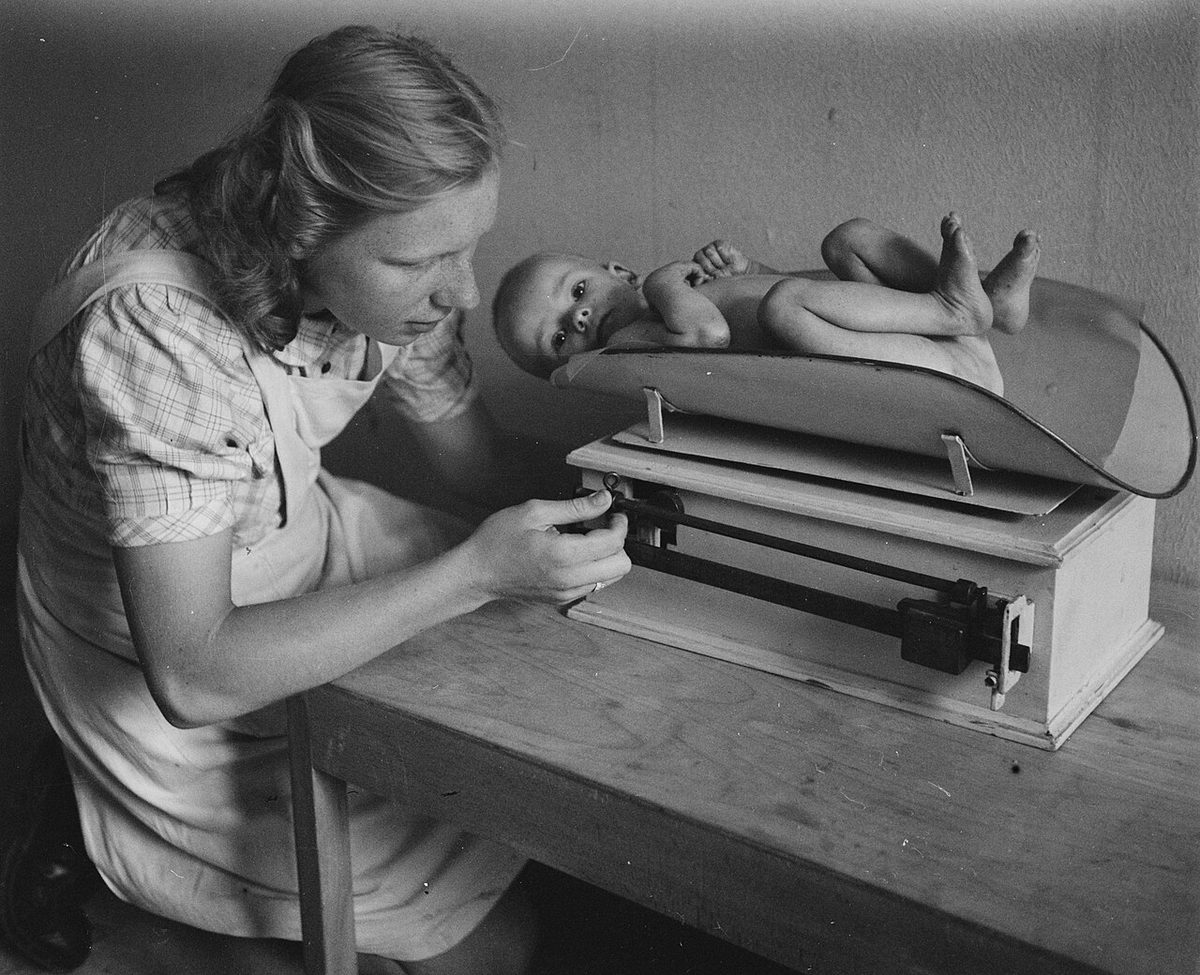
- Een baby wordt gewogen (Anefo, 1945)Wikimedia Commons · The photo, CC0 (Nationaal Archief)
General information, not medical advice. This study shows an association in a small group of babies, not that a mother's diet changes her baby's growth. If you think your baby reacts to a food, or you are worried about their weight, see your doctor or health visitor before cutting foods from your own diet or your baby's, and ask for a dietitian's help if you need to avoid foods while breastfeeding.
Analysis by NutroPractic from the sources listed. Written for general readers; it does not replace advice from your own doctor.
From our articles
Read, then eat a little better
Plain-language guides on nutrition and wellness, backed by research.

Women's health
Inositol for PCOS: the 40:1 ratio, trial doses, and food milligrams
Why do randomized trials in polycystic ovary syndrome prioritize the 40:1 myo to D-chiro inositol ratio? Here is the science behind the ovarian epimerase paradox, clinical ovulation and insulin metrics, and why cantaloupe cannot replace 4,000 mg trial powder.
21 Nov 2026

Everyday eating
Extra virgin olive oil polyphenols: the EU health claim, smoke point myths, and cooking stability
Does extra virgin olive oil degrade when cooked? What does the EU 5 mg polyphenol health claim require, how does oleocanthal act like ibuprofen, and why does oxidative stability matter more than smoke point in domestic frying? Here is the clinical and culinary data.
21 Nov 2026

Food and nutrition
L-theanine and caffeine: what cognitive trials measured on sustained attention, and milligrams in matcha vs green tea
Combining L-theanine with caffeine produces clean focus without caffeine jitters. Here is what randomized trials measured on attention-switching, EEG alpha brain waves, and the exact milligrams across ceremonial matcha, culinary powder, gyokuro, and sencha.
20 Nov 2026
Newsfeed for your website
Want this feed on your website?
Add it to any site with one copy-and-paste snippet. No sign-up, and it updates itself every hour.
Start with a virtual consultation
Tell Dr. Triveni what you want to change. You will leave with a clear next step, whether you are in Toronto, London, New York or Chennai.