Home cooking · October 24, 2026
It isn't only knowing how to cook: 4,453 US adults were asked how confident they felt in the kitchen, whether they liked it and what got in the way, and those who scored highest cooked dinner about one more night a week and had about two fewer fast-food meals
A Johns Hopkins team looked past cooking skills to 'food agency': confidence, attitude and the time, money and kitchen that make cooking possible. In a national online survey, adults in the top quarter for food agency reported cooking dinner 5.4 nights a week against 4.1 in the bottom quarter, and about 4.7 fast-food meals a week against 6.8. Their diet scores were higher too, though only by a few points, and everyone's were low.
Advice to cook more at home is everywhere, from the US dietary guidelines down, and it rests on a reasonable body of evidence: people who cook dinner most nights tend to eat fewer calories, less sugar and less fat than people who rarely do. The usual fix offered is a cooking class. Researchers at the Johns Hopkins Bloomberg School of Public Health and the University of Michigan argue that skills are only part of it. Their idea, 'food agency', bundles three things together: how capable you feel at planning and making meals, whether you see cooking as worthwhile or a chore, and the outside barriers, such as time, money or a cramped kitchen, that stand in your way. Their study was published in Public Health Nutrition on 22 October.
In November 2023 they ran a 20-minute online survey through a market research panel, with quotas so that the mix of gender, age and race matched US census figures. Of 9,835 people who started it, 4,453 adults were kept after removing those who failed attention checks, rushed, looked like bots or gave incomplete answers. Food agency was scored with an 11-item version of a validated questionnaire, and people were split into four equal groups by their score. They were also asked how many nights in the past week someone at home had cooked dinner, how many times they had eaten fast food (including drive-through and delivery), and how often over the past month they had eaten 22 food groups, from leafy greens and nuts to processed meat and sugary drinks, which gives a diet quality score out of 126.
After allowing for age, gender, race and ethnicity, income, education, work, marital status, household size and food security, the pattern ran in a straight line across the four groups. The top quarter was predicted to cook dinner on 5.37 nights a week against 4.09 in the bottom quarter, a 27% difference. It reported 4.74 fast-food meals in the past week against 6.83, 26% fewer. Its diet score was 57.2 against 50.8. Each of the three parts counted separately: confidence, a positive attitude and fewer practical barriers were each linked to more cooking, less fast food and a better diet. The barriers part had the strongest link with fast food, which the authors read as fast food filling the gap when time or circumstances make cooking hard.
The authors are frank about what the numbers do not show. A six-point gap on a 126-point scale is small, they write, its clinical meaning is unclear, and diet quality was low at every level of food agency: the average score was 53.5. Everything was self-reported, so people who see themselves as good cooks may also tend to report a tidier diet. Cooking was asked only about dinner and only for one week, fast food likewise, while diet was asked over a month. The panel was English-speaking and online, so it is not truly nationally representative. And because it is a single snapshot, it cannot say whether food agency leads to cooking, or whether cooking a lot builds confidence and a liking for it.
That last point matters, because one earlier cooking programme at the University of Vermont raised students' food agency scores without changing how often they cooked or how well they ate. The authors' suggestion is that cooking programmes deal with barriers as well as knife skills: frozen vegetables, canned beans, slow cookers and cooking ahead to save time and money. They also note that time to cook is not evenly shared: people who work from home spend more time preparing food, and they tend to earn more. The study was funded by the US National Institute of Diabetes and Digestive and Kidney Diseases, and the authors report no conflicts of interest. We read the full open-access paper.
Food agency, dinner cooking, fast food and diet quality in 4,453 US adults (published 22 October 2026)
4,453
US adults in the final sample of a census-matched online survey, November 2023
5.37 vs 4.09
Nights a week dinner was cooked at home, top versus bottom quarter of food agency (adjusted)
4.74 vs 6.83
Fast-food meals in the past week, top versus bottom quarter (adjusted)
57.2 vs 50.8
Diet quality score out of 126, top versus bottom quarter (adjusted)
53.5
Average diet quality score across the whole sample: low at every level of food agency
26%
Fewer fast-food meals expected in the top quarter than the bottom, after adjustment
Source: Choi E, Tucker AC, Leung CW, Wolfson JA, 'Associations between food agency and dinner cooking frequency, fast-food frequency and diet quality among US adults', Public Health Nutrition 2026;29(1):e202, published online 22 October 2026, doi 10.1017/S1368980026103474, open access (CC BY 4.0). Cross-sectional online survey via CloudResearch Prime Panels, November 2023, with quotas matched to 2019-2020 US Census data for gender, age and race and ethnicity; 9,835 started, 4,453 analysed. Food agency measured with the 11-item CAFPAS-short (self-efficacy, attitudes, structure), split into quartiles. Dinner cooking: nights in the past 7 days someone cooked dinner at home (0-7). Fast food: times in the past 7 days (0-32). Diet quality: PDQS-30D, 22 food groups over 30 days, 0-126. Models adjusted for gender, age, race and ethnicity, income, education, employment, marital status, household size and household food security. Top versus bottom quartile: dinner cooking IRR 1.27 (95% CI 1.22 to 1.33), fast food IRR 0.74 (lower by 26%, 95% CI 23% to 29%), PDQS-30D beta 6.28 points (5.31 to 7.24); P for trend < 0.001 for all. Predicted values Q4 vs Q1: 5.37 vs 4.09 nights, 4.74 vs 6.83 fast-food meals, 57.2 vs 50.8 points. Each 1-SD rise in a subscale: dinner cooking IRR 1.07 (self-efficacy), 1.07 (attitude), 1.09 (structure); fast food IRR 0.94, 0.94, 0.91; PDQS-30D +2.17, +2.03, +1.13 points. Results held after adjusting cooking for fast food (IRR 1.24) and fast food for cooking (IRR 0.79). Mean PDQS-30D 53.5 (SD 12.0). Limitations stated by the authors: not nationally representative, English-speaking web panel, self-report, single-week measures for dinner and fast food, cross-sectional. Funded by NIDDK (K01DK119166); no conflicts of interest declared.
- In US national survey data from 2007-2010, adults in households where dinner was cooked 6-7 nights a week ate about 2,164 kcal a day, against about 2,301 kcal for those where it was cooked 0-1 nights, along with less fat (81 g vs 86 g) and less sugar (119 g vs 135 g).
- Only 8% of US adults in 2007-2010 lived in a household where dinner was cooked at home no more than once a week.
- Between 2013 and 2016, 36.6% of US adults ate fast food on any given day: 44.9% of those aged 20-39, falling to 24.1% of those 60 and over. Unexpectedly, the share rose with income, from 31.7% in lower-income adults to 42.0% in higher-income ones.
- US adults' share of daily calories from food at home and their time spent cooking fell sharply between 1965 and the early 1990s, then levelled off; by 2007-2008 only slightly more than half did any cooking on a given day.
- Associations between food agency and dinner cooking frequency, fast-food frequency and diet quality among US adultsPublic Health Nutrition (Cambridge University Press) · The study, open access, published 22 October 2026
- Is cooking at home associated with better diet quality or weight-loss intention?Public Health Nutrition · Dinner cooking frequency and diet in NHANES 2007-2010
- Fast Food Consumption Among Adults in the United States, 2013-2016 (NCHS Data Brief No. 322)US Centers for Disease Control and Prevention · How many US adults eat fast food on a given day
- Trends in US home food preparation and consumption: analysis of national nutrition surveys and time use studies from 1965-1966 to 2007-2008Nutrition Journal · Four decades of home cooking trends
- Development of the Cooking and Food Provisioning Action Scale (CAFPAS): A new measurement tool for individual cooking practiceFood Quality and Preference · The original 28-item food agency questionnaire, 2017
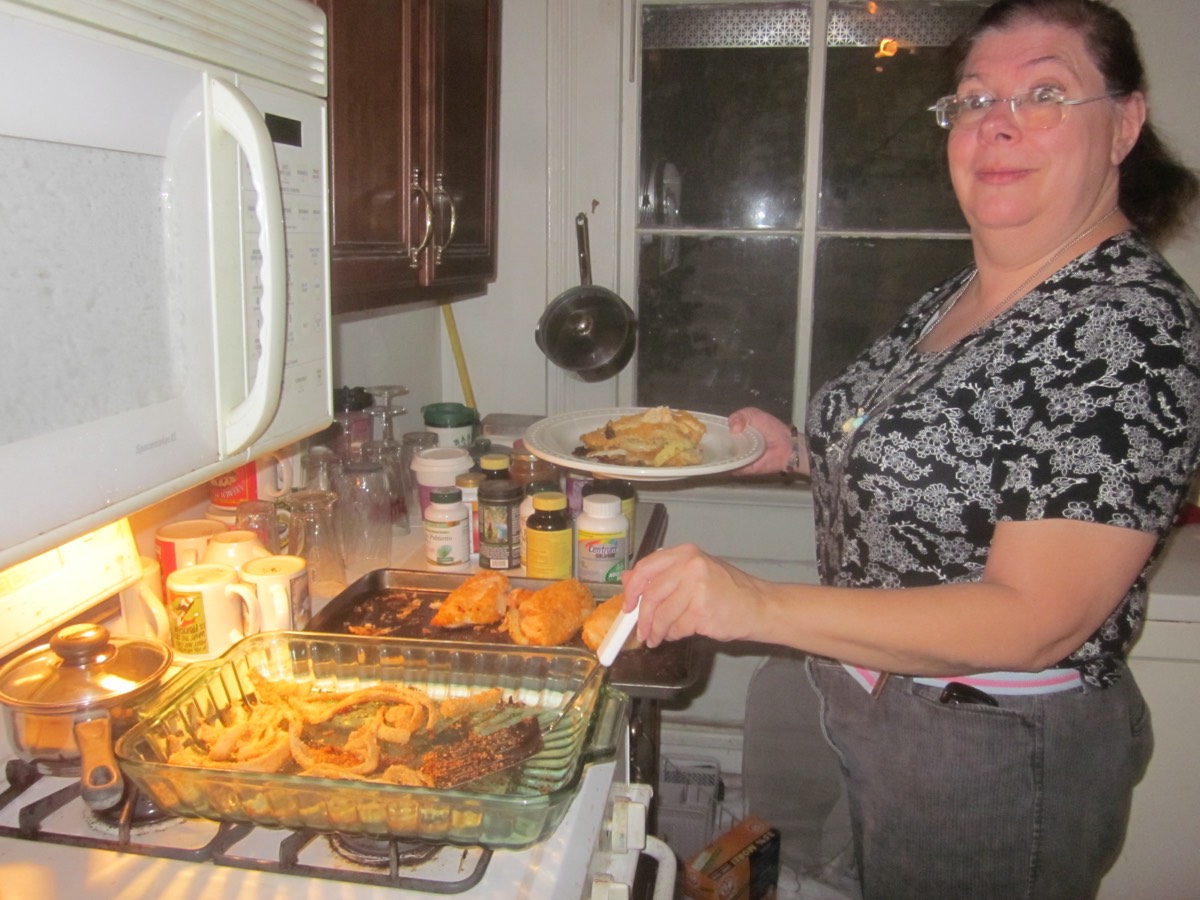
- Dinner 21 Jan 2013 Hollie in the KitchenWikimedia Commons · The photo, CC BY 2.0 (Infrogmation of New Orleans)
General information, not medical advice. This was a one-off survey that shows links, not causes, and it tested no diet. If you want help making home cooking work around your time, budget or a health condition, a registered dietitian can help.
Analysis by NutroPractic from the sources listed. Written for general readers; it does not replace advice from your own doctor.
From our articles
Read, then eat a little better
Plain-language guides on nutrition and wellness, backed by research.

Women's health
Inositol for PCOS: the 40:1 ratio, trial doses, and food milligrams
Why do randomized trials in polycystic ovary syndrome prioritize the 40:1 myo to D-chiro inositol ratio? Here is the science behind the ovarian epimerase paradox, clinical ovulation and insulin metrics, and why cantaloupe cannot replace 4,000 mg trial powder.
21 Nov 2026

Everyday eating
Extra virgin olive oil polyphenols: the EU health claim, smoke point myths, and cooking stability
Does extra virgin olive oil degrade when cooked? What does the EU 5 mg polyphenol health claim require, how does oleocanthal act like ibuprofen, and why does oxidative stability matter more than smoke point in domestic frying? Here is the clinical and culinary data.
21 Nov 2026

Food and nutrition
L-theanine and caffeine: what cognitive trials measured on sustained attention, and milligrams in matcha vs green tea
Combining L-theanine with caffeine produces clean focus without caffeine jitters. Here is what randomized trials measured on attention-switching, EEG alpha brain waves, and the exact milligrams across ceremonial matcha, culinary powder, gyokuro, and sencha.
20 Nov 2026
Newsfeed for your website
Want this feed on your website?
Add it to any site with one copy-and-paste snippet. No sign-up, and it updates itself every hour.
Start with a virtual consultation
Tell Dr. Triveni what you want to change. You will leave with a clear next step, whether you are in Toronto, London, New York or Chennai.