Food choices · October 23, 2026
Tell people a mostly-plant diet saves money or the planet and almost nothing changes. Tell them it lowers the risk of dying early and agreement jumps 17 points, but only among people who weren't already keen
Economists at the University of Warwick showed 303 British adults the same flexitarian diet with one of four messages: nothing extra, money saved, health or carbon. Only the health message moved intentions, by about 17 percentage points. It worked best on people who scored low on openness and conscientiousness, and did nothing for those who scored high.
A flexitarian diet is the compromise version of eating less meat: mostly plants, with moderate amounts of meat, fish, eggs and dairy rather than none. Modelling studies credit it with lower premature death rates, lower greenhouse gas emissions and, in rich countries, a cheaper shopping bill. That gives anyone trying to sell the idea three different pitches. Three economists at the University of Warwick wanted to know which one actually changes minds, and for whom. Their experiment was published in Frontiers in Nutrition on 15 October.
In June 2025 they recruited 412 adults in the UK through Prolific, an online panel that pays people to take part in research. People who already followed a structured diet such as vegetarian or vegan were taken out, along with a few who failed attention checks or left questions blank, leaving 303. Everyone first answered a short ten-item personality test covering the Big Five traits. Then each person read a standard description of a flexitarian diet, randomly paired with one of four messages: no extra information (71 people), the yearly money it could save (76), its lower risk of premature death (80), or its lower diet-related CO2 emissions (76). Finally they were asked whether they would agree to start a flexitarian diet that day.
Across the whole sample 45.9% agreed or strongly agreed. Against the group who got no extra information, the health message raised the chance of saying yes by about 17 percentage points, a clear effect. The environmental message nudged it up by about 9.5 points, and the money message by under 1 point; neither was distinguishable from chance. The single strongest predictor was not the message at all but what people already thought about the environment: each step up on a five-point environmental-attitudes index went with 15.3 points more agreement. People more comfortable with risk were also a little more willing.
Personality changed the picture. In the no-message group, people one standard deviation above average on openness were 12.8 points more likely to say yes, and on conscientiousness 9.1 points more. These people were largely persuaded already, and the health message added nothing for them: among high scorers on openness its effect was about minus 1 point. Among low scorers it was large, 36.5 points more agreement for low openness and 32.9 points for low conscientiousness. The authors read this as a ceiling effect rather than people pushing back against being told what to eat. Contrary to what the team expected, the money message did not do better among the lowest-income households, and the health message did not clearly differ by age.
The limits are spelled out. The outcome was a stated intention from one question on a screen, not a change in what anyone ate, and intentions are a weak guide to behaviour. The sample was small for testing interactions, so the personality findings are less certain than the headline result, and some of them held only in one of the statistical models. Personality was measured with two questions per trait, the panel was better educated than the UK as a whole, and the exact wording and figures in each message are in a supplement. The study was funded by Warwick's economics department and the authors declare no conflicts. We read the full open-access paper.
Four ways to pitch a flexitarian diet: online experiment with 303 UK adults, June 2025
+17 points
Higher chance of agreeing to start the diet after the health message, vs no message
+9.5 / +0.9
Environmental and money messages: neither different from chance
45.9%
Of all 303 participants agreed they would start a flexitarian diet that day
+36.5 vs −1.3
Health message effect for people low vs high in openness (points)
+15.3 points
More agreement per step up a five-point environmental-attitudes index
71 / 76 / 80 / 76
People given no message / money / health / environment
Study: Barile L, Kollmar F, Markoulakis A, 'Benefit framing, personality traits and intention to adopt a flexitarian diet', Frontiers in Nutrition 13, published 15 October 2026, doi 10.3389/fnut.2026.1848757, open access (CC BY 4.0). Between-subjects online vignette experiment in Qualtrics, June 2025, UK adults recruited via Prolific. 412 took part; 8 did not finish, 4 failed both attention checks, 88 following structured diets were excluded, and missing or 'prefer not to say' answers left 303. Personality: BFI-10 (two items per trait), standardised, measured before the message. Outcome: 'I would agree to take on a flexitarian diet starting today', agree or strongly agree coded 1. The diet description was based on Springmann and colleagues; message wording is in the paper's supplementary appendix. Probit models with robust standard errors, controlling for environmental morale, risk attitudes, cognitive reflection, age, gender, education and income; effects are average marginal effects in percentage points against the no-message group. Health framing about +17 points (significant); environmental about +9.5 and financial about +0.9 (not significant). In the no-message group, +1 SD openness 12.8 points and conscientiousness 9.1 points. Health framing at −1 SD openness 36.5 points (p < 0.001), at the mean 18.5, at +1 SD −1.3 (not significant); at −1 SD conscientiousness 32.9 points. No framing effect was significant at +1 SD on either trait. Environmental morale +15.3 points per unit. Hypotheses that framing effects would differ by income or age were not supported. Approved by the University of Warwick ethics process; funded by the Warwick economics department; no conflicts declared.
- The British were already cutting back before anyone pitched them a diet: in the National Diet and Nutrition Survey, average meat eaten per person fell from 103.7 g a day in 2008–09 to 86.3 g in 2018–19, including 13.7 g less red meat and 7.0 g less processed meat, while white meat rose by 3.2 g.
- The money argument is not made up: a 2021 modelling study across 150 countries found healthy and sustainable diets, flexitarian among them, were up to 22–34% cheaper than current diets on average in upper-middle and high-income countries, though at least 18–29% dearer in lower-income countries.
- In the same UK survey data, meat eating rose among people born after 1999 while it fell in most other groups, so the youngest adults were going against the trend.
- The ten-item personality test used here asks two questions for each of the Big Five traits: openness, conscientiousness, extraversion, agreeableness and neuroticism. It trades precision for speed, which is one reason the authors treat their personality results with caution.
- Results were reported as percentage points, not percent: for example, a rise from 40% to 57% agreeing is 17 points, which is a 42% relative increase.
- Benefit framing, personality traits and intention to adopt a flexitarian dietFrontiers in Nutrition · The paper, open access
- The global and regional costs of healthy and sustainable dietary patterns: a modelling studyThe Lancet Planetary Health (Springmann et al., 2021) · Cost of flexitarian and other diets in 150 countries
- Trends in UK meat consumption: analysis of data from years 1–11 (2008–09 to 2018–19) of the National Diet and Nutrition Survey rolling programmeThe Lancet Planetary Health (Stewart et al., 2021) · UK meat intake over eleven years
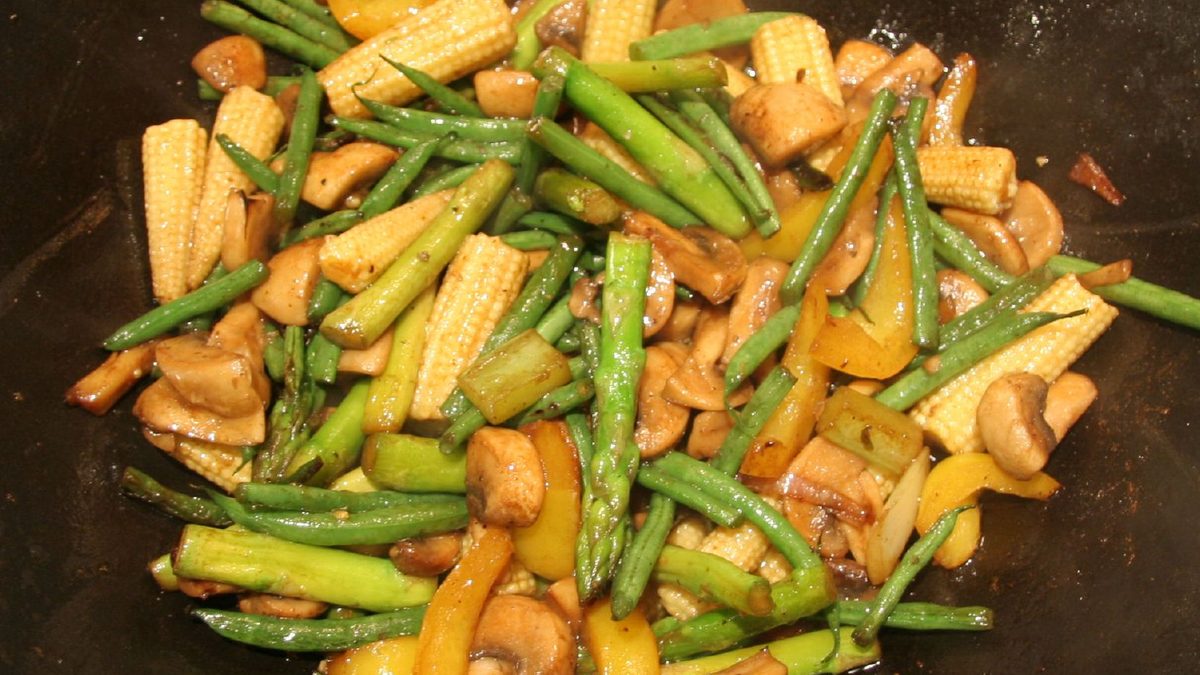
- Stir fry à la GabiWikimedia Commons · The photo, CC BY 2.0 (Brian Snelson)
General information, not medical advice. Eating mostly plants with some meat, fish, eggs or dairy suits most people, but if you are pregnant, have a medical condition, a history of disordered eating or take medicines affected by diet, talk to a doctor or registered dietitian before making big changes. Cutting animal foods sharply can leave gaps in vitamin B12, iron, iodine and calcium unless they are planned for.
Analysis by NutroPractic from the sources listed. Written for general readers; it does not replace advice from your own doctor.
From our articles
Read, then eat a little better
Plain-language guides on nutrition and wellness, backed by research.

Women's health
Inositol for PCOS: the 40:1 ratio, trial doses, and food milligrams
Why do randomized trials in polycystic ovary syndrome prioritize the 40:1 myo to D-chiro inositol ratio? Here is the science behind the ovarian epimerase paradox, clinical ovulation and insulin metrics, and why cantaloupe cannot replace 4,000 mg trial powder.
21 Nov 2026

Everyday eating
Extra virgin olive oil polyphenols: the EU health claim, smoke point myths, and cooking stability
Does extra virgin olive oil degrade when cooked? What does the EU 5 mg polyphenol health claim require, how does oleocanthal act like ibuprofen, and why does oxidative stability matter more than smoke point in domestic frying? Here is the clinical and culinary data.
21 Nov 2026

Food and nutrition
L-theanine and caffeine: what cognitive trials measured on sustained attention, and milligrams in matcha vs green tea
Combining L-theanine with caffeine produces clean focus without caffeine jitters. Here is what randomized trials measured on attention-switching, EEG alpha brain waves, and the exact milligrams across ceremonial matcha, culinary powder, gyokuro, and sencha.
20 Nov 2026
Newsfeed for your website
Want this feed on your website?
Add it to any site with one copy-and-paste snippet. No sign-up, and it updates itself every hour.
Start with a virtual consultation
Tell Dr. Triveni what you want to change. You will leave with a clear next step, whether you are in Toronto, London, New York or Chennai.