Infant feeding · October 30, 2026
306 new fathers in Shanghai rated how sure they felt about helping with breastfeeding. Their weakest point: telling whether the baby had had enough
A survey on a Shanghai maternity ward caught fathers two or three days after the birth, before mother and baby went home. Most cared about breastfeeding, yet fewer than half had been to a class, and the dads who knew least about it were the least confident they could help. The one task almost all of them were unsure about is the question every new parent asks at 3 a.m.
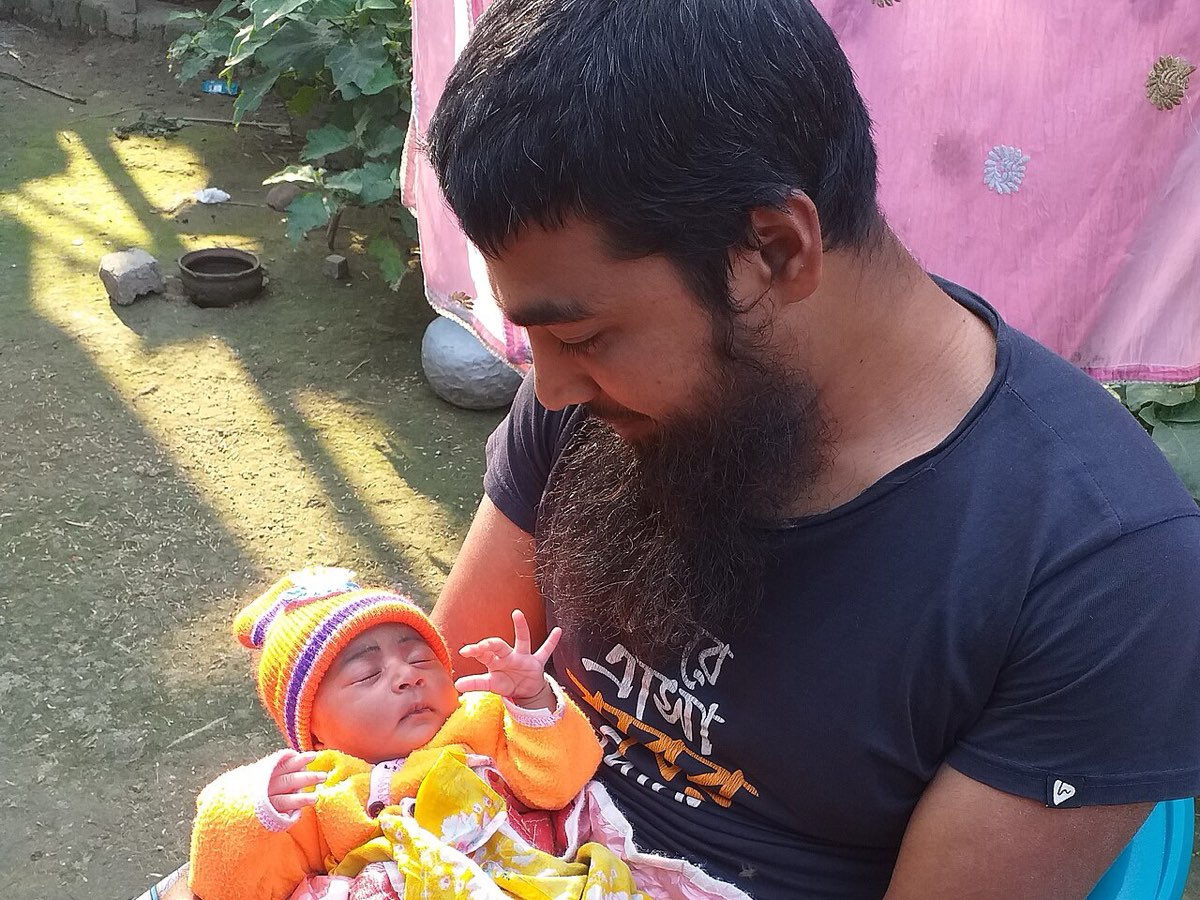
Breastfeeding advice is usually aimed at mothers, but the person standing next to her in the first weeks matters too. Studies have linked a partner's support with whether a mother starts breastfeeding and how long she keeps going. What sits underneath that support is confidence: a father who believes he can help is more likely to step in. A study published in Frontiers in Nutrition on 27 October looked at how confident new fathers actually feel, and whether they fall into distinct groups.
Researchers at Shanghai First Maternity and Infant Hospital, part of Tongji University, approached fathers on the postnatal wards between September 2024 and February 2025. Most filled in the questionnaire on the second or third day after the birth, before their partner went home. Of 355 questionnaires, 49 were thrown out for being rushed (under two minutes) or answered in a straight line, leaving 306 fathers with an average age of 31.7. Seven in ten had a bachelor's degree or higher and three quarters were first-time fathers. They answered the 14-item Father Support Breastfeeding Self-Efficacy Scale, a short form developed in Canada, where each item runs from 1 (not at all confident) to 5 (very confident), plus a 17-question knowledge quiz on the benefits and practical skills of breastfeeding.
On paper, the fathers were on board: 95.5% said breastfeeding was important and 51.3% hoped their baby would be exclusively breastfed after discharge. Only 44.8% had gone to a breastfeeding class with their partner before the birth. The average confidence score was 53 out of 70, and the item that scored lowest was "I can help my spouse determine whether the baby is fully fed", at 3.51 out of 5. The authors point to earlier research showing that fathers often miss out on exactly this kind of practical teaching.
A statistical method called latent profile analysis sorted the men into three groups. About two thirds (64.7%) sat in the middle, with an average score of 54. Close to one in five (18.6%) were in a low-confidence group averaging 37, and one in six (16.7%) were in a high group averaging 67. The groups ran largely parallel across the 14 questions, so the authors read them mainly as low, medium and high levels of the same confidence rather than different kinds of father. The low group scored lowest on the knowledge quiz (10.5 out of 17, against 12.5 and 13.6), and only 26.3% of them had been to a class, against 66.7% of the high group. They also more often said their partner's milk supply was low, that she was in pain or that she was worn out.
When all eight factors went into one model, three things held up. Each extra point on the knowledge quiz went with about 10% lower odds of being in the low group rather than the middle one. Fathers who said breastfeeding wasn't important had more than nine times the odds of being in the low group, though only 14 men gave that answer and the range around the figure is very wide. And fathers who called breastfeeding only "generally" rather than "very" important, or who expected anything other than exclusive breastfeeding, were less likely to be in the high group. Class attendance, the mother's pain, tiredness and milk supply didn't stand out once the rest were accounted for, and age, education and income changed nothing.
The study has clear limits, which the authors spell out. It was a one-off survey, so it can't say whether knowledge builds confidence or confident fathers simply learn more, or whether low confidence colours how a father sees his partner's milk supply. Everyone came from one well-resourced hospital in Shanghai, the mothers' pain, tiredness and milk supply were the fathers' own impressions, and nobody checked what the fathers actually did once the family got home or how long the babies were breastfed. The authors suggest the three groups could help nurses spot the fathers who need more help, and say whether teaching fathers alongside mothers changes anything is a question for future trials.
A latent profile analysis of father support breastfeeding self-efficacy in the early postpartum period: a cross-sectional study (Frontiers in Nutrition, 2026)
306
Fathers surveyed on the postnatal wards of a Shanghai maternity hospital, mostly two to three days after the birth
95.5% vs 44.8%
Said breastfeeding was important, against had been to a breastfeeding class with their partner
53 of 70
Average confidence score on the 14-item fathers' breastfeeding support scale
3.51 of 5
Lowest-scoring item: "I can help my spouse determine whether the baby is fully fed"
18.6% / 64.7% / 16.7%
Fathers in the low, moderate and high confidence groups (average scores 37, 54 and 67)
26.3% vs 66.7%
Had been to a breastfeeding class, low confidence group against high confidence group
Cross-sectional survey of a convenience sample at one tertiary hospital, so it shows associations, not cause and effect. Groups found by latent profile analysis in Mplus 8.3 (entropy 0.977); factors linked to group membership tested with the three-step (R3STEP) multinomial method. In that model, knowledge (OR 0.90 per point for the low vs moderate group), seeing breastfeeding as not important (OR 9.44, 95% CI 1.65 to 53.91, only 14 fathers), seeing it as generally rather than very important (OR 0.18 for the high group) and expecting non-exclusive feeding (OR 0.38 for the high group) were significant; class attendance was not. Maternal milk supply, pain and fatigue were reported by the fathers. Figures from the open-access article (CC BY 4.0).
- The fathers' scale was adapted in 2018 by Canadian researchers from the Breastfeeding Self-Efficacy Scale, a questionnaire first written for mothers.
- The paper cites China's national surveillance figure of 34.9% exclusive breastfeeding for babies under 6 months, below the global average of 48%.
- The World Health Organization recommends breastfeeding alone for the first 6 months and continuing alongside other foods to 2 years or beyond.
- 32 of the 355 questionnaires were finished in under two minutes and thrown out: in pilot runs, even the research team needed about three minutes to answer it properly.
- A latent profile analysis of father support breastfeeding self-efficacy in the early postpartum period: a cross-sectional studyFrontiers in Nutrition · The study, published 27 October 2026 (open access, CC BY 4.0); figures from the abstract, results (Tables 1 and 5), discussion and limitations
- Full textFrontiers · Article page with the profile figure and all tables
- New born baby with fatherWikimedia Commons · The image, CC0; an illustration, not a family from the study
General information, not medical advice. This survey can't show that classes or more knowledge make fathers more helpful or babies breastfeed longer. If you're unsure whether your baby is feeding well, ask your midwife, health visitor, lactation consultant or doctor.
Analysis by NutroPractic from the sources listed. Written for general readers; it does not replace advice from your own doctor.
From our articles
Our guides on this subject
Plain-language guides on nutrition and wellness, backed by research.
Women's health
Eating in pregnancy: fish, caffeine, cheese and what you really need to avoid
Most fish is encouraged in pregnancy, not banned: 8-12 oz a week from the low-mercury list. The mercury numbers per fish, what 200 mg of caffeine looks like in real cups, which cheeses carry the listeria risk and how many cases there actually are, why liver is on the list, and how much weight to gain for your BMI.
29 Oct 2026
Women's health
Folic acid before pregnancy: why it has to start before you know, and who needs the higher dose
The neural tube closes 26 to 28 days after conception, about six weeks after the last period and before many people know they are pregnant. Folic acid cut neural tube defects by about 72% in the 1991 MRC trial, yet only about a third of women take it beforehand. The dose, who needs 4 or 5 mg, what changed for higher BMI, fortified flour from the US to the UK's 2026 law, folate foods and the B12 link.
25 Oct 2026
Diabetes
Potatoes and blood sugar: boiled, cooled, mashed or fried, and what the cohorts and trials found
Fries were linked to 20% higher diabetes risk per three servings a week in 205,000 US adults; boiled, baked and mashed potatoes to almost none. GI by cooking method, resistant starch in grams after chilling, the glycaemic load of a potato against a cup of rice, and how to fit aloo into an Indian plate.
30 Oct 2026
Newsfeed for your website
Want this feed on your website?
Add it to any site with one copy-and-paste snippet. No sign-up, and it updates itself every hour.
Start with a virtual consultation
Tell Dr. Triveni what you want to change. You will leave with a clear next step, whether you are in Toronto, London, New York or Chennai.