Energy drinks · October 20, 2026
404 students at an Italian university, most of them training for health careers: more than a third took supplements and over a quarter drank energy drinks, yet only 17 did both. The two habits came from different places
You might expect the student with a can of energy drink in one hand to have a tub of protein powder at home. In a survey at a university in southern Italy, that person barely existed. Supplements went with the gym, mostly weight training; energy drinks went with being male, drinking more coffee and playing in a sports team.
Energy drinks and dietary supplements are usually studied apart, but they are sold with similar promises, more energy and better performance, and sometimes share ingredients such as caffeine and B vitamins. A team at the G. d'Annunzio University of Chieti-Pescara asked whether young adults who use one also use the other, and who reaches for each. Their paper appeared in Nutrients on 15 October.
The data are not new. They come from an online survey about caffeine that ran between February and September 2023, shared on social media and in lectures, and the authors re-analysed it for this question. 404 students answered. Three in four were women, their average age was 22, and 60% were studying for a health profession, with another 12% in medicine or dentistry and 2.5% in pharmacy. The questions covered the past 30 days.
148 students (36.7%) said they took a supplement regularly. Protein and amino acid products led with 50 users, then vitamins and minerals (38), carbohydrate products (28), probiotics (20) and immune-boosting products (10). More than half of the users (82) took them to improve performance; 52 to improve their general health, 12 to prevent disease and only 2 for a medical reason.
113 students (27.9%) drank energy drinks, but mostly not often: 73 of them less than once a week, 29 one to three times a week and 11 more than three times a week. Only 17 students, 4.2% of the sample, both drank energy drinks and took supplements.
Exercise split the two habits cleanly. Of the 128 students who exercised regularly, 79 (62%) took a supplement, against 69 of 276 (25%) who did not exercise. Energy drinks did not follow exercise at all: 28.1% of the active students drank them and 27.9% of the inactive ones. When the authors put sex, age, coffee, smoking, BMI and type of exercise into one model, students whose main exercise was weight training had about 32 times the odds of taking a supplement compared with inactive students, and aerobic exercisers about 3 times. Men had about half the odds of women of using supplements but more than three times the odds of drinking energy drinks. Each extra daily cup of coffee went with 28% higher odds of an energy drink habit, and playing in a sports team with about 6.6 times the odds.
Some of those numbers rest on very few people. Only 11 students named a team sport, so the team estimate could sit anywhere from about 1.8 to 24, and the weight-training figure has a range from about 9 to 111. The paper's own figures also disagree in places: the abstract gives the range for men and energy drinks as 1.94 to 6.79 while the table and discussion give 2.22 to 5.94, and the abstract and table differ for aerobic exercise too. The main finding, that supplements track the gym and energy drinks do not, holds either way.
A side result: 45% of these students, most of them future health workers, said they smoked, and two thirds did no regular exercise. The authors call that a reminder that a health degree does not make healthy habits automatic.
The limits are the usual ones for a survey like this, and the authors list them. It was one university, students chose to answer, women and health students were over-represented, and no response rate could be worked out. The questionnaire was not validated, everything was self-reported, and the data are three years old. A single snapshot cannot say whether training leads people to supplements or the other way round. The study had no outside funding and the authors declare no conflicts of interest.
Energy drink and supplement use in the past 30 days among 404 students at one university in southern Italy (survey February to September 2023)
36.7%
Took a dietary supplement regularly (148 of 404); protein and amino acids were the most common (50 users)
27.9%
Drank energy drinks (113 of 404); 73 of them less than once a week, 11 more than three times a week
4.2%
Did both (17 of 404)
62% vs 25%
Supplement use in students who exercised regularly against those who did not
28.1% vs 27.9%
Energy drink use in the same two groups: no difference
55%
Of supplement users, took them to improve performance (82 of 148); 2 for a medical reason
Study: Vaccaro F, Di Martino G, Di Giovanni P, Staniscia T, 'Consumption of Energy Drinks and Use of Dietary Supplements Among Italian University Students: A Cross-Sectional Study', Nutrients 2026, 18(20), 3386, published 15 October 2026, doi 10.3390/nu18203386 (open access, CC BY). Secondary analysis of the CCAP caffeine survey at G. d'Annunzio University of Chieti-Pescara: web questionnaire shared on social media and in lectures, February to September 2023, convenience sample, no response rate. 404 students, 74.8% women, mean age 22.1 (SD 3.9), 60.2% health professions, 11.9% medicine and dentistry, 2.5% pharmacy, 0.9% food science, 24.5% non-health courses; 93.3% from southern Italy. 45.3% smokers, 77.5% drank coffee daily, 31.7% exercised regularly (weight training 76, aerobic 33, team sport 11, other 8). 30-day recall; questionnaire not validated. Supplement types among 148 users: protein/amino acids 50 (33.8%), vitamins and minerals 38 (25.6%), carbohydrate-based 28 (18.9%), probiotics 20 (13.5%), immune boosting 10 (6.8%), fatty acids 2 (1.4%). Reasons: performance 82 (55.4%), overall health 52 (35.2%), prevent disease 12 (8.1%), clinical 2 (1.3%). Energy drink frequency among 113 users: under once a week 73 (64.6%), 1 to 3 times a week 29 (25.7%), more than 3 times a week 11 (9.7%). Supplement use: active 79/128 (61.7%) against inactive 69/276 (25.0%), p < 0.001. Energy drinks: 36/128 (28.1%) against 77/276 (27.9%), p = 0.962. Co-use: 9/128 (7.1%) against 8/276 (2.9%), p = 0.054. Multivariable logistic regression (adjusted for sex, age, coffee cups a day, smoking, BMI, main type of exercise), energy drinks: male OR 3.63 (95% CI 2.22 to 5.94 in the table and discussion, 1.94 to 6.79 in the abstract), coffee OR 1.28 per cup (1.02 to 1.61), team sport OR 6.59 (1.79 to 24.2; abstract 1.76 to 24.60). Supplements: weight training OR 32.2 (9.36 to 111.2), aerobic OR 3.03 (abstract 1.34 to 6.85; the table's confidence intervals for this row are misaligned), male OR 0.50 (0.28 to 0.87). Age, smoking and BMI not associated with either. Co-use too rare for a multivariable model; in univariate models only younger age was associated. Firth penalised regression gave the same direction and significance. No external funding; no conflicts declared.
- The European Food Safety Authority judged in 2015 that, for healthy adults, single doses of caffeine up to 200 mg and up to 400 mg across a day raise no safety concerns; a standard 250 ml can of Red Bull has 80 mg.
- In the EU, any drink other than tea or coffee with more than 150 mg of caffeine per litre must carry the words 'High caffeine content. Not recommended for children or pregnant or breast-feeding women', with the amount per 100 ml.
- Energy drinks began in Asia: Japan's Lipovitan D went on sale in 1962, and Red Bull, adapted from a Thai tonic, launched in Austria in 1987.
- In the EU, food supplements are regulated as foods under a 2002 directive, so they do not need approval showing they work before going on sale, and the rules for herbal ones still differ from country to country.
- Consumption of Energy Drinks and Use of Dietary Supplements Among Italian University Students: A Cross-Sectional StudyNutrients, October 2026 · The study: full text, open access
- CaffeineEuropean Food Safety Authority · How much caffeine is considered safe for adults, in pregnancy and for children
- Regulation (EU) No 1169/2011 on food information to consumersEUR-Lex · Annex III sets the 'high caffeine content' label
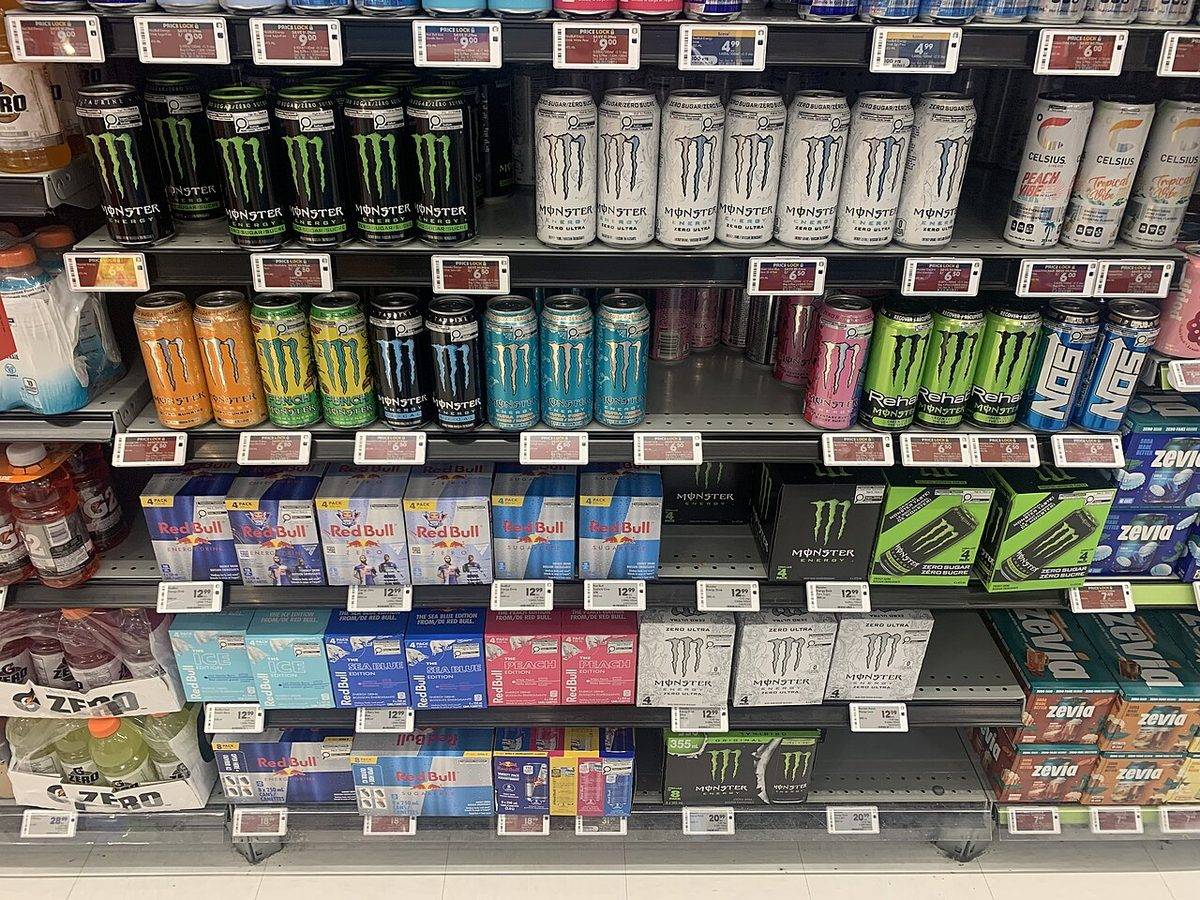
- Energy Drink DisplayWikimedia Commons · The photo, CC0
General information, not medical advice. This survey describes habits; it did not test whether energy drinks or supplements help or harm. If you have a heart condition or high blood pressure, are pregnant or take regular medication, check with a doctor or pharmacist before using energy drinks or supplements.
Analysis by NutroPractic from the sources listed. Written for general readers; it does not replace advice from your own doctor.
From our articles
Our guides on this subject
Plain-language guides on nutrition and wellness, backed by research.
Children's nutrition
Feeding a teenage athlete: energy, iron, calcium and the sports drink question
Teenage athletes are growing and training at the same time, and under-eating (REDs) is found in up to 80% of female and 70% of male athletes in studies. A worked energy example for a 15-year-old footballer, protein and carbohydrate targets, iron and calcium in the growth spurt, when sports drinks help and when they are dessert, and the supplements to skip.
20 Oct 2026

Women's health
Inositol for PCOS: the 40:1 ratio, trial doses, and food milligrams
Why do randomized trials in polycystic ovary syndrome prioritize the 40:1 myo to D-chiro inositol ratio? Here is the science behind the ovarian epimerase paradox, clinical ovulation and insulin metrics, and why cantaloupe cannot replace 4,000 mg trial powder.
21 Nov 2026

Everyday eating
Extra virgin olive oil polyphenols: the EU health claim, smoke point myths, and cooking stability
Does extra virgin olive oil degrade when cooked? What does the EU 5 mg polyphenol health claim require, how does oleocanthal act like ibuprofen, and why does oxidative stability matter more than smoke point in domestic frying? Here is the clinical and culinary data.
21 Nov 2026
Newsfeed for your website
Want this feed on your website?
Add it to any site with one copy-and-paste snippet. No sign-up, and it updates itself every hour.
Start with a virtual consultation
Tell Dr. Triveni what you want to change. You will leave with a clear next step, whether you are in Toronto, London, New York or Chennai.