Hydration · October 29, 2026
Drink on schedule or when thirsty? 24 small trials of long rides and runs were pooled. In races against the clock, the water made no clear difference to finishing times
Every long race has its water stations, and every runner has a theory about them. A new review gathered the randomised trials that tested drinking during at least an hour of running or cycling. Bodies ran a little cooler and hearts a little slower with fluid. Whether anyone got to the finish sooner is a different story.
How much to drink during a long run or ride is one of the oldest arguments in endurance sport. One camp says plan it: weigh yourself, work out your sweat rate and drink to a target. The other says thirst is a good enough guide. Drinking too little lets the body's water run down, and drinking far too much can dilute the blood's sodium, which is its own danger. Researchers in Shijiazhuang and Jilin, China, set out to see what the randomised trials actually show, and published a systematic review with meta-analysis in Frontiers in Nutrition on 27 October.
They searched six databases up to 1 June 2026 for trials in healthy adults doing at least 60 minutes of continuous endurance exercise, in which the drinking strategy itself was assigned at random. Twenty-four studies made the cut, all crossover trials where the same people tried each approach, with 6 to 20 participants each and 225 in total. Most were cyclists or runners in a laboratory, often in heat of 30 °C or more. Of the 190 people whose sex was reported, only 20 were women.
Drinking against little or no fluid gave a split picture. In self-paced tests, where people rode or ran a set distance or time as hard as they could, performance was no different on average: minus 0.1%, with a range from 3.6% worse to 3.5% better (four studies, 30 people). In open-ended tests, where people kept going until they couldn't, they lasted about 34% longer with fluid, but that came from only three studies and 21 people, and the range of results a new study might expect still included no benefit at all.
The body's readings leaned towards drinking. Core temperature ended about 0.4 °C lower on average (nine studies) and heart rate about 7 beats a minute lower (12 studies). Both results varied a lot from trial to trial. Planned drinking against drinking to thirst made no clear difference to self-paced performance (0.7%, three studies, 27 people). It did mean people finished having lost about 1.5 percentage points less of their body weight, which the authors point out is simply what happens when you drink more, not a benefit in itself. There was too little evidence to say anything about how much sodium helps.
The authors rate every main result as very low certainty. The trials were small and mostly men, and the authors are open about how the analysis changed after it was registered and that parts of their search records weren't kept. What the review does show is narrower than either camp might like: drinking during long exercise eases some of the strain on the body, but these trials can't name an ideal amount, and they don't show that drinking to a plan beats drinking to thirst when the clock is running.
Drinking strategies during at least 60 minutes of endurance exercise: systematic review and meta-analysis of randomised trials (Frontiers in Nutrition, 2026)
24
Randomised crossover trials kept, each with 6 to 20 people, 225 in all; 21 went into the pooled analyses
20 of 190
Participants who were women, among those whose sex was reported
-0.1%
Difference in self-paced performance with fluid vs little or none (95% CI -3.6% to 3.5%; 4 studies, 30 people)
+34%
Longer to exhaustion with fluid (11.9% to 60.7%; 3 studies, 21 people); prediction interval -21% to +129%
-0.38 °C
Core temperature with fluid vs little or none (9 studies); heart rate 6.8 beats/min lower (12 studies)
+0.7%
Self-paced performance, planned drinking vs drinking to thirst (-4.4% to 6.2%; 3 studies, 27 people)
Systematic review with meta-analysis (PROSPERO CRD420261460972). Six databases searched to 1 June 2026 for randomised trials in healthy adults doing at least 60 min of continuous endurance exercise. Random-effects models (REML with modified Hartung-Knapp intervals); performance as ratio of means, physiology as mean differences. Fluid vs no or minimal fluid: core temperature -0.38 °C (95% CI -0.74 to -0.02; I² 87%); heart rate -6.82 beats/min (-11.16 to -2.48; I² 83%); body-mass loss -2.63 percentage points (7 studies). Planned or individualised vs self-regulated drinking: body-mass loss -1.47 percentage points (-1.96 to -0.99; 4 studies). Sodium at matched fluid volume: plasma-volume change 1.78 percentage points (-5.24 to 8.81; 2 studies). All critical and important results graded very low certainty. No external funding reported. Published 27 October 2026, open access (CC BY).
- The trials split performance into two kinds of test. In a time trial you cover a set distance as fast as you can, much like a race; in a time-to-exhaustion test you hold a fixed pace until you stop. Exhaustion tests vary more from one day to the next, which is one reason the authors kept the two apart.
- One of the pooled trials had cyclists drink 3.6 litres over two hours at about 35 °C, against 0.2 litres in the comparison ride.
- Weighing yourself before and after a long session is the usual way to estimate sweat loss: each kilogram lost is roughly a litre of fluid, less whatever you drank along the way.
- Overdrinking during long events can lower blood sodium, a condition called exercise-associated hyponatraemia, which is why the review's introduction warns that more fluid isn't automatically better.
- Effects of during-exercise oral hydration strategies on endurance performance and thermophysiological strain: a systematic review with meta-analysisFrontiers in Nutrition · The review, published 27 October 2026; figures from the full text and its summary-of-findings table
- Registration CRD420261460972PROSPERO · The review's registration
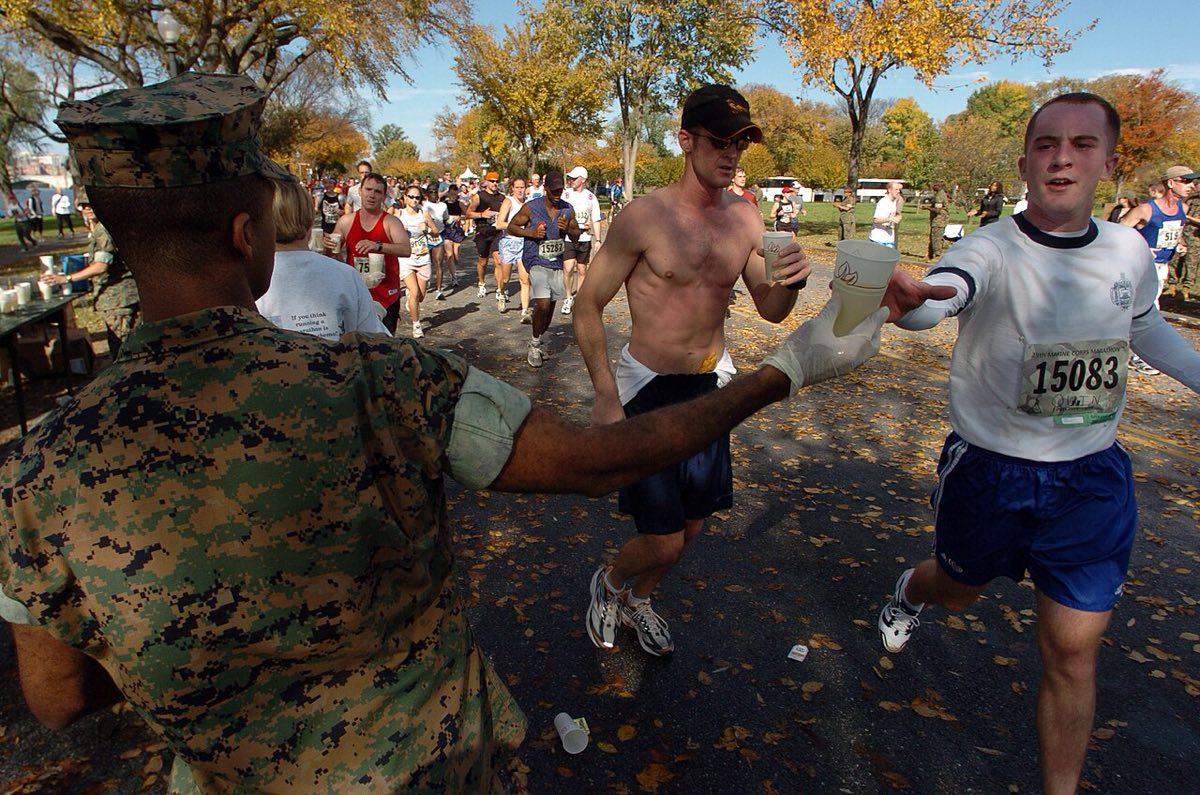
- U.S. Marines hand out water and sports drinks during the 29th annual Marine Corps MarathonWikimedia Commons · The image, public domain (U.S. Navy photo)
General information, not medical advice. This review pooled small trials, mostly in trained young men in a laboratory, and its authors rate the evidence as very low certainty. It doesn't set a drinking target for anyone. Drinking far more than you sweat can be dangerous, and people with heart or kidney conditions, or anyone told to limit fluids, should ask a doctor before changing how much they drink when they exercise.
Analysis by NutroPractic from the sources listed. Written for general readers; it does not replace advice from your own doctor.
From our articles
Read, then eat a little better
Plain-language guides on nutrition and wellness, backed by research.

Diabetes
Potatoes and blood sugar: boiled, cooled, mashed or fried, and what the cohorts and trials found
Fries were linked to 20% higher diabetes risk per three servings a week in 205,000 US adults; boiled, baked and mashed potatoes to almost none. GI by cooking method, resistant starch in grams after chilling, the glycaemic load of a potato against a cup of rice, and how to fit aloo into an Indian plate.
30 Oct 2026
Children's nutrition
Picky eaters aged 2 to 8: what feeding studies show works at the table
Fussy eating peaks between two and six and is usually a normal stage, not a parenting failure. Feeding trials show what moves it: small repeated tastes, eating together, no pressure and the right kind of reward. Here is how to use them, and the signs that mean it's more than picky eating.
30 Oct 2026
Women's health
PCOS and food: what the diet trials show for cycles, insulin and weight
PCOS affects about one woman in ten, and most are told to "lose weight" with little else. Here is what drives it, why insulin matters even in slim women, how much weight loss brings cycles back, what the low-GI and Mediterranean trials found, what inositol and metformin do, and which tests to ask for.
30 Oct 2026
Newsfeed for your website
Want this feed on your website?
Add it to any site with one copy-and-paste snippet. No sign-up, and it updates itself every hour.
Start with a virtual consultation
Tell Dr. Triveni what you want to change. You will leave with a clear next step, whether you are in Toronto, London, New York or Chennai.