Lung health · October 25, 2026
1,021 Koreans aged 65 and over blew into a spirometer: those with the best-scoring diets had slightly better airflow out of their lungs. But the gap per step up in diet score was just 28 mL, and the authors themselves say it may not matter clinically
Researchers at Yonsei University matched one day of food records against breathing tests from South Korea's 2024 national health survey, the first since lung tests restarted after the pandemic. Better diet scores went with a little more air blown out in the first second and less narrowing of the airways, but not with lung size or peak flow. A one-off snapshot, so it cannot show which came first.
Lungs lose some of their springiness with age, and breathing muscles weaken, so the amount of air older people can blow out falls year by year. Diet is one of the few things people can change, and earlier studies, mostly in the US and Europe, have linked healthier eating patterns to better lung function. Two researchers at Yonsei University College of Medicine in Seoul asked whether the same holds for older Koreans eating a Korean-style diet. Their study was published in the journal Nutrients on 22 October.
They used the 2024 Korea National Health and Nutrition Examination Survey, a nationally representative survey run by the Korea Disease Control and Prevention Agency, and the first round in which lung tests were done again after the COVID-19 pandemic. Of 1,896 people aged 65 and over, 18 with a history of lung cancer were left out, 670 had no valid lung test (some were not tested for safety reasons, others did not meet the quality rules) and 187 had missing data, leaving 1,021, with an average age of 71.6 and about half of them women. Diet was recorded by trained dietitians as everything eaten the previous day and scored on the Korean Healthy Eating Index, which runs from 0 to 100 across 14 items such as vegetables, fruit, protein foods, grains, salt, added sugar and saturated fat. The average score was 67.4.
Trained technicians measured five things with a spirometer, before any inhaler medicine: how much air people could blow out in total (forced vital capacity, average 2.95 litres), how much in the first second (FEV1, average 2.21 litres), the ratio of the two (average 75.2%, where a low ratio points to narrowed airways), the flow in the middle of the breath, and the peak flow. After adjusting for sex, age, income, schooling, marital status, exercise, alcohol, smoking, weight, height, high blood pressure, diabetes and heart disease, each step up of one standard deviation in diet score (about 11 points) went with 28 mL more FEV1, a ratio 0.54 percentage points higher and a mid-breath flow 0.057 litres per second faster. All three held after correcting for testing five outcomes at once. Total lung volume and peak flow showed no clear link.
The authors are frank about the size. An earlier study of older adults without COPD found FEV1 fell by about 43 mL, so the 28 mL here is smaller than that, and they write that statistical significance should not be read as clinical significance, though small differences can matter across a whole population. Their suggested explanation, that a better diet brings more antioxidants and less low-grade inflammation in the small airways, was not measured here and remains a hypothesis.
The limits are large. It is a single snapshot, so people in poorer health may simply eat worse rather than the other way round; one day of food records is a rough guide to usual eating; job and pollution exposures, other illnesses and inhaler use were not recorded; and the 875 people left out were older, poorer and had weaker lungs, which may bias the result. The authors call it preliminary and ask for long-term studies. The work was funded by the Korea Occupational Safety and Health Agency and Korea's National Bio Bigdata Project. We read the full open-access paper.
Korea National Health and Nutrition Examination Survey 2024: 1,021 adults aged 65+, diet score and spirometry (published 22 October 2026)
1,021
Adults aged 65 and over with a valid lung test and diet record, average age 71.6
67.4
Average Korean Healthy Eating Index score out of 100 (standard deviation 11.0)
+28 mL
More air blown out in the first second (FEV1) per 11-point higher diet score
+0.54
Percentage points higher FEV1/FVC ratio per 11-point higher diet score
+13 mL
Total lung volume (FVC) per 11-point higher score: no clear link
43 mL
FEV1 decline reported in an earlier study of older adults without COPD, for comparison
Source: Baek S-U, Yoon J-H, 'Association Between Dietary Quality and Pulmonary Function Among Older Adults: Results from the Korea National Health and Nutrition Examination Survey, 2024', Nutrients 2026;18(21):3467, published 22 October 2026, doi 10.3390/nu18213467, open access (CC BY). Yonsei University College of Medicine, Seoul. Cross-sectional; KNHANES 2024 (Korea Disease Control and Prevention Agency), 1,896 adults aged 65+ with the nutrition survey; excluded lung cancer history (18), no valid spirometry (670) and missing data (187). Diet: single-day 24-hour recall by trained dietitians, Korean Healthy Eating Index (14 items, 0-100), mean 67.41 (SD 10.97). Pre-bronchodilator spirometry (Vyntus Spiro, ATS/ERS standards): FVC 2.95 (0.72) L, FEV1 2.21 (0.54) L, FEV1/FVC 75.22 (7.68)%, FEF25-75% 1.93 (0.79) L/s, PEF 6.03 (1.73) L/s. Survey-weighted linear regression adjusted for sex, age, education, income, marital status, exercise, AUDIT-C, smoking pack-years, BMI, height, hypertension, diabetes and ischaemic heart disease; beta per 1 SD of KHEI: FVC 0.013 L (95% CI -0.016 to 0.041), FEV1 0.028 L (0.003 to 0.053), FEV1/FVC 0.539% (0.129 to 0.950), FEF25-75% 0.057 L/s (0.010 to 0.104), PEF 0.066 L/s (-0.018 to 0.149). Benjamini-Hochberg FDR-corrected p: 0.380, 0.048, 0.043, 0.043, 0.154. Crude FEV1 beta 0.046 L. Restricted cubic splines: no evidence of non-linearity. The 0.043 L FEV1 decline is from an earlier study of community-dwelling older adults without COPD cited by the authors. Limitations stated by the authors: cross-sectional design and possible reverse causation, residual confounding (occupational and environmental exposure, comorbidities), no respiratory medication data, single 24-hour recall, selection bias from 875 exclusions (older, lower income and education, lower FVC and PEF). Funding: Korea Occupational Safety and Health Agency (RS-2026-25549947) and the National Bio Bigdata Project (RS-2024-00462006).
- Chronic obstructive pulmonary disease (COPD) was the third leading cause of death worldwide in 2023, with 3.4 million deaths, about 6% of all deaths, according to the World Health Organization.
- Tobacco smoking accounts for over 70% of COPD cases in high-income countries, but only 30-40% in low- and middle-income countries, where household air pollution is a major risk factor.
- For a spirometry result to count in this survey, the two best blows had to agree within 150 mL for both total volume and the first second, with between two and eight attempts allowed.
- Association Between Dietary Quality and Pulmonary Function Among Older Adults: Results from the Korea National Health and Nutrition Examination Survey, 2024Nutrients (MDPI) · The study, open access, published 22 October 2026
- Chronic obstructive pulmonary disease (COPD) (fact sheet)World Health Organization · Global deaths, causes and risk factors
- Korea National Health and Nutrition Examination SurveyKorea Disease Control and Prevention Agency · The national survey whose data the study used
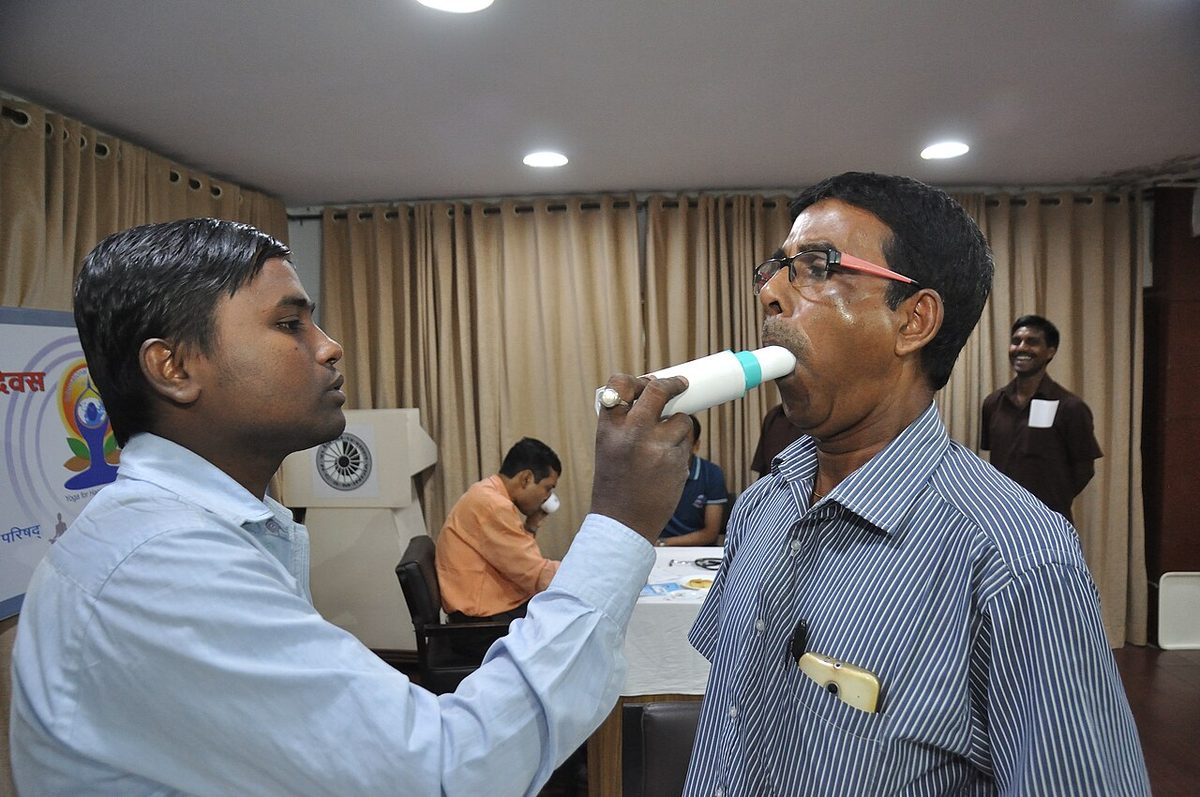
- Performing Spirometry - Health Check-up Camp - NCSM - Salt Lake City - KolkataWikimedia Commons · The photo, CC BY 3.0 (Biswarup Ganguly)
General information, not medical advice. This study shows an association at one point in time, not that a better diet improves lung function. If you are short of breath, have a cough that will not go away or are worried about your lungs, see your doctor. If you smoke, the World Health Organization names avoiding smoking and air pollution as the main ways to protect your lungs.
Analysis by NutroPractic from the sources listed. Written for general readers; it does not replace advice from your own doctor.
From our articles
Read, then eat a little better
Plain-language guides on nutrition and wellness, backed by research.

Women's health
Inositol for PCOS: the 40:1 ratio, trial doses, and food milligrams
Why do randomized trials in polycystic ovary syndrome prioritize the 40:1 myo to D-chiro inositol ratio? Here is the science behind the ovarian epimerase paradox, clinical ovulation and insulin metrics, and why cantaloupe cannot replace 4,000 mg trial powder.
21 Nov 2026

Everyday eating
Extra virgin olive oil polyphenols: the EU health claim, smoke point myths, and cooking stability
Does extra virgin olive oil degrade when cooked? What does the EU 5 mg polyphenol health claim require, how does oleocanthal act like ibuprofen, and why does oxidative stability matter more than smoke point in domestic frying? Here is the clinical and culinary data.
21 Nov 2026

Food and nutrition
L-theanine and caffeine: what cognitive trials measured on sustained attention, and milligrams in matcha vs green tea
Combining L-theanine with caffeine produces clean focus without caffeine jitters. Here is what randomized trials measured on attention-switching, EEG alpha brain waves, and the exact milligrams across ceremonial matcha, culinary powder, gyokuro, and sencha.
20 Nov 2026
Newsfeed for your website
Want this feed on your website?
Add it to any site with one copy-and-paste snippet. No sign-up, and it updates itself every hour.
Start with a virtual consultation
Tell Dr. Triveni what you want to change. You will leave with a clear next step, whether you are in Toronto, London, New York or Chennai.