Women's health · November 1, 2026
Two points on a 100-point diet score separated women newly diagnosed with PCOS from those without it. What a Mecca study of 300 women can and cannot say
Women recently diagnosed with polycystic ovary syndrome reported eating less fruit, fewer vegetables and less low-fat dairy than women without it. Those whose diets scored in the top third had 70% lower odds of having PCOS. But the gap was small, the design looks backwards, and the most surprising number points the other way.
Polycystic ovary syndrome is the most common hormonal condition in women of reproductive age, with global estimates of roughly 9 to 12 percent. It is diagnosed when two of three signs are present: irregular or absent ovulation, higher androgen levels (on a blood test or as signs such as excess hair growth), and many small follicles on an ovarian ultrasound. Diet comes up in almost every conversation about it, usually as single nutrients or single foods. A case-control study published on 30 October in Frontiers in Nutrition looked instead at the whole plate.
The team recruited 300 women aged 20 to 35 at Umm Al-Qura University Hospital in Mecca, Saudi Arabia. Half had been diagnosed with PCOS within the previous three months; the other half came from orthopaedic, ear-nose-throat and pre-surgery clinics, had regular cycles, and had blood tests and ultrasounds to rule PCOS out. Women on metformin, GLP-1 drugs, hormonal contraceptives or a special diet in the past three months were excluded. Trained interviewers took each woman through a 152-item food questionnaire validated for Saudi adults, covering the past year, and the answers were scored on the Diet Quality Index-International: up to 20 points for variety, 40 for adequacy (enough fruit, vegetables, grains, fibre, protein, calcium, iron and vitamin C), 30 for moderation (fat, saturated fat, cholesterol, sodium and 'empty calorie' foods) and 10 for balance between macronutrients and fats.
The women with PCOS scored a median of 68, against 70 for the others. The difference came from adequacy and moderation; variety and balance were the same. Women with PCOS reported a median of 430 g of fruit a day against 500 g, 300 g of vegetables against 362 g, and 565 g of low-fat dairy against 670 g. When everyone was split into thirds by score, the top third (above 70.5) held 35 women with PCOS and 65 without; the bottom third (66 or less) held the reverse. After allowing for age, BMI, smoking, fibre, physical activity and total calories, a top-third diet went with 70% lower odds of having PCOS (odds ratio 0.30). Sweets, sugary drinks, refined grains and red meat did not differ significantly between the groups.
Two details deserve a second look. First, the women with PCOS got slightly more of their calories from unsaturated fats, the kind usually called healthy (13.0% against 12.2% from monounsaturated fat), which the authors suggest may reflect which foods the fat came from rather than how much. Second, the whole sample scored well on variety and poorly on moderation, a median of about 7 out of 30 in both groups, so 'higher quality' here mostly means a bit more fruit, vegetables and low-fat dairy within diets that scored poorly on the fat, salt and empty-calorie limits for everyone. The authors list the limits plainly: diet and diagnosis were measured at the same time, so the study cannot show which came first; food questionnaires depend on memory; the women came from one hospital; PCOS types were not analysed separately; and no hormone or insulin tests were linked to diet scores. The best use of the finding is as one more reason the advice usually given in PCOS clinics, more fruit and vegetables and fewer energy-dense, nutrient-poor foods, is worth taking seriously, not as proof that diet prevents the condition.
Diet quality and polycystic ovary syndrome in 300 women at a Mecca hospital: a case-control study (Frontiers in Nutrition, 30 October 2026)
300
Women aged 20 to 35: 150 diagnosed with PCOS in the previous three months, 150 without
68 vs 70
Median Diet Quality Index-International score (out of 100), women with PCOS versus without
0.30
Adjusted odds ratio for PCOS, top third of diet scores versus bottom third (95% CI 0.16 to 0.56)
430 vs 500 g
Median fruit a day reported by women with PCOS versus without
300 vs 362 g
Median vegetables a day, same comparison
565 vs 670 g
Median low-fat dairy a day, same comparison
6.5 vs 7
Median moderation score out of 30 in each group: low for everyone
A case-control study: diet was asked about after diagnosis and covered the previous year, so it shows an association, not cause and effect. Adjusted for age, BMI, smoking, fibre, physical activity and energy intake. Gram figures come from a food frequency questionnaire, which tends to overestimate amounts; compare the groups with each other rather than with dietary guidelines. One hospital in Saudi Arabia.
- The Rotterdam criteria used here date from 2003 and need only two of three features, so two women can both have PCOS while sharing just one symptom.
- An odds ratio of 0.30 is not the same as a 70% lower risk of developing PCOS: a case-control study picks women because they already have the condition or not, so it compares the odds of having it, and it cannot say how many women eating either way would go on to be diagnosed.
- The Diet Quality Index-International was designed in 2003 so that diets in very different countries could be scored on one scale; it was first tested on data from China and the United States.
- In this study, nearly every woman got the full 20 points for variety: eating many kinds of food was not what set the groups apart.
- Association between Diet Quality Index-International and the odds of polycystic ovary syndrome: a case-control studyFrontiers in Nutrition, 30 October 2026 · Open-access original research (CC BY): methods, Tables 1 to 3 with scores, food intakes and odds ratios, and the limitations.
- Full text on the journal siteFrontiers · Table 2 lists every food group compared; Table 3 gives the counts of women in each third of diet score.
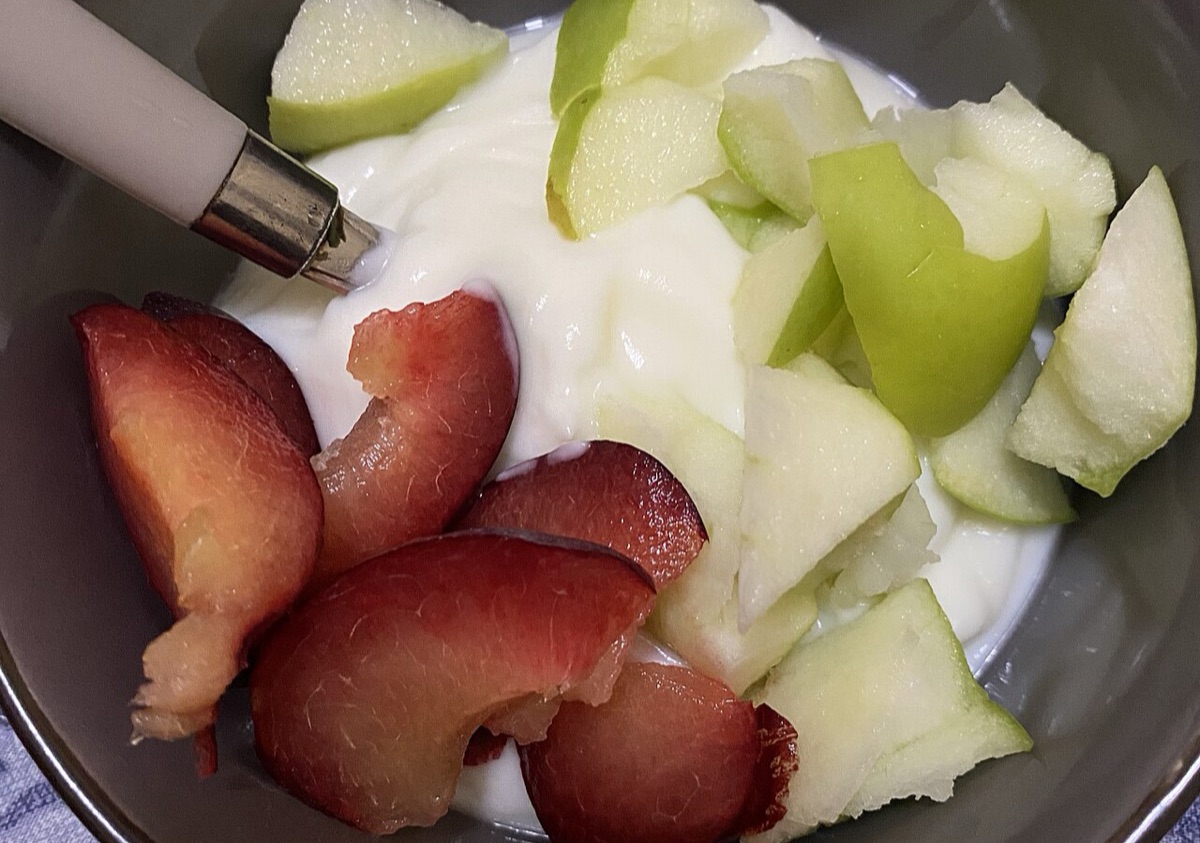
- Apples, plums and yogurtWikimedia Commons · Photograph released under CC0, used as a general illustration.
General information, not medical advice. This study compared the diets of women with and without polycystic ovary syndrome at one hospital; it did not test a diet as treatment or prevention. If you have PCOS or irregular periods, talk to your doctor or a registered dietitian before changing your diet or medicines.
Analysis by NutroPractic from the sources listed. Written for general readers; it does not replace advice from your own doctor.
From our articles
Our guides on this subject
Plain-language guides on nutrition and wellness, backed by research.
Women's health
PCOS and food: what the diet trials show for cycles, insulin and weight
PCOS affects about one woman in ten, and most are told to "lose weight" with little else. Here is what drives it, why insulin matters even in slim women, how much weight loss brings cycles back, what the low-GI and Mediterranean trials found, what inositol and metformin do, and which tests to ask for.
30 Oct 2026
Diabetes
Potatoes and blood sugar: boiled, cooled, mashed or fried, and what the cohorts and trials found
Fries were linked to 20% higher diabetes risk per three servings a week in 205,000 US adults; boiled, baked and mashed potatoes to almost none. GI by cooking method, resistant starch in grams after chilling, the glycaemic load of a potato against a cup of rice, and how to fit aloo into an Indian plate.
30 Oct 2026
Children's nutrition
Picky eaters aged 2 to 8: what feeding studies show works at the table
Fussy eating peaks between two and six and is usually a normal stage, not a parenting failure. Feeding trials show what moves it: small repeated tastes, eating together, no pressure and the right kind of reward. Here is how to use them, and the signs that mean it's more than picky eating.
30 Oct 2026
Newsfeed for your website
Want this feed on your website?
Add it to any site with one copy-and-paste snippet. No sign-up, and it updates itself every hour.
Start with a virtual consultation
Tell Dr. Triveni what you want to change. You will leave with a clear next step, whether you are in Toronto, London, New York or Chennai.