Gout · November 3, 2026
People with diabetes and gout scored almost the same on diet as those without. The gap appeared only after adjusting
A new analysis of 5,067 Americans with diabetes found raw diet scores that barely differed by gout: 51.4 against 51.9 on one 100-point index. Once age, sex and other differences were accounted for, better scores on three of five diet measures went with lower odds of gout. Two measures showed nothing at all.
Gout and diabetes keep bad company. Both are tied to weight, kidneys and how the body handles fuel, and the two conditions share some genetic ground. Plenty of work has looked at diet and each disease on its own. A team from Zhejiang University and hospitals in Hangzhou and Ningbo asked the narrower question: among people who already have diabetes, do the ones who eat better have gout less often?
They used six rounds of the US National Health and Nutrition Examination Survey, from 2007 to 2018. Of 34,770 participants, 5,067 had diabetes and complete data, and 561 of them, or 10.5%, said a doctor had told them they had gout. Each person's food recalls were scored five ways: the Healthy Eating Index 2020, the DASH diet score, the alternate Mediterranean score, the Alternative Healthy Eating Index, and the Dietary Inflammatory Index.
The first look at the numbers is the surprising part. People with and without gout had nearly identical diet scores: 51.42 against 51.93 on the Healthy Eating Index, 22.36 against 22.59 on DASH, 3.35 against 3.42 on the Mediterranean score. In the unadjusted models, none of the five came close to significance. But the two groups weren't alike in other ways. Those with gout were about six years older on average (65.1 against 59.0), more often men (64.8% against 47.9%), and much more likely to have chronic kidney disease (32.6% against 13.7%) or high blood pressure (83.1% against 63.7%).
After adjusting for differences like these and more, including smoking, alcohol, activity, calories, obesity and medicines such as urate-lowering drugs and diuretics, a pattern appeared. Each standard-deviation rise in the Healthy Eating Index went with 18% lower odds of having gout, DASH with 17% lower and the Mediterranean score with 14% lower. The Alternative Healthy Eating Index and the Dietary Inflammatory Index still showed nothing. The associations were already there after the first adjustment, for age, sex, race, education and marital status. The paper doesn't discuss the gap between the raw and adjusted results. Our reading is that an older, more male gout group may have been hiding the link, but a result that only appears after adjustment deserves some caution.
The authors are open about how far this goes. It's a snapshot: diet was measured by 24-hour recall while gout could have been diagnosed at any time before, so people may have changed how they eat because of it, and the paper names reverse causation as a possibility. Gout was self-reported, type 1 and type 2 diabetes weren't separated, and two of the three main results sit close to the usual significance line (p = 0.031 and 0.041). The team also tested whether blood markers might carry the link. A measure combining triglycerides, glucose and waist-to-height ratio accounted for 40.2% of the DASH association, but with a confidence interval running from 2.1% to 78.3%. They call all of this exploratory, and they note that the diet scores overlap so much that the result probably reflects overall diet quality rather than any one named diet.
Diet quality scores and gout among US adults with diabetes, NHANES 2007-2018 (Journal of Global Health, 30 October 2026)
5,067
Adults with diabetes analysed, from 34,770 survey participants
561 (10.5%)
Also reported a doctor's diagnosis of gout
51.42 vs 51.93
Average Healthy Eating Index 2020 score, gout vs no gout, before any adjustment (p = 0.537)
0.82 (0.70-0.96)
Fully adjusted odds ratio for gout per 1 SD higher Healthy Eating Index 2020 (11.73 points); p = 0.015
0.83 (0.70-0.98)
Same, per 1 SD higher DASH score (4.63 points); p = 0.031
0.86 (0.74-0.99)
Same, per 1 SD higher alternate Mediterranean score (1.28 points); p = 0.041
0.95 and 1.01
Same, for the Alternative Healthy Eating Index (p = 0.594) and Dietary Inflammatory Index (p = 0.943): no association
32.6% vs 13.7%
Chronic kidney disease in those with gout vs those without
Figures are from the paper's abstract, Tables 1 and 2 and discussion. This is a cross-sectional study, so it shows associations, not cause and effect, and odds ratios are not the same as absolute risk. Subgroup and mediation results were exploratory, with no correction for multiple comparisons and no significant interaction in the subgroups. The authors report no relevant interests; funding came from public research and health programmes in Zhejiang Province. The article is published under CC BY 4.0.
- Several of these scores measure overlapping things. Fruit, vegetables, whole grains and red or processed meat all count in DASH, the Alternative Healthy Eating Index and the Mediterranean score.
- Alcohol is a scored component in the Mediterranean score and the Alternative Healthy Eating Index, but not in DASH, which scores sugar-sweetened drinks and sodium instead.
- The paper cites an estimate that 529 million people were living with diabetes worldwide in 2021, a figure projected to pass 1.31 billion by 2050.
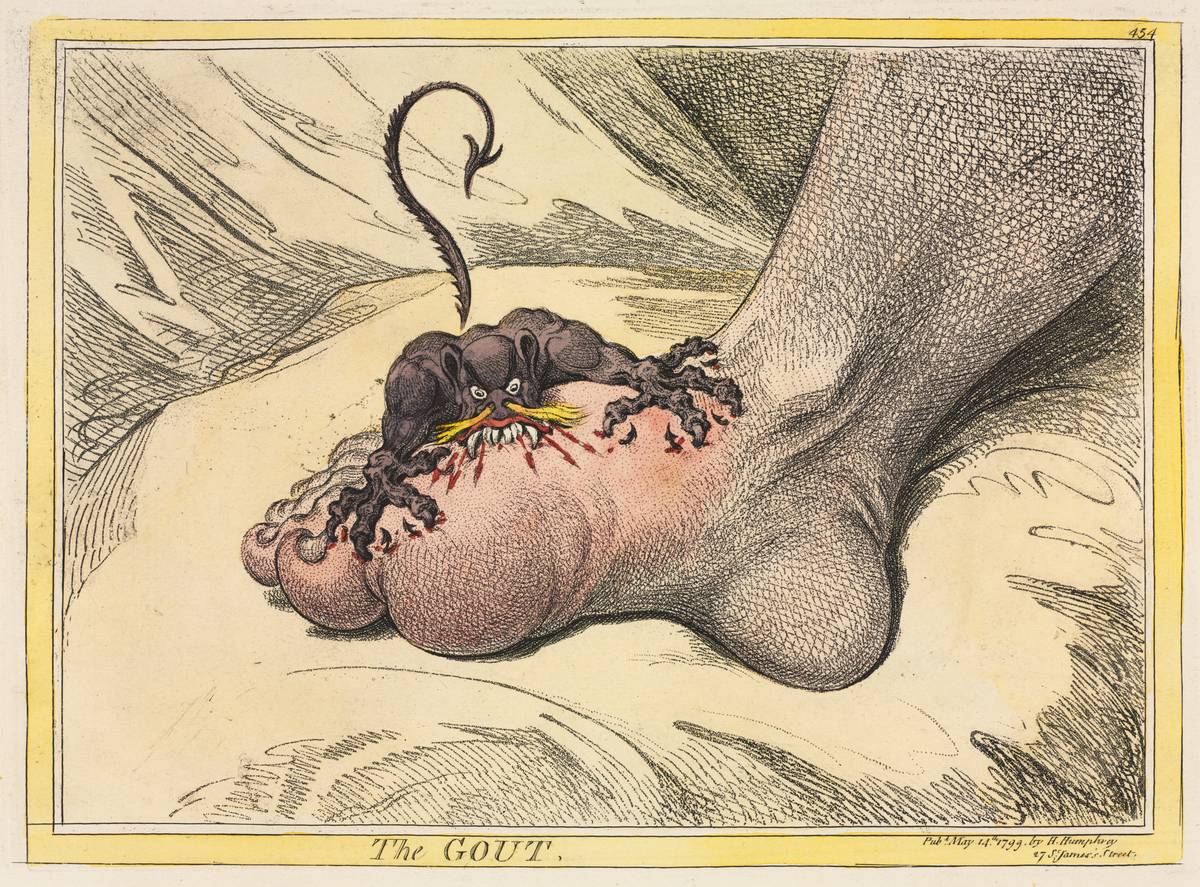
- In the same year as the print above, James Gillray published another with the title Punch Cures the Gout, the Colic and the 'Tisick, using an old word for a chest complaint.
- People with gout in this sample were less likely to be current smokers (8.2% against 16.2%), a reminder that a single comparison in a survey rarely tells the whole story.
- Dietary patterns and odds of prevalent gout comorbidity in diabetes mellitus: a mediation analysis of glucose metabolism and renal functionJournal of Global Health, 30 October 2026 · Cross-sectional analysis of NHANES data (open access, CC BY 4.0), with the baseline table, odds ratios, mediation results and limitations quoted here.
- National Health and Nutrition Examination SurveyUS National Center for Health Statistics · The public survey data behind the analysis.
- The Gout, James Gillray, 1799Wikimedia Commons (Cleveland Museum of Art) · CC0 image of the etching.
- Punch cures the gout, the colic, and the 'tisickWikimedia Commons (US National Library of Medicine) · Catalogue record for the second Gillray print, published 13 July 1799.
General information, not medical advice. This survey can't show that changing your diet prevents gout. If you have diabetes or gout, talk to your doctor or a dietitian before changing your diet, and don't stop or change any medicine on your own.
Analysis by NutroPractic from the sources listed. Written for general readers; it does not replace advice from your own doctor.
From our articles
Our guides on this subject
Plain-language guides on nutrition and wellness, backed by research.
Diabetes
Fenugreek, cinnamon and turmeric for blood sugar: what the trials in an Indian kitchen measured
Fenugreek seed at 5-10 g a day lowered HbA1c by about 0.85 points in pooled trials, and in a 3-year Hyderabad study 23% went on to diabetes against 55%. Cinnamon trims fasting glucose by 15-25 mg/dL, but a teaspoon of cassia tops the coumarin limit. Curcumin: about 0.3-0.4 points, and rare liver injury from capsules. Doses in teaspoons, and a fair way to test it at home.
1 Nov 2026

Diabetes
Potatoes and blood sugar: boiled, cooled, mashed or fried, and what the cohorts and trials found
Fries were linked to 20% higher diabetes risk per three servings a week in 205,000 US adults; boiled, baked and mashed potatoes to almost none. GI by cooking method, resistant starch in grams after chilling, the glycaemic load of a potato against a cup of rice, and how to fit aloo into an Indian plate.
30 Oct 2026
Women's health
PCOS and food: what the diet trials show for cycles, insulin and weight
PCOS affects about one woman in ten, and most are told to "lose weight" with little else. Here is what drives it, why insulin matters even in slim women, how much weight loss brings cycles back, what the low-GI and Mediterranean trials found, what inositol and metformin do, and which tests to ask for.
30 Oct 2026
Newsfeed for your website
Want this feed on your website?
Add it to any site with one copy-and-paste snippet. No sign-up, and it updates itself every hour.
Start with a virtual consultation
Tell Dr. Triveni what you want to change. You will leave with a clear next step, whether you are in Toronto, London, New York or Chennai.