Cooking oils · October 24, 2026
A street vendor's day in a lab: 12 Indian cooking oils were held at 230 °C for four hours, and the 'cold-pressed' label mattered less than what the oil was made of. Refined soybean oil went from under 1% trans fat to almost 6%
Scientists at India's National Institute of Nutrition in Hyderabad bought groundnut, sunflower, rice bran, palm, mustard, sesame, coconut and soybean oils from local markets and heated them in open steel pans for up to four hours, the stretch a frying oil does at a busy stall. Cold-pressed oils held up a little better for the first hour and worse by the fourth. Oils rich in polyunsaturated fat built up the most trans fat; coconut and rice bran oil changed least.
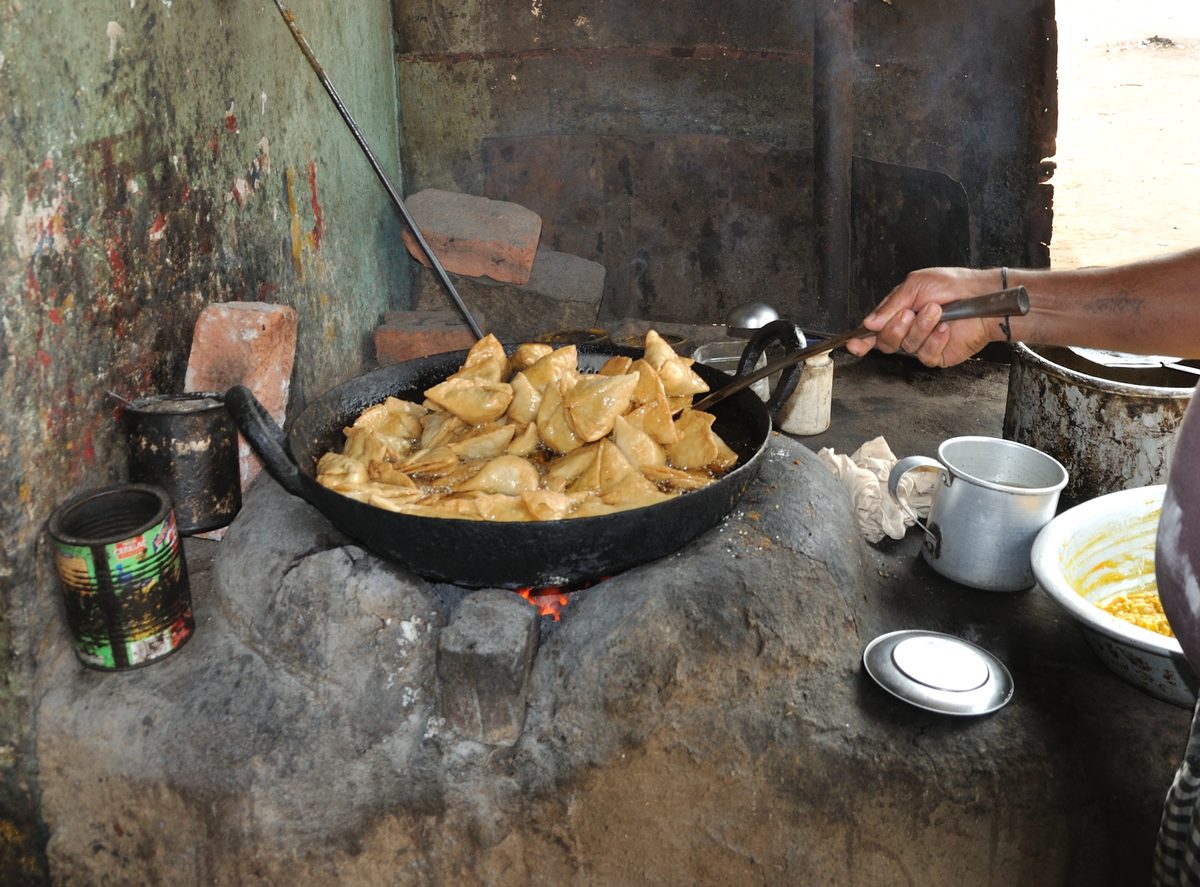
Cold-pressed oils are sold as the healthier choice, and in the bottle they often are: pressed below about 50 °C and only settled and filtered, they keep more of their natural antioxidants than refined oils, which are extracted hot and then degummed, bleached and deodorised. But most cooking oil in India is not eaten from the bottle. It goes into a kadai for puris, pakoras and samosas, often at well over 200 °C, and at a street stall the same oil can stay on the fire all day. A team at the ICMR-National Institute of Nutrition in Hyderabad asked what that does to the oils people actually buy. Their study was published in Frontiers in Nutrition on 23 October.
In January 2025 they bought 12 oils from three busy markets in Hyderabad: seven cold-pressed (groundnut, sunflower, rice bran, palm, mustard, sesame and coconut) and five refined (groundnut, sunflower, rice bran, palm and soybean). For each oil they took three brands from each market and pooled the nine bottles into one sample. Based on a survey of street vendor stalls, they heated 100 mL portions in open stainless-steel containers on a hotplate at 230 °C for one, two and four hours, three separate batches for each time, and measured the fatty acids, trans fat, peroxides (an early sign of oxidation), later breakdown products and colour.
Every oil got darker and every oil gained trans fat, but by very different amounts. Refined soybean oil went from 0.76% trans fat to 5.88% of its fatty acids after four hours, and cold-pressed sesame oil from 0.16% to 4.05%. Cold-pressed coconut oil, which is almost all saturated fat to begin with, ended on just 0.38%, and cold-pressed palm oil on 0.40%. Polyunsaturated fat, the kind with the most double bonds for heat and oxygen to attack, fell sharply in some oils: in cold-pressed mustard oil it dropped from 30.6% to 17.3%. Peroxides in refined sunflower oil roughly doubled, from 7.60 to 15.81 mEq O2/kg, while in both kinds of rice bran oil they fell to almost nothing by two hours; peroxides break down into other compounds with long heating, so a low figure late on is not proof of a fresh oil.
On the cold-pressed question, the answer was mixed. For the four oils that could be compared directly (groundnut, sunflower, rice bran and palm), the cold-pressed versions kept more of their polyunsaturated fat after one hour but lost more than the refined ones by four. Cold-pressed groundnut oil started with no measurable trans fat and ended on 3.86%, a little above the refined oil's 3.52%. The authors conclude that how unsaturated an oil is, rather than how it was processed, decides how well it stands up to long heating, with rice bran oil the most stable of the 12 on their measures and soybean and sesame oil the least.
There are clear limits. Each oil was a single pooled sample, so the results describe that blend, not any brand. The oil was heated on its own, with no food in it, and without the topping up and cooling that happen at a real stall. The team did not measure total polar compounds, the test many regulators use to decide when frying oil must be thrown away, or toxic breakdown products directly, and they say firm frying advice would need those. Some oils were tested in only one form, so not every cold-pressed versus refined comparison was possible. Nobody ate anything: this is chemistry, not a health study. It was funded by the ICMR-National Institute of Nutrition and the authors declare no conflicts of interest. We read the full open-access paper.
12 Indian cooking oils heated at 230 °C for up to four hours (published 23 October 2026)
12
Market oils tested: 7 cold-pressed and 5 refined, bought in Hyderabad in January 2025
0.76% → 5.88%
Trans fat in refined soybean oil, before and after four hours at 230 °C
0.16% → 4.05%
Trans fat in cold-pressed sesame oil over the same four hours
0.38%
Trans fat in cold-pressed coconut oil after four hours, the lowest of the 12
7.60 → 15.81
Peroxide value of refined sunflower oil (mEq O2/kg), before and after heating
30.6% → 17.3%
Polyunsaturated fat in cold-pressed mustard oil after four hours
Source: Nandipeta V, Chava S, Mergu N, Rajendran A, 'Effect of continuous high thermal processing on physico-chemical and nutritional alterations in cold-pressed and refined edible oils', Frontiers in Nutrition 2026;13, published 23 October 2026, doi 10.3389/fnut.2026.1949768, open access (CC BY). ICMR-National Institute of Nutrition, Hyderabad. Oils: cold-pressed groundnut, sunflower, rice bran, palm, mustard, sesame and coconut; refined groundnut, sunflower, rice bran, palm and soybean. Three brands from each of three Hyderabad markets pooled into one composite per oil. 100 mL heated in open stainless-steel containers on a hotplate at 230 ± 5 °C for 0, 1, 2 and 4 h (times chosen from a survey of street vendor stalls); three independently heated batches per time point; no food fried. Fatty acids by gas chromatography, reported as % of fatty acid methyl esters. Total trans fat 0 h to 4 h: soybean (refined) 0.76 to 5.88; sesame (cold-pressed) 0.16 to 4.05; groundnut cold-pressed 0 to 3.86, refined 0.92 to 3.52; rice bran cold-pressed 0.99 to 2.11, refined 1.22 to 3.40; mustard 0 to 2.39; sunflower cold-pressed 0 to 1.62, refined 0.93 to 1.42; palm cold-pressed 0 to 0.40, refined 0.34 to 1.16; coconut 0 to 0.38. Polyunsaturated fat in cold-pressed mustard oil 30.64 to 17.31%. Peroxide value of refined sunflower oil 7.60 to 15.81 mEq O2/kg; both rice bran oils fell to 0.01 by 2 h. Two-way ANOVA (oil x time), with a Bonferroni check of the interactions. Limitations stated by the authors: one composite sample per oil, not all oils in both forms, and no total polar compounds, TOTOX, polymerised triacylglycerols or toxicological endpoints, so no definitive frying safety advice. Funded by ICMR-NIN; no conflicts of interest declared.
- The Codex Alimentarius standard for named vegetable oils, which the authors cite, allows a peroxide value of up to 10 mEq O2/kg in refined oils. Refined sunflower oil in this study started at 7.60 and ended at 15.81.
- Since 1 January 2022 India's food regulator, FSSAI, has capped industrially produced trans fat at 2% of the fat in edible oils and fats, down from 3% in 2021. The cap applies to oil as it is sold, not to oil after hours on a stove.
- The WHO advises adults to keep trans fat below 1% of daily energy, under 2.2 g a day on a 2,000-calorie diet, and links more than 278,000 deaths a year worldwide to industrially produced trans fat.
- Almost half of the world's population lives in countries with the WHO's 'best-practice' trans fat rules: either a limit of 2 g of industrial trans fat per 100 g of total fat in all foods, or a ban on partially hydrogenated oils.
- Effect of continuous high thermal processing on physico-chemical and nutritional alterations in cold-pressed and refined edible oilsFrontiers in Nutrition · The study, open access, published 23 October 2026
- Trans fat (fact sheet, 24 January 2024)World Health Organization · Intake advice, deaths and best-practice policies
- FSSAI's new policy limits industrial trans fatFood Safety and Standards Authority of India · India's 3% (2021) and 2% (2022) limits on trans fat in oils and fats
- Frying Samosas - Ranchi 8440Wikimedia Commons · The photo, CC BY 3.0 (Biswarup Ganguly)
General information, not medical advice. This was a laboratory test of heated oils, not a study of people, and it measured no health effects. If you want help choosing cooking oils or cooking methods for your diet or a health condition, a registered dietitian can help.
Analysis by NutroPractic from the sources listed. Written for general readers; it does not replace advice from your own doctor.
From our articles
Our guides on this subject
Plain-language guides on nutrition and wellness, backed by research.
Heart health
Cooking oils: olive, seed oils, ghee and coconut, and what the trials actually compared
Olive oil is praised, seed oils are called toxic and ghee is said to be back. What PREDIMED compared, where the seed-oil argument from the Sydney and Minnesota trials comes from and why most evidence points the other way, what butter, ghee and coconut oil do to LDL, what smoke points tell you, how often to reuse frying oil, and where mustard and rice bran oil fit.
19 Oct 2026

Everyday eating
Extra virgin olive oil polyphenols: the EU health claim, smoke point myths, and cooking stability
Does extra virgin olive oil degrade when cooked? What does the EU 5 mg polyphenol health claim require, how does oleocanthal act like ibuprofen, and why does oxidative stability matter more than smoke point in domestic frying? Here is the clinical and culinary data.
21 Nov 2026

Women's health
Inositol for PCOS: the 40:1 ratio, trial doses, and food milligrams
Why do randomized trials in polycystic ovary syndrome prioritize the 40:1 myo to D-chiro inositol ratio? Here is the science behind the ovarian epimerase paradox, clinical ovulation and insulin metrics, and why cantaloupe cannot replace 4,000 mg trial powder.
21 Nov 2026
Newsfeed for your website
Want this feed on your website?
Add it to any site with one copy-and-paste snippet. No sign-up, and it updates itself every hour.
Start with a virtual consultation
Tell Dr. Triveni what you want to change. You will leave with a clear next step, whether you are in Toronto, London, New York or Chennai.