Nutrition knowledge · October 24, 2026
Four in five Chongqing pupils in their first three school years passed a food quiz. By senior high, one in five did. On a question about leftovers and meat frozen for over a year, 4% of the oldest got it right
Public-health researchers quizzed 4,980 pupils in Chongqing, south-west China, on what to eat, how food affects health and how to store it safely. The pass rate fell at every stage of school, from 81% in the first three years of primary to 22% in senior high. But each age group sat a different test, and the authors admit the slide may partly be down to harder questions.
Nutrition lessons are usually aimed at younger children, on the idea that habits set early will last. A survey from Chongqing, the vast municipality in south-west China, suggests that what children know about food does not simply build up as they get older. Researchers from the Chongqing Center for Disease Control and Prevention and its Jiangbei District branch published the results in Frontiers in Nutrition on 19 October.
The data come from the Chongqing part of a national survey of what school-age children know about nutrition, run in 2023 and 2024. Six urban districts and two rural counties were picked, and in each one two primary schools, a junior high and a senior high school, with whole classes chosen at random. In total 4,980 pupils aged 6 to 17 filled in a questionnaire, split almost evenly between boys and girls. The questions covered five areas: dietary recommendations, food groups and what is in them, how food affects growth and health, choosing food, and food safety. A score of 75 out of 100 counted as a pass.
Overall, 48.5% passed. The split by school stage is what stands out: 80.6% of pupils in the first three years of primary school, 51.4% in the last three, 38.3% in junior high and 22.4% in senior high. Average scores slid the same way, from 83.6 to 64.5. The weakest area at every stage was dietary recommendations, such as how much salt, oil, milk or soy to eat each day. Only 7.8% of senior high students passed that section.
The individual questions show where the gaps are. Among senior high students, 5.0% answered the question on iron-deficiency anaemia correctly, 4.1% knew what to do with food near its expiry date, leftovers, spoiled food and meat frozen for more than a year, and 19.7% knew the recommended daily amount of cooking oil. In junior high, 3.8% got the same food-disposal question right and 15.1% knew how whole grains differ from refined ones. Among older primary pupils, 3.1% answered the breakfast question correctly. The youngest children did much better on their simpler items: 94.7% picked the right drink advice and 91.5% knew that sugary drinks harm teeth.
A few things went with passing. In primary school girls did better than boys, though the gap disappeared later on. Children who ate their school lunch, breakfast or dinner were generally more likely to pass, which the authors connect to rules introduced in 2021 requiring school canteens in China to spread nutrition information. Boarding went in opposite directions: young boarders had about twice the odds of passing, senior high boarders less than half. In senior high, students who said their mother worked in education had nearly six times the odds of passing.
The authors suggest older students get fewer food lessons as exam pressure rises, and eat more meals away from home. But they are frank about a bigger problem: each school stage answered a different version of the questionnaire, of 24 to 26 items, and the versions were never linked, so part of the slide could reflect harder questions rather than children forgetting. The test for the youngest group was also the least reliable. The survey measured knowledge only, not what the children actually ate, and it could not be weighted to represent all of Chongqing's pupils. The study had no outside funding.
Share of pupils scoring at least 75 out of 100 on a nutrition knowledge questionnaire, by school stage, Chongqing, 2023 to 2024
80.6%
Primary school, grades 1 to 3
51.4%
Primary school, grades 4 to 6
38.3%
Junior high school
22.4%
Senior high school
7.8%
Senior high students passing the dietary recommendations section, the weakest area at every stage
4.1%
Senior high students who knew how to handle near-expiry food, leftovers, spoiled food and meat frozen for over a year
Source: Wang M, Wang D, Li F, Huo J, Feng P, Chen J, 'Nutrition knowledge awareness and associating factors among school-age children in Chongqing: a 2023–2024 survey', Frontiers in Nutrition 13, published 19 October 2026, doi:10.3389/fnut.2026.1935221, open access (CC BY). 4,984 surveyed, 4,980 analysed (2,467 boys, 2,513 girls) from six urban districts and two rural counties. Each stage answered its own questionnaire version (25, 24, 26 and 25 items; Cronbach's alpha 0.54, 0.76, 0.79 and 0.79), not linked across stages. Passes by stage: 1,040, 645, 447 and 284 pupils; group sizes of about 1,291, 1,255, 1,167 and 1,267 are our calculation from those counts and percentages. Mean total scores 83.6, 72.3, 69.3 and 64.5. Pass rates by section across all pupils: dietary recommendations 30.3%, food groups 49.7%, food choices 57.3%, food safety 67.2%, food and growth or health 68.5%. Odds ratios are from complex-sample logistic regression with sampling weights set to 1. No external funding was declared.
- Chongqing's overall pass rate of 48.5% was higher than earlier surveys the authors cite for south-west China as a whole (34.2%), Sichuan (33.0%) and Hubei (27.6%).
- In the youngest group, eating school lunch mattered a lot: pupils who skipped it had about a quarter of the odds of passing (odds ratio 0.25) of those who ate it.
- The number of questions that fewer than one in four pupils answered correctly rose from none in the first three years of primary school to 3, then 7, then 8 in senior high.
- Only 34.1% of senior high students answered the question comparing the calcium in bone broth with milk correctly, and 47.0% the one on vitamin C in freshly squeezed juice versus whole fruit.
- The World Health Organization advises adults to keep salt below 5 grams a day and free sugars below 10% of daily energy, about 50 grams on a 2,000-calorie diet, with lower salt limits for children. In this survey, 23.6% of senior high students knew the recommended salt intake for their age.
- Nutrition knowledge awareness and associating factors among school-age children in Chongqing: a 2023–2024 surveyFrontiers in Nutrition · The study, open access, published 19 October 2026
- Healthy diet: fact sheetWorld Health Organization · WHO limits for salt and free sugars
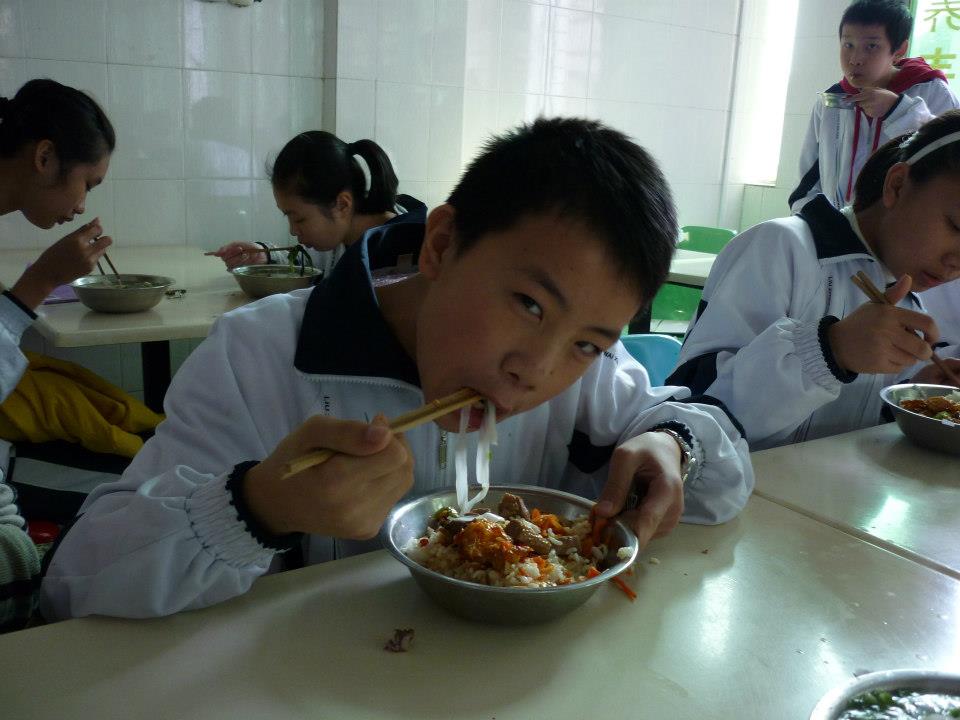
- School lunch in Yangshuo, Guangxi, 2012Wikimedia Commons · The photo, CC BY 2.0 (Frontierofficial)
General information, not medical advice. This survey measured what children in one Chinese city knew about food, using a different questionnaire for each age group; it did not measure what they ate or test any way of teaching nutrition. For advice on a child's diet, talk to your doctor, a registered dietitian or your child's school health service.
Analysis by NutroPractic from the sources listed. Written for general readers; it does not replace advice from your own doctor.
From our articles
Read, then eat a little better
Plain-language guides on nutrition and wellness, backed by research.

Women's health
Inositol for PCOS: the 40:1 ratio, trial doses, and food milligrams
Why do randomized trials in polycystic ovary syndrome prioritize the 40:1 myo to D-chiro inositol ratio? Here is the science behind the ovarian epimerase paradox, clinical ovulation and insulin metrics, and why cantaloupe cannot replace 4,000 mg trial powder.
21 Nov 2026

Everyday eating
Extra virgin olive oil polyphenols: the EU health claim, smoke point myths, and cooking stability
Does extra virgin olive oil degrade when cooked? What does the EU 5 mg polyphenol health claim require, how does oleocanthal act like ibuprofen, and why does oxidative stability matter more than smoke point in domestic frying? Here is the clinical and culinary data.
21 Nov 2026

Food and nutrition
L-theanine and caffeine: what cognitive trials measured on sustained attention, and milligrams in matcha vs green tea
Combining L-theanine with caffeine produces clean focus without caffeine jitters. Here is what randomized trials measured on attention-switching, EEG alpha brain waves, and the exact milligrams across ceremonial matcha, culinary powder, gyokuro, and sencha.
20 Nov 2026
Newsfeed for your website
Want this feed on your website?
Add it to any site with one copy-and-paste snippet. No sign-up, and it updates itself every hour.
Start with a virtual consultation
Tell Dr. Triveni what you want to change. You will leave with a clear next step, whether you are in Toronto, London, New York or Chennai.