Lung health · November 2, 2026
US adults who remember drinking milk daily at age 5 to 12 blew out about 230 mL more air in a second than those who never did. Only 81 people were in the 'never' group, and the memories were decades old
A new analysis of 3,935 American adults set their recalled childhood milk habits beside a lung test taken in a mobile clinic. The gap showed up for milk at 5 to 12 but not for milk in the teens or twenties. How the groups were split, and what was never measured, matter as much as the number.
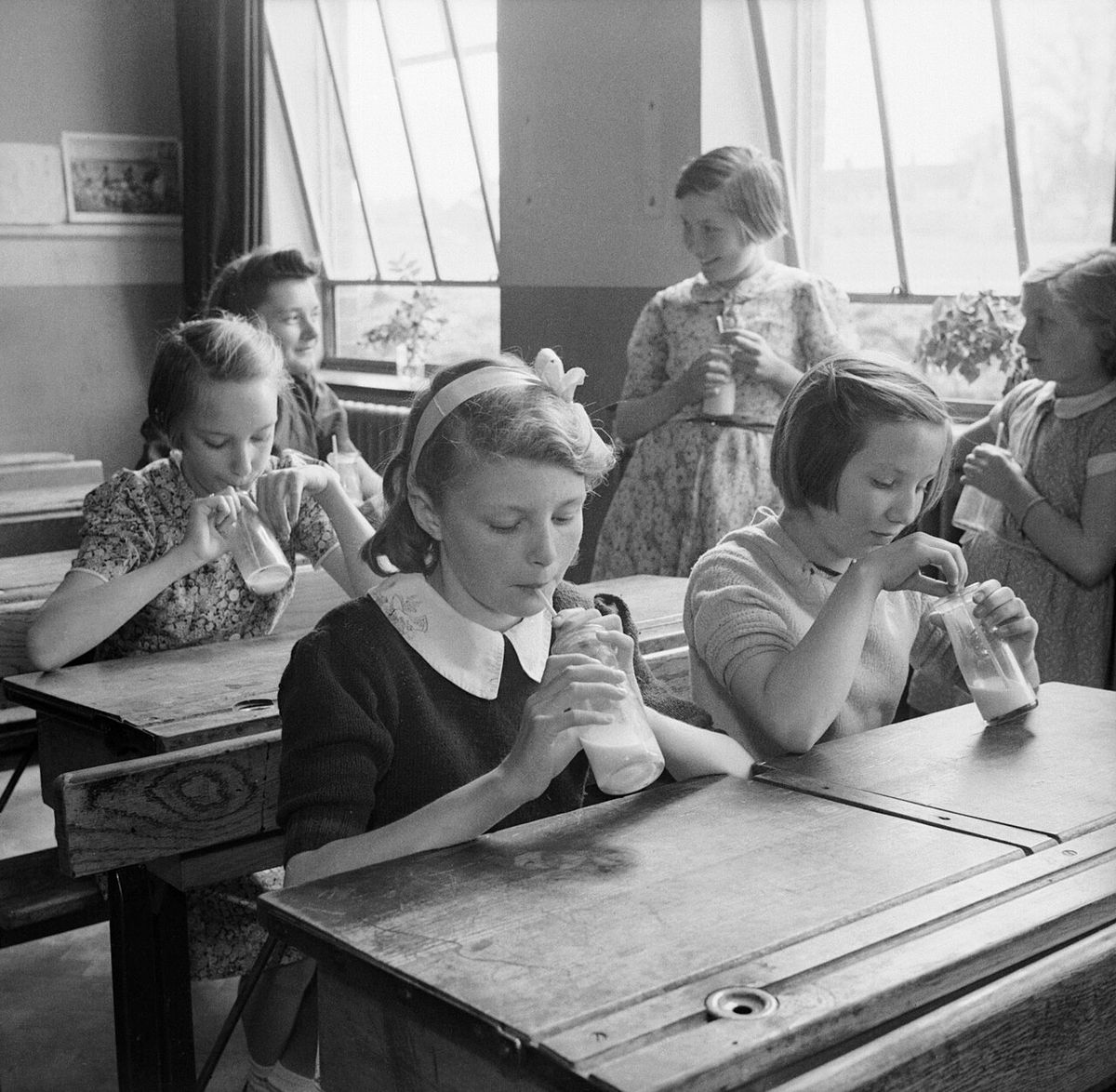
Lungs keep growing through childhood and the teens, and may not reach their best until early adulthood, so researchers keep asking whether what children eat leaves a mark decades later. A team from several Chinese universities and hospitals looked at one everyday food, milk, and published the result in Food Science & Nutrition on 26 October.
They used NHANES, the long-running US health survey, for the years 2007 to 2012. Trained technicians gave adults aged 20 and over a spirometry test in a mobile clinic, which measures how much air a person can blow out in the first second (FEV1) and in total (FVC). The same adults were asked how often they drank milk at three stages of life: ages 5 to 12, 13 to 17, and 18 to 35. People with asthma were left out, leaving 3,935, with an average age of 47.
Compared with adults who said they never drank milk at 5 to 12, those who said once a day or more had an FEV1 about 230 mL higher (95% CI 46 to 414) and an FVC about 324 mL higher (120 to 529), after allowing for age, sex, race and ethnicity, education, marital status, income, height, weight, BMI, smoking, smoke at home, recreational activity and asthma in the family. On our arithmetic that is about 7% of the group's average for each measure. People who drank milk one to six times a week came out almost the same as the daily drinkers (221 and 281 mL), and those who drank it less than weekly showed no gap in FEV1 (minus 3.7 mL). The ratio of the two measures, FEV1/FVC, which is used to spot narrowed airways, did not differ. Milk in the teens and at 18 to 35 showed no significant link with either measure.
Now the caveats. Almost everyone drank milk as a child: weighted to the US population, 88% said daily and only 1.6% said never. That 'never' group was 81 people, and every comparison is against them, which helps explain why the confidence intervals are so wide. A child who never drank milk may have had an allergy, an intolerance, a different family diet or less money at home, and the survey can't separate those. The authors themselves name childhood circumstances, overall diet and growth as things the data did not fully capture. They also point out that the milk memories were collected only once, in adulthood, that they cover how often but not how much or what type, and that today's habits can colour them. Allowing for the other factors already shrank the FEV1 gap by about a third, from 348 to 230 mL.
The gap looked larger in non-smokers (FEV1 307 mL, FVC 495 mL) and in people with no smoker at home (384 and 537 mL), and these splits passed a formal interaction test. The authors still call all the subgroup findings exploratory because so many comparisons were run. Their own conclusion is unusually plain: the results should not be read as evidence that milk directly builds lungs, or that drinking more in childhood would improve adult lung function or prevent lung disease. It is a signal worth testing in studies that follow children forward and record their diet at the time. For a parent, it adds little to the existing reasons to give or not give a child milk.
Recalled milk drinking at ages 5 to 12 and adult lung function, NHANES 2007–2012 (Food Science & Nutrition, 26 October 2026)
3,935
US adults aged 20 and over analysed, average age 47, people with asthma excluded
+230 mL
FEV1, milk daily or more vs never at ages 5 to 12, fully adjusted (95% CI 46 to 414)
+324 mL
FVC, the same comparison (95% CI 120 to 529)
+221 mL
FEV1, milk one to six times a week vs never (95% CI 7.3 to 435): about the same as daily
−3.7 mL
FEV1, milk less than weekly vs never (95% CI −227 to 220): no gap
81 people
The 'never' group at ages 5 to 12, 1.6% of the weighted sample; 88% said daily
348 → 230 mL
The FEV1 gap for daily vs never, before and after adjustment
No link
FEV1/FVC ratio at ages 5 to 12, and FEV1 or FVC for milk at 13 to 17 or 18 to 35
Figures come from the open-access paper's text and Tables 1 and 2. The study is cross-sectional with recalled exposure: milk habits were asked once, in adulthood, alongside the lung test. The 7% is our own sum (230 of an average 3,346 mL FEV1; 324 of an average 4,352 mL FVC), and the list of reasons a child might never drink milk is our own comment; the paper raises childhood circumstances, diet and growth in general terms. Because the models adjust for adult height, the gap is not simply that milk drinkers grew taller. Three things we noticed: the paper's highlights say the link was independent of asthma history, yet people with asthma were excluded altogether; Table 1 labels 53% of participants as smoking 'some days' against 8.3% 'every day', which looks like a coding issue, so we have not used those shares; and a few subgroup intervals are not centred on their estimates (FEV1 248 mL, CI 39 to 535), so we have left out the age-group results. Results for the later age periods are in supplementary tables, which we did not check; we report them as the paper's text describes them. Funded by Chinese research grants, including the Natural Science Foundation of Henan Province.
- The survey question was simply: 'When you were [age range], how often did you drink milk?' The analysis had no information on the amount or the type of milk.
- Daily milk drinking fell steeply with age in this group: 88% at ages 5 to 12, 72% at 13 to 17 and 49% at 18 to 35, in the survey-weighted figures.
- The 'never' group grew with age as well, from 81 people at 5 to 12 to 117 at 13 to 17 and 229 at 18 to 35.
- On average the 3,935 adults blew out about 3.3 litres in the first second and 4.4 litres in total.
- The authors mention milk protein, calcium and links with the growth factor IGF-1 as possible explanations, but call such pathways speculative because the survey measured none of them.
- The photograph's original 1944 caption says each child at the English school received a third or two-thirds of a pint of milk a day, with free milk for evacuees and poor children.
- Association Between Frequency of Childhood Milk Intake and Adult Lung FunctionFood Science & Nutrition, 26 October 2026 · The paper's DOI. Open access under CC BY.
- Full text of the paperPubMed Central · Methods, Tables 1 and 2, the subgroup results, limitations and funding.
- Girls at Baldock County Council School enjoy a drink of milk, 1944Wikimedia Commons / Imperial War Museums · Public domain photograph with its original caption, used as a historic illustration.
General information, not medical advice. This survey found an association based on adults' memories of childhood; it doesn't show that milk changes how lungs grow. If you have breathlessness or a lasting cough, talk to your doctor, and ask a doctor or dietitian about your child's diet, especially with an allergy or intolerance.
Analysis by NutroPractic from the sources listed. Written for general readers; it does not replace advice from your own doctor.
From our articles
Read, then eat a little better
Plain-language guides on nutrition and wellness, backed by research.
Gut health
Gluten-free without coeliac disease: who actually benefits, and what the blinded gluten challenges found
In blinded trials only 16% of people who said gluten made them ill reacted to gluten rather than placebo, and in Oslo fructans caused more bloating than gluten. Who really needs to avoid it, how to get tested before you stop, how much gluten is in a slice of bread or a roti, and what gluten-free food costs (159% more in the UK) and lacks.
1 Nov 2026
Diabetes
Fenugreek, cinnamon and turmeric for blood sugar: what the trials in an Indian kitchen measured
Fenugreek seed at 5-10 g a day lowered HbA1c by about 0.85 points in pooled trials, and in a 3-year Hyderabad study 23% went on to diabetes against 55%. Cinnamon trims fasting glucose by 15-25 mg/dL, but a teaspoon of cassia tops the coumarin limit. Curcumin: about 0.3-0.4 points, and rare liver injury from capsules. Doses in teaspoons, and a fair way to test it at home.
1 Nov 2026

Diabetes
Potatoes and blood sugar: boiled, cooled, mashed or fried, and what the cohorts and trials found
Fries were linked to 20% higher diabetes risk per three servings a week in 205,000 US adults; boiled, baked and mashed potatoes to almost none. GI by cooking method, resistant starch in grams after chilling, the glycaemic load of a potato against a cup of rice, and how to fit aloo into an Indian plate.
30 Oct 2026
Newsfeed for your website
Want this feed on your website?
Add it to any site with one copy-and-paste snippet. No sign-up, and it updates itself every hour.
Start with a virtual consultation
Tell Dr. Triveni what you want to change. You will leave with a clear next step, whether you are in Toronto, London, New York or Chennai.