Child development · November 2, 2026
Under-twos in Ghana who ate one more food group the day before scored slightly higher on development. Mothers' play and talk went with higher scores at every age checked; fathers' showed no clear link
Mothers and fathers in Greater Accra each listed what they had done with their child in the past 24 hours. Mothers also reported the child's food and milestones. The pattern is neat, but one person answering most of the questions may be part of why.
Few studies have set a young child's food and play side by side, and fathers' part in this is little studied in Ghana. Researchers at McGill University and colleagues, including in Ghana, looked at both in the same households and asked both parents. The paper appeared in BMJ Public Health on 26 October.
The data come from the Mental Health in Ghana study, which visited two-parent households in the Ga South district of Greater Accra between December 2023 and February 2024. This analysis covers the 460 children aged 6 to 36 months for whom development data were collected: 296 aged 6 to 23 months and 164 aged 24 to 36 months.
Mothers said which of seven food groups the child had eaten in the past 24 hours. Each parent separately said which of six activities they had done with the child in the same period: books or picture books, an outing, stories, songs, play, and talking to the child during housework. Mothers then answered a 108-item checklist of milestones, which gives a score where 0 is the average of the tool's reference population.
The children's diets were narrow. The younger group averaged 3.0 food groups out of seven and the older group 3.73, with grains, roots and tubers, and flesh foods the most common. Mothers averaged 2.87 activities out of six and fathers 1.81. Overall development averaged -0.14, a little below the reference population, and 61% of the children had been ill in the previous two weeks.
In the younger group, each extra food group went with a development score 0.11 of a standard deviation higher, after adjusting for things like income, parents' education and recent illness. The confidence interval ran from 0.01 to 0.22, so it only just clears zero. By domain, the link showed in motor and language development, not in cognitive or social-emotional development. In the older group the figure was 0.08, and its interval crossed zero.
Each extra activity reported by a mother went with a score 0.13 higher in the younger group and 0.15 higher in the older group. Fathers' activities showed nothing clear in either group: 0.04 and -0.03, both with intervals spanning zero. Food variety wasn't clearly linked to either parent's activities.
Who answered matters here. Mothers reported the diet, their own activities and the child's milestones, so a mother who sees her child's progress in a good light might also describe her own efforts that way. The authors flag this shared reporting as a possible bias. Fathers reported their own activities but not the milestones, so their answers had no such overlap. To our reading, that could account for some of the gap between mothers and fathers, though the study can't say how much.
The maternal link also depended on the adjustments. Before them the figures were 0.08 and 0.10, and both intervals crossed zero. The authors didn't correct for multiple testing and ask that results close to zero be read cautiously. They also say plainly that their findings don't mean fathers' involvement doesn't matter, pointing to other studies showing it does, and suggest that local ideas of fathers as providers may shape how much of this care they give.
A single survey can't show which came first. A child who is developing quickly might get more talk and play, rather than the other way round. Breastfeeding and growth weren't recorded, and the food and activity answers describe just one day. The authors want longitudinal studies and trials next, including of feeding and play support offered together.
Diet, parents' activities and development in 460 children in Ga South, Ghana (BMJ Public Health, 2026)
460
Children aged 6 to 36 months analysed: 296 aged 6 to 23 months, 164 aged 24 to 36 months
3.0 vs 3.73
Average food groups out of 7 in the past 24 hours: younger vs older group
2.87 vs 1.81
Average activities out of 6 in the past 24 hours: mothers vs fathers
+0.11 SD
Development score per extra food group at 6 to 23 months (95% CI 0.01 to 0.22)
+0.08 SD
Development score per extra food group at 24 to 36 months (95% CI -0.07 to 0.23)
+0.13 / +0.15 SD
Development score per extra activity reported by mothers: younger / older group (95% CI 0.01 to 0.24; 0.03 to 0.27)
+0.04 / -0.03 SD
Development score per extra activity reported by fathers: younger / older group (95% CI -0.06 to 0.14; -0.15 to 0.08)
-0.14
Average overall development score (0 is the reference population's average): 0.00 younger, -0.40 older
Figures come from the open-access paper's abstract and Tables 1 to 5. Betas are adjusted for child sex, recent illness, another significant caregiver at home, household size, income, and each parent's age and education. All of this is cross-sectional and exploratory, with no correction for multiple testing. The older children had more varied diets but lower development scores; that is a difference between age groups in Table 1, not a test of diet. The paper's results text gives mothers' average as 2.8 activities, while Table 1 gives 2.87; we use the table. The point in the story about who answered what combines the authors' shared-reporting caveat with our own reading. Mental health was the parent study's main aim, so its sample size wasn't set for these questions. Single-parent households weren't eligible. Average household income was about US$144 a month. The study was funded by the Thrasher Research Fund, which had no role in the design or analysis, and the authors declare no competing interests.
- The paper cites national figures for Ghana: only 23% of children aged 6 to 24 months have sufficiently diverse diets.
- It also cites 11.3% of mothers and 3.1% of fathers doing four or more play and stimulation activities with a child in the last three days.
- Similar links between dietary diversity and development in young children have been reported in Uganda and Nepal, the authors note.
- The milestone checklist used here, the Caregiver Reported Early Development Instruments, was tested and validated across 17 countries, including Ghana.
- The paper quotes an estimate that 43% of under-fives in low- and middle-income countries experience suboptimal development.
- The authors cite a national figure that 97% of Ghanaian children under two are breastfed, which is why they think the missing breastfeeding data probably didn't change their findings.
- Associations of child diet and parental stimulation with early childhood development in Ghana: a cross-sectional studyBMJ Public Health, 26 October 2026 · The paper's DOI. Open access under CC BY-NC.
- Full text of the paperPubMed Central · Methods, Tables 1 to 5, limitations, funding.
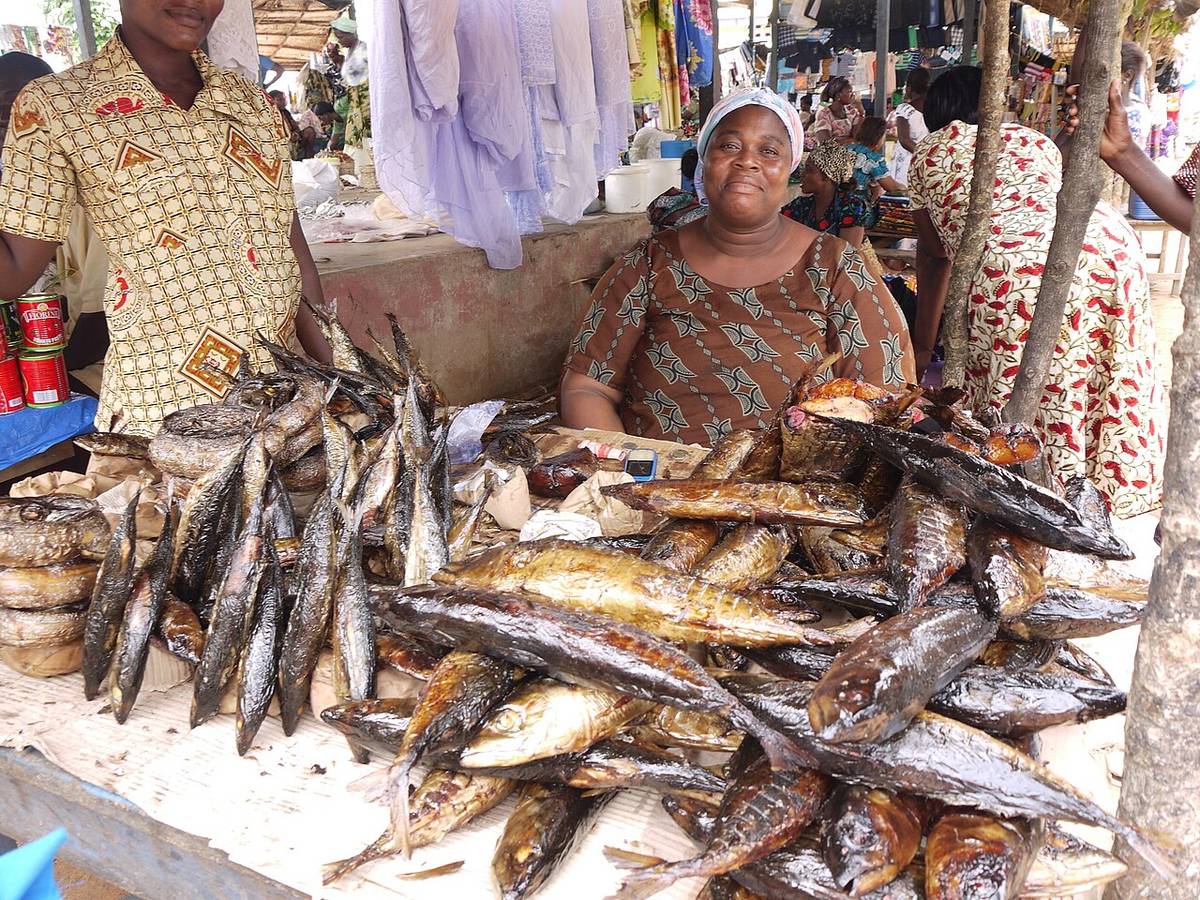
- Fish seller in market, GhanaWikimedia Commons · CC BY 2.0 photograph by Gina Gleeson, used as an illustration.
General information, not medical advice. This survey found associations in one district of Ghana; it didn't test any feeding or play programme. If you're concerned about your child's development or diet, talk to your paediatrician or a registered dietitian.
Analysis by NutroPractic from the sources listed. Written for general readers; it does not replace advice from your own doctor.
From our articles
Read, then eat a little better
Plain-language guides on nutrition and wellness, backed by research.
Gut health
Gluten-free without coeliac disease: who actually benefits, and what the blinded gluten challenges found
In blinded trials only 16% of people who said gluten made them ill reacted to gluten rather than placebo, and in Oslo fructans caused more bloating than gluten. Who really needs to avoid it, how to get tested before you stop, how much gluten is in a slice of bread or a roti, and what gluten-free food costs (159% more in the UK) and lacks.
1 Nov 2026
Diabetes
Fenugreek, cinnamon and turmeric for blood sugar: what the trials in an Indian kitchen measured
Fenugreek seed at 5-10 g a day lowered HbA1c by about 0.85 points in pooled trials, and in a 3-year Hyderabad study 23% went on to diabetes against 55%. Cinnamon trims fasting glucose by 15-25 mg/dL, but a teaspoon of cassia tops the coumarin limit. Curcumin: about 0.3-0.4 points, and rare liver injury from capsules. Doses in teaspoons, and a fair way to test it at home.
1 Nov 2026

Diabetes
Potatoes and blood sugar: boiled, cooled, mashed or fried, and what the cohorts and trials found
Fries were linked to 20% higher diabetes risk per three servings a week in 205,000 US adults; boiled, baked and mashed potatoes to almost none. GI by cooking method, resistant starch in grams after chilling, the glycaemic load of a potato against a cup of rice, and how to fit aloo into an Indian plate.
30 Oct 2026
Newsfeed for your website
Want this feed on your website?
Add it to any site with one copy-and-paste snippet. No sign-up, and it updates itself every hour.
Start with a virtual consultation
Tell Dr. Triveni what you want to change. You will leave with a clear next step, whether you are in Toronto, London, New York or Chennai.