Social life and diet · October 20, 2026
11,900 Canadians over 45 who ate fruit or vegetables every day: six years on, the ones whose social lives had narrowed were more likely to have dropped the daily habit, and the strongest links turned up in better-off women
Researchers in Vancouver followed people from the Canadian Longitudinal Study on Aging through three rounds of interviews, tracking how many kinds of social activity they kept up and whether they still ate fruit and vegetables every day. Fewer social ties went with losing the daily fruit habit in both sexes. The surprise was who seemed most affected: not the poorest, but women with higher incomes.
Eating well in later life is usually discussed as a matter of money, knowledge and appetite. A study published on 18 October in Nutrients by researchers at the University of British Columbia, the University of Waterloo and BC Cancer looks at something less obvious: how much of a social life people keep up as they age, and whether changes in it show up in a habit as simple as eating fruit and vegetables every day. They also asked whether the link was the same for richer and poorer, and for women and men.
The team used three waves of the Canadian Longitudinal Study on Aging (CLSA), a national cohort of adults aged 45 and over: Wave 1 in 2011 to 2015, Wave 2 in 2015 to 2018 and Wave 3 in 2018 to 2021. They kept the 11,900 people who ate fruit or vegetables at least once a day at the start and had complete data, with an average age of 62; 61% were women and follow-up averaged about 70 months. At each wave people said how often they had taken part in eight kinds of social activity over the past year. Taking part in five or more at least monthly counted as diverse social participation; zero or one counted as socially isolated. The question was whether people who changed, or stayed put, between Waves 1 and 2 had dropped to less than daily fruit or vegetables by Wave 3. Income was judged against age-specific lines: at least C$100,000 a year in household income counted as high for people aged 45 to 64, and C$50,000 for those 65 and over.
The most consistent finding was about breadth. Compared with people who kept up five or more kinds of social activity, those who stayed below five had higher odds of losing their daily fruit habit in every income group of both sexes: odds ratios of 1.74 for high-income women, 1.40 for lower-income women, 1.40 for high-income men and 1.44 for lower-income men, after allowing for age, BMI, chronic illness, sleep, food insecurity, local fruit and vegetable prices and provincial economics. For vegetables the link was narrower: 43% higher odds of losing the daily habit among high-income women, and 31% and 26% higher odds among university-educated women and men.
Isolation told a sharper but shakier story. Women who stayed isolated had higher odds of losing daily fruit whether their income was high (an odds ratio of 7.59) or lower (1.91), as did lower-income men (1.76). The 7.59 comes from just 21 women, 10 of whom lost the habit, so its confidence interval runs from about 3 to 18 and the authors warn it may overstate the effect. Income only formally changed the strength of the links for women's fruit intake; education did not significantly change any of them.
The researchers expected people with less money and less education to be hit hardest, and that was only partly true. Among men the transition links turned up mainly in lower-income or less educated groups, but among women they were concentrated in the better-off. Stranger still, high-income women who moved the other way, out of isolation (odds ratio 2.70) or into a broader social life (1.69), were also more likely to lose daily fruit. The authors suggest that for women whose healthy eating is built into routines and social settings, any big shift in social life may upset those routines; they also float the idea that more outings could mean more fats and sweets displacing fruit, which this study could not test.
There are real limits. Diet came from a short frequency questionnaire, so it records whether people ate fruit or vegetables daily, not how much; social activity was self-reported for the past year. Events between waves that could drive both changes, such as bereavement, a move or failing health, were not measured. The cohort is 96% white, and the people analysed had more education and income than those left out for missing data. The authors did not correct for the many comparisons they made, so some single results may be chance. It is an observational study, so it shows associations, not cause and effect. Still, the broad pattern points one way: as social lives narrow in middle and older age, the daily fruit bowl seems to be one of the things that goes.
Changes in social ties and losing daily fruit or vegetable intake, Canadian Longitudinal Study on Aging, 2011 to 2021 (11,900 adults aged 45 and over, all eating fruit or vegetables daily at the start)
1.74
Odds ratio for losing daily fruit among high-income women who stayed in fewer than five kinds of social activity, against those who kept up five or more (lower-income women 1.40; men 1.40 high income, 1.44 lower income)
+43%
Higher odds of losing daily vegetables in high-income women who stayed less socially diverse; university-educated women +31%, men +26%
7.59
Odds ratio for losing daily fruit in high-income women who stayed socially isolated, but from only 21 women (95% CI 3.16 to 18.19); lower-income women 1.91, lower-income men 1.76
2.70
Odds ratio for losing daily fruit in high-income women who moved out of isolation, against those never isolated: change in either direction went with losing the habit
~70 months
Average follow-up from Wave 1 (2011 to 2015) to Wave 3 (2018 to 2021); mean age 62, 61% women
8
Kinds of social activity asked about; five or more at least monthly counted as diverse, zero or one as isolated
Study: Mehranfar S, Keller H, Murphy RA, Cohen TR, Ceolin G, Madani Civi R, Conklin AI, 'Whose Diet Suffers When Social Ties Change? Inter-Related Socioeconomic and Gender Inequalities in the Canadian Longitudinal Study on Aging Cohort', Nutrients 2026, 18(20), 3416, published 18 October 2026, doi 10.3390/nu18203416 (open access, CC BY). Prospective analysis of the CLSA Comprehensive Cohort (30,097 adults aged 45 and over); the analytic sample was the 11,900 who ate fruit or vegetables at least once a day at Wave 1 and had complete data. Diet from the CLSA Short Diet Questionnaire (36 items; one question on fruit, four on vegetables), dichotomised into daily or non-daily intake. Social transitions measured between Waves 1 and 2; outcome at Wave 3. High income: household income of at least C$100,000 at ages 45 to 64 or C$50,000 at 65 and over; high education: university. Mixed-effects logistic regression with a three-way interaction (social tie x gender x SES), adjusted for follow-up time, age, BMI, chronic conditions, sleep deprivation, provincial GDP, provincial food insecurity, provincial public spending and the fruit and vegetable consumer price index. Effect modification by income was significant only for women's fruit intake (p = 0.02 for each exposure, using p < 0.10 as the threshold); no overall modification by education. No correction for multiple comparisons. Funded by the Social Sciences and Humanities Research Council and the Canadian Institutes of Health Research.
- Being socially isolated and having a narrow social life are not the same thing: in this study the two measures were only weakly related, so someone can avoid isolation yet still take part in just two or three kinds of activity.
- The CLSA diet questionnaire asks one question about all fruit but four about vegetables, covering green vegetables, potatoes, carrots and other vegetables.
- Earlier Canadian research cited by the authors found that middle-aged and older women generally lose more of their social activities over time than men do.
- Only 21 high-income women stayed socially isolated across the first two waves, which is why the study's most striking number, an odds ratio of 7.59, also comes with the widest margin of error.
- Whose Diet Suffers When Social Ties Change? Inter-Related Socioeconomic and Gender Inequalities in the Canadian Longitudinal Study on Aging CohortNutrients, October 2026 · The study: full text, open access
- Canadian Longitudinal Study on AgingCLSA · The national cohort the data came from
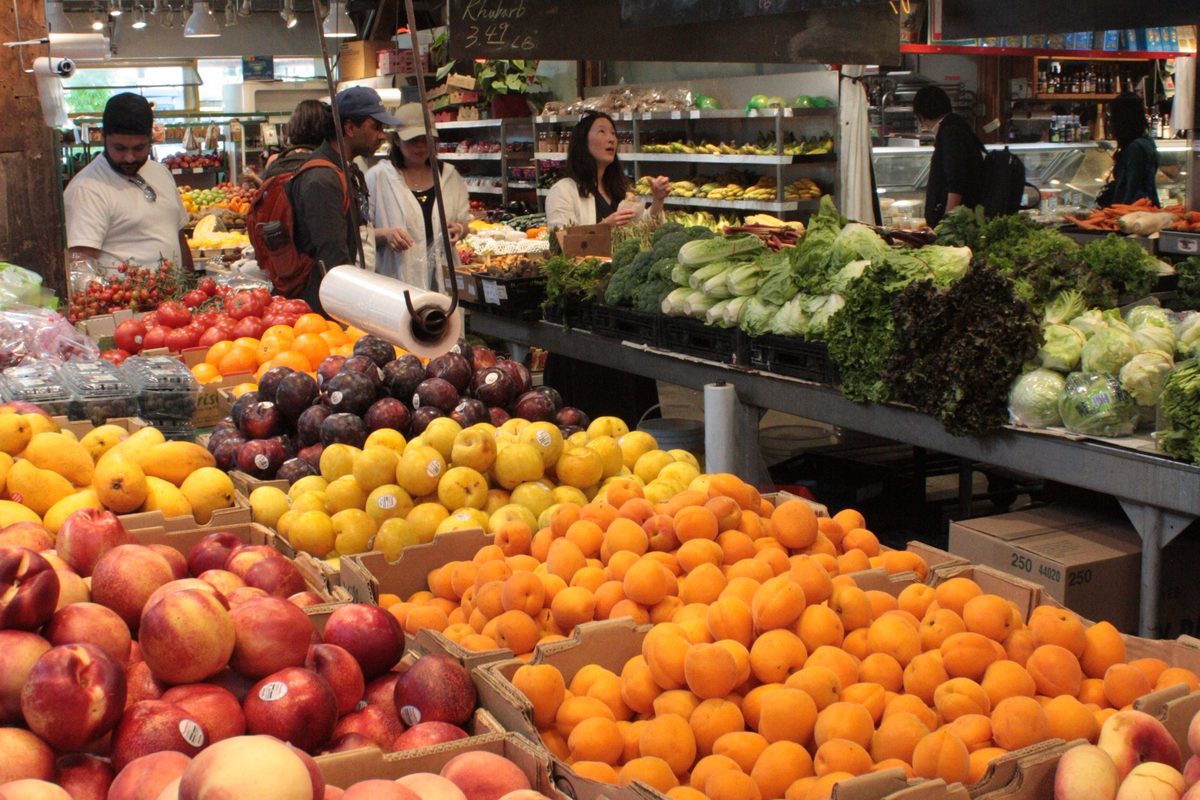
- Fruit stands, Granville Island Public Market- July 2024Wikimedia Commons, photo by Lbtexploring · The photo, CC0
General information, not medical advice. This observational study shows associations between changes in social life and daily fruit and vegetable eating, not cause and effect. If you are worried about your diet, your weight or loneliness, talk to your doctor or a registered dietitian.
Analysis by NutroPractic from the sources listed. Written for general readers; it does not replace advice from your own doctor.
From our articles
Read, then eat a little better
Plain-language guides on nutrition and wellness, backed by research.

Women's health
Inositol for PCOS: the 40:1 ratio, trial doses, and food milligrams
Why do randomized trials in polycystic ovary syndrome prioritize the 40:1 myo to D-chiro inositol ratio? Here is the science behind the ovarian epimerase paradox, clinical ovulation and insulin metrics, and why cantaloupe cannot replace 4,000 mg trial powder.
21 Nov 2026

Everyday eating
Extra virgin olive oil polyphenols: the EU health claim, smoke point myths, and cooking stability
Does extra virgin olive oil degrade when cooked? What does the EU 5 mg polyphenol health claim require, how does oleocanthal act like ibuprofen, and why does oxidative stability matter more than smoke point in domestic frying? Here is the clinical and culinary data.
21 Nov 2026

Food and nutrition
L-theanine and caffeine: what cognitive trials measured on sustained attention, and milligrams in matcha vs green tea
Combining L-theanine with caffeine produces clean focus without caffeine jitters. Here is what randomized trials measured on attention-switching, EEG alpha brain waves, and the exact milligrams across ceremonial matcha, culinary powder, gyokuro, and sencha.
20 Nov 2026
Newsfeed for your website
Want this feed on your website?
Add it to any site with one copy-and-paste snippet. No sign-up, and it updates itself every hour.
Start with a virtual consultation
Tell Dr. Triveni what you want to change. You will leave with a clear next step, whether you are in Toronto, London, New York or Chennai.