Bone health · October 20, 2026
Do calcium and vitamin D pills make children grow taller? 16 trials, about 2,100 children: no clear gain in height or weight, and only a sliver more bone
Calcium and vitamin D are often sold to parents as growth helpers. A new review of 16 randomised trials in healthy children aged 3 to 17 put that idea to the test. The height result was flat, the bone result was real but tiny, and the authors end with clear advice on who actually needs a supplement.

Few nutrients carry as much parental hope as calcium and vitamin D. Both are central to how a growing skeleton is built, and supplements for children are often marketed with the promise of stronger bones and better growth. A systematic review published on 16 October in Frontiers in Nutrition asked a simple question: in healthy children, does adding calcium, vitamin D or both actually change how fast they grow or how dense their bones become?
A team from Chengdu University of Traditional Chinese Medicine searched eight databases, in English and Chinese, up to June 2026 for randomised controlled trials of oral calcium and/or vitamin D in healthy children and adolescents. They found 16 trials with about 2,100 participants aged 3 to 17, mostly around puberty and mostly girls. Doses ran from 300 to 1,200 mg of calcium a day and 60 to 800 IU of vitamin D a day, for 6 to 48 months. Besides pooling the trials, they ran a network meta-analysis, which compares calcium alone, vitamin D alone and the two together even where no trial tested them head to head.
Growth first. Children given a supplement grew 0.0441 cm a month more than those on placebo, roughly half a centimetre a year, but the 95% confidence interval ran from slightly below zero to about 0.1 cm a month, so the difference was not statistically significant, and the trials disagreed with each other a lot (I² 85.6%). Weight gain was just as flat: 0.0075 kg a month more, also not significant, with the trials this time in close agreement. None of the three regimens clearly beat placebo or each other for height or weight.
Bone density is where something did show up. Supplemented children ended up with slightly denser bone at the lumbar spine (+0.0145 g/cm²), the femoral neck at the top of the thigh bone (+0.0101 g/cm²) and the whole body (+0.0110 g/cm²), all statistically significant. These are small numbers, and for the spine and whole body the trials varied widely. In the network analysis, calcium alone was the only regimen with a clear edge over placebo, for the spine and the whole body; the calcium plus vitamin D combination ranked highest for the spine and hip, but its credible intervals crossed zero, and no active regimen proved better than another.
The age splits are intriguing but thin. The only real height signal came from children aged 3 to 6, and that rests on a single trial of 133 children; in children over 11 the height effect was essentially zero, while their spine and hip density gains held up. How long the supplements were taken made no significant difference. The authors flag the weak points themselves: most trials had some risk of bias, mainly in how they reported results; DXA scanners and methods differed; few trials reported children's starting calcium intake or vitamin D blood levels, so deficient and well-fed children were pooled together; and safety was barely reported (the trials that did report it noted only mild stomach upset).
Their conclusion is plain. Calcium and vitamin D supplements did not meaningfully speed up height or weight gain in healthy children, and the small bone density gains do not show stronger bones or fewer fractures. Supplements make sense for a child whose diet is short of calcium, who has a measured deficiency or who has another medical reason, not as a routine way to boost growth. For everyone else, the building blocks are still food, sensible time outdoors and plenty of active play.
Calcium and/or vitamin D supplements in healthy children: 16 randomised trials, about 2,100 participants aged 3 to 17
16
Randomised controlled trials pooled, from eight databases searched up to June 2026
+0.044 cm
Extra height growth per month with supplements, not significant (MD 0.0441, 95% CI -0.0114 to 0.0996)
+0.008 kg
Extra weight gain per month, not significant (MD 0.0075, 95% CI -0.0064 to 0.0214)
+0.0145 g/cm²
Lumbar spine bone density gain (95% CI 0.0040 to 0.0249; I² 94.1%)
+0.0101 g/cm²
Femoral neck (hip) bone density gain (95% CI 0.0064 to 0.0138; I² 34.3%)
6 to 48 months
Trial length; doses 300 to 1,200 mg calcium and 60 to 800 IU vitamin D a day
Study: Lv G, Liu P, He J, Qu F, Zhou Y, Wang S, Xiang H, Gou H, 'Comparative effects of calcium, vitamin D, and combined supplementation on growth and bone mineral density in healthy children and adolescents: a systematic review and network meta-analysis', Frontiers in Nutrition 2026, volume 13, published 16 October 2026, doi 10.3389/fnut.2026.1979566 (open access, CC BY 4.0; PROSPERO CRD420261388414). Databases: PubMed, Web of Science, Embase, Cochrane Library, CNKI, Wanfang, VIP, SinoMed. Pairwise random-effects results, supplement vs control: height 14 trials, weight 12, lumbar spine BMD 11, femoral neck BMD 5, total body BMD 6 (MD 0.0110 g/cm², 95% CI 0.0049 to 0.0170; I² 86.8%). Bayesian network meta-analysis vs placebo, 95% credible intervals: lumbar spine BMD calcium 0.014 (0.0001 to 0.029), calcium + vitamin D 0.024 (-0.0010 to 0.050), vitamin D 0.006 (-0.025 to 0.035); total body BMD calcium 0.012 (0.002 to 0.023); height vitamin D 0.111 cm/month (-0.006 to 0.247). SUCRA rankings were not treated as proof of superiority. Age subgroups: height in ages 3 to 6, one trial of 133 children, 0.16 cm/month (0.106 to 0.214); ages over 11, -0.006 (-0.026 to 0.013). 'Roughly half a centimetre a year' is 0.0441 x 12, our arithmetic. Most trials had some risk-of-bias concerns; adverse events were reported in few trials and were mild gastrointestinal discomfort.
- The photo above was taken in 1944 at a school in Hertfordshire, England. According to its original caption, every child received either a third or two-thirds of a pint of milk a day, and free milk was given to evacuees and poor children.
- Bone density keeps climbing through childhood and the teens: until bone mass peaks in the mid to late 20s, new bone is made faster than old bone is broken down, according to the US National Institute of Arthritis and Musculoskeletal and Skin Diseases.
- Bone mineral density in studies like this one is measured with DXA, a low-dose X-ray scan, and reported in grams of mineral per square centimetre of bone as seen on the scan. That is why the gains here are written as fractions of a gram per cm².
- The vitamin D doses in these trials ran from 60 to 800 IU a day, which is 1.5 to 20 micrograms (1 microgram of vitamin D is 40 IU).
- Comparative effects of calcium, vitamin D, and combined supplementation on growth and bone mineral density in healthy children and adolescents: a systematic review and network meta-analysisFrontiers in Nutrition, October 2026 · The study: full text, open access
- Healthy Bones MatterNational Institute of Arthritis and Musculoskeletal and Skin Diseases (NIH) · How bones are built through childhood and when bone mass peaks
- Girls at Baldock County Council School in Hertfordshire enjoy a drink of milk, 1944 (IWM D 20552)Wikimedia Commons, from the Imperial War Museums collection · The photo and its original caption on school milk
General information, not medical advice. This review looked at healthy children; it does not apply to children with a vitamin D or calcium deficiency, a bone condition or another medical reason for supplements. Do not start, stop or change a child's supplements without advice. If you are worried about your child's growth, diet or bones, talk to your doctor, paediatrician or a registered dietitian.
Analysis by NutroPractic from the sources listed. Written for general readers; it does not replace advice from your own doctor.
From our articles
Our guides on this subject
Plain-language guides on nutrition and wellness, backed by research.
Women's health
Eating through menopause: what changes for your bones, muscle and heart, and what to put on the plate
Around the final period, bone density at the spine drops by about 2% a year and LDL cholesterol jumps within a year or two. Hot flushes get the attention, but these quieter changes are where food and strength training do the most. Targets for protein, calcium and vitamin D, an honest look at soy, and a week you can start on Monday.
8 Oct 2026
Supplements and vitamins
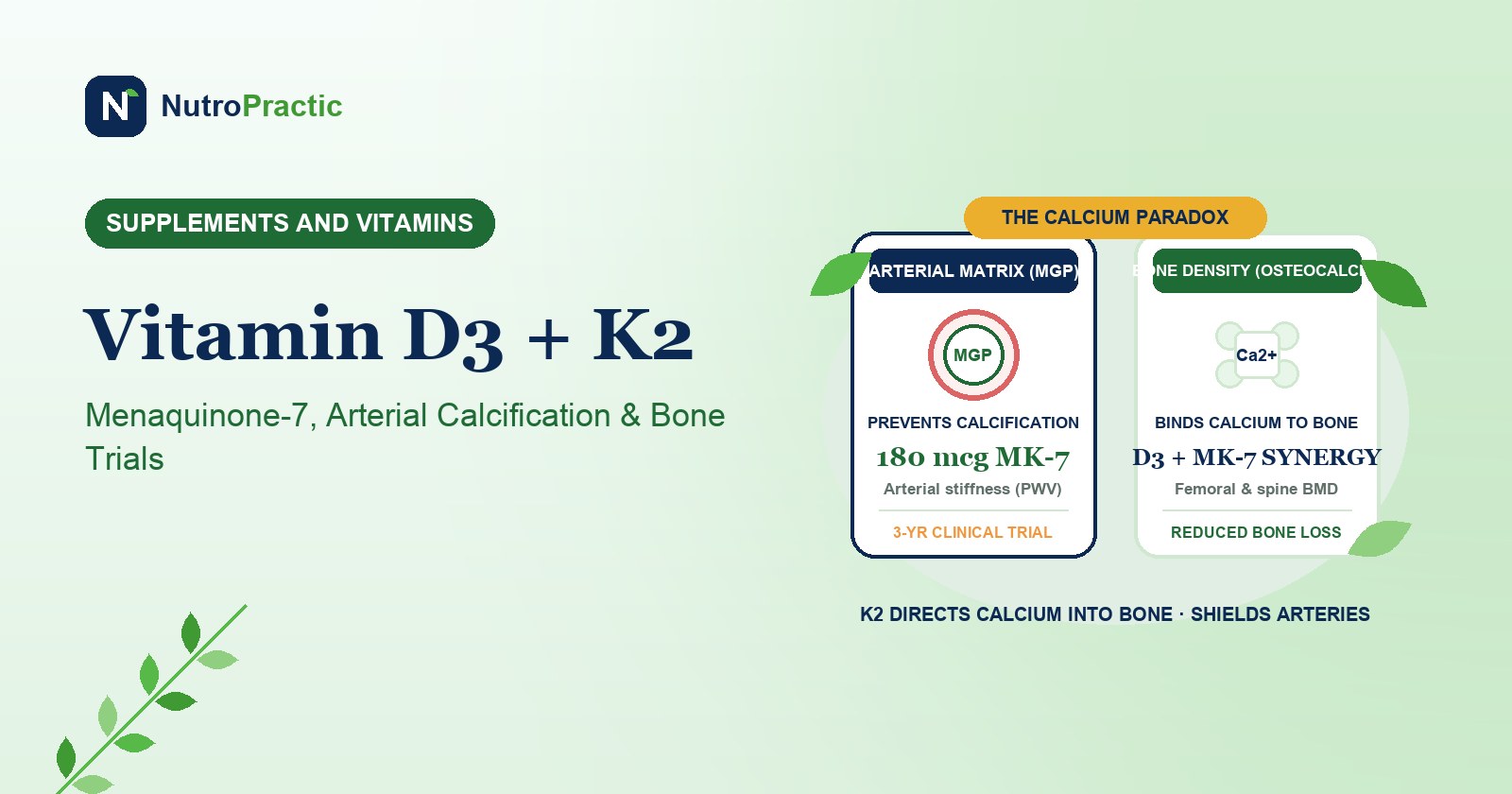
Vitamin D3 with K2: does adding menaquinone-7 actually protect arteries and bones in trials?
Vitamin D3 enhances intestinal calcium absorption, but without adequate vitamin K2, calcium can deposit in vascular walls instead of bone matrix. Clinical trials evaluating menaquinone-7 (MK-7) demonstrate improved carboxylation of Matrix Gla Protein, preserved arterial elasticity, and reduced bone mineral density loss. Discover what human clinical trials actually prove about cardiovascular calcification, bone density, MK-4 vs. MK-7 dosing, and critical drug interactions.
13 Nov 2026

Children's nutrition
Feeding a teenage athlete: energy, iron, calcium and the sports drink question
Teenage athletes are growing and training at the same time, and under-eating (REDs) is found in up to 80% of female and 70% of male athletes in studies. A worked energy example for a 15-year-old footballer, protein and carbohydrate targets, iron and calcium in the growth spurt, when sports drinks help and when they are dessert, and the supplements to skip.
20 Oct 2026
Newsfeed for your website
Want this feed on your website?
Add it to any site with one copy-and-paste snippet. No sign-up, and it updates itself every hour.
Start with a virtual consultation
Tell Dr. Triveni what you want to change. You will leave with a clear next step, whether you are in Toronto, London, New York or Chennai.