Supplement safety · October 23, 2026
'With black pepper extract for better absorption': 22 human studies behind the label claim. The boost for nutrients came mostly from the ingredient's maker; the boost for prescription drugs showed up in 12 of 14
Piperine, the hot compound in black pepper, is added to turmeric capsules and many other supplements to help them 'absorb better'. A new Perspective in Frontiers in Nutrition lined up every human study the author could find. Trials run without the piperine maker mostly found no extra curcumin, while drug studies kept finding more of the medicine in the blood.
Turn a tub of turmeric capsules around and there is a good chance the label says 'with black pepper extract' or names a branded piperine ingredient, usually with a line about better absorption. The claim goes back to one widely cited study in which 20 mg of piperine raised blood levels of curcumin, turmeric's main compound, by about 2,000 per cent. Piperine now turns up in blends for joints, skin, gut and liver as well.
Masaki Kaneko, who runs a Japanese group of supplement companies, set out to check what that claim rests on. His Perspective, published in Frontiers in Nutrition on 16 October, gathers 22 human studies in which piperine was compared with no piperine (or less of it) and the amount of another substance in the blood was measured: 8 with nutrients or plant compounds and 14 with prescription drugs. He also sorted each study by who ran or paid for it. It is a structured search he did alone, not a formal systematic review.
The first point is how piperine works. It mostly does not help the gut take things in. It slows the enzymes and pumps that break down and clear substances from the body, chiefly the liver and gut enzyme CYP3A4, CYP2C9 and a transporter called P-glycoprotein. That is the same kind of effect that makes grapefruit juice a problem with some medicines, and those enzymes handle a large share of the drugs people swallow. So piperine cannot pick out the nutrient it was added for.
On the nutrient side, the studies that found a boost were, with one exception from 2025, run or paid for by the company that makes the piperine ingredient, and they were small. In the 2,000 per cent study, curcumin taken alone was barely detectable, so the rise was measured from almost nothing. A 14-day trial found a bigger rise in beta-carotene with piperine, and in a coenzyme Q10 trial only the 21-day, 120 mg arm went up, by about 30 per cent. Studies without the piperine maker told a different story: in three curcumin trials with 12, 30 and 9 people, piperine products did no better than plain curcumin, and in one of them curcumin made more soluble with micelles reached 57 times the blood level of plain curcumin. In a trial of 2,280 mg of curcumin with 20 mg of piperine, free curcumin stayed under 2 nanomoles per litre in most people, and 20 mg of piperine did not change blood resveratrol.
The drug studies, mostly from university pharmacology units, went the other way. Twelve of the 14 found more of the medicine in the blood. Taking 20 mg of piperine a day for 10 days raised exposure to the epilepsy drug carbamazepine by about 48 per cent, to the painkiller diclofenac by about 66 per cent and to the allergy drug fexofenadine by about 68 per cent; with the HIV drug nevirapine the rise was about 170 per cent. Three days of 15 mg raised levels of the sedative midazolam and made its effect last longer. In 15 women with breast cancer, curcumin plus piperine instead lowered the active form of tamoxifen by 12.4 per cent, so the direction cannot be taken for granted.
There is a safety angle too. In a US registry series of ten cases of liver injury linked to turmeric, five people were taken to hospital and one died, and three of the seven products tested also contained piperine. Causation is not proven and such cases appear rare, but the author points out that people can end up on the combination without knowing it, by taking a joint or skin blend with a little curcumin alongside a separate product with black pepper extract.
The paper has limits that matter. It is one author's reading of mostly small, often older studies, several of them open-label and not randomised, and none tested piperine in the multi-ingredient products where it is most often sold. Newer curcumin studies also use better lab methods, which may explain part of the gap between old and new results. The author declares that his own companies make supplements, though none with piperine, and that his employer paid the publication fee. He does not argue for a ban: piperine can make sense when a nutrient is known to be broken down fast, the boost has been shown in people for that form and dose, and the label warns people on medicines. His practical advice is to look for 'black pepper extract', 'Piper nigrum extract' or 'piperine' on labels and tell your doctor or pharmacist about every supplement you take.
Piperine in 22 human studies: what it did to blood levels of nutrients and of prescription drugs
22
Human studies compared: 8 with nutrients or plant compounds, 14 with prescription drugs
12 of 14
Drug studies in which piperine raised the amount of the medicine in the blood
+48% / +66%
Rise in exposure to carbamazepine and diclofenac after 20 mg of piperine a day for 10 days
≈ +170%
Rise in exposure to the HIV drug nevirapine with 20 mg of piperine a day
3 of 3
Curcumin trials with 12, 30 and 9 people in which piperine products did no better than plain curcumin
−12.4%
Change in the active form of tamoxifen with curcumin plus piperine in 15 women with breast cancer
Source: Kaneko M, 'Enhancement without a rationale? Black pepper extract (piperine) in dietary supplements and the future of formulation: a perspective from Japan', Frontiers in Nutrition 13:1981406, published 16 October 2026, doi 10.3389/fnut.2026.1981406, open access (CC BY 4.0). Article type: Perspective with a structured, not formally systematic, summary of 22 human pharmacokinetic studies (PubMed and Google Scholar, September 2026; screened by the sole author), each classed by funding or affiliation as piperine-ingredient manufacturer, competing-formulation manufacturer, patent-holding research group or no commercial affiliation identified. Nutrient studies (8): curcumin +2,000% (piperine maker; curcumin alone near the limit of detection); beta-carotene 49.8 vs 30.9 µg/dL serum response (piperine maker); coenzyme Q10 not significant at single dose or 14 days, about +30% at 21 days on 120 mg (piperine maker); resveratrol unchanged (academic); curcumin formulations in 12 adults, piperine not significant vs native, micelles 57×, gamma-cyclodextrin 30× (academic); curcuminoids in 30 adults, no difference vs standard extract (competing maker); curcumin 2,280 mg in 9 men, unconjugated curcumin < 2 nM in most (academic); 2025 three-arm long-pepper study, 10% vs 1% extract AUC 1,480 vs 25 ng·h/mL, piperine-free comparator 1,458 from less than half the curcuminoid dose (competing maker). Drug studies (14): raised exposure in 12, including carbamazepine AUC about +48%, diclofenac AUC +66%, Cmax +64%, half-life +34%, fexofenadine AUC about +68%, nevirapine AUC about +170%, Cmax about +120%; no meaningful change for midazolam, flurbiprofen and paracetamol after 2 days of curcuminoids 4 g plus piperine 24 mg; endoxifen AUC −12.4% (−7.7% with curcumin alone). Three drug studies come from the group holding a patent on piperine as a bioenhancer; one has manufacturer co-authors. Liver: US registry series of 10 adjudicated turmeric liver-injury cases, 5 hospitalised, 1 death, 3 of 7 analysed products contained piperine (causation unproven). Conflicts: the author is chief executive of the KYB Group, which makes and sells supplements (none with piperine) and paid the article processing charge. The author states an AI tool helped with drafting and language. AUC = total exposure over time; Cmax = peak blood level.
- Piperine is the compound that gives black pepper its bite. The studies in the review gave 5 to 24 mg of purified piperine at a time, and the author's concern is this kind of concentrated daily dose, not the pepper ground over a meal.
- Whether everyday cooking amounts of black pepper affect medicines is unclear. In one small crossover study of six volunteers, the epilepsy drug phenytoin was absorbed more after a pepper-containing meal, but nobody knows if that matters in real life.
- Grapefruit juice and St John's wort change how the body handles many medicines through the same enzyme, CYP3A4, that piperine slows down.
- Most curcumin in the blood circulates in a 'conjugated' form the body has already tagged for removal. Older studies that showed big rises with piperine generally measured this total, not the free curcumin.
- The US National Center for Complementary and Integrative Health warns that liver damage has been reported with curcumin products made to be more bioavailable, and advises stopping and seeing a doctor if you notice tiredness, nausea, poor appetite, dark urine or yellowing skin.
- Enhancement without a rationale? Black pepper extract (piperine) in dietary supplements and the future of formulation: a perspective from JapanFrontiers in Nutrition · The Perspective, open access, with the table of 22 human studies
- TurmericUS National Center for Complementary and Integrative Health · Piperine in curcumin products and reports of liver damage
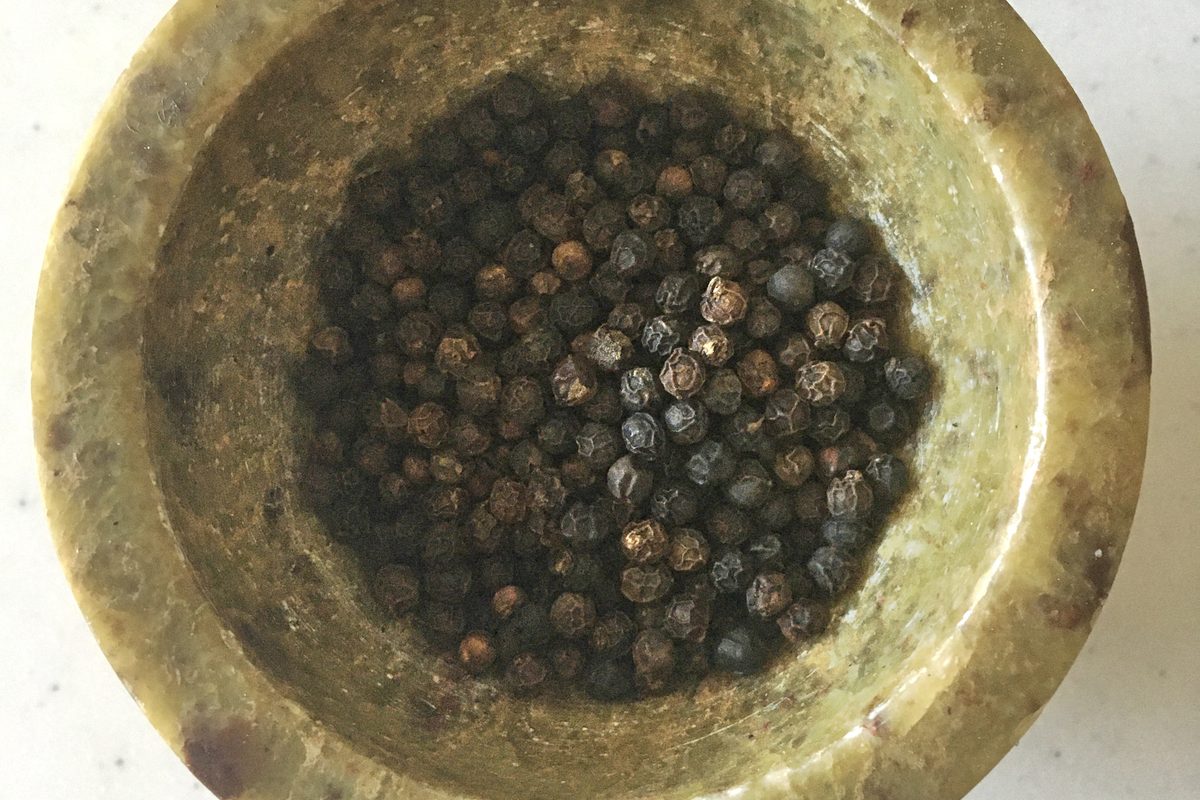
- Tellicherry Black PeppercornsWikimedia Commons · The photo, CC0
General information, not medical advice. This is one author's review of mostly small studies, not a test of any product. If you take prescription medicines, especially for epilepsy, blood thinning, HIV, cancer or after a transplant, ask your doctor or pharmacist before starting a supplement with black pepper extract or turmeric, and don't stop or change any medicine on your own.
Analysis by NutroPractic from the sources listed. Written for general readers; it does not replace advice from your own doctor.
From our articles
Read, then eat a little better
Plain-language guides on nutrition and wellness, backed by research.

Women's health
Inositol for PCOS: the 40:1 ratio, trial doses, and food milligrams
Why do randomized trials in polycystic ovary syndrome prioritize the 40:1 myo to D-chiro inositol ratio? Here is the science behind the ovarian epimerase paradox, clinical ovulation and insulin metrics, and why cantaloupe cannot replace 4,000 mg trial powder.
21 Nov 2026

Everyday eating
Extra virgin olive oil polyphenols: the EU health claim, smoke point myths, and cooking stability
Does extra virgin olive oil degrade when cooked? What does the EU 5 mg polyphenol health claim require, how does oleocanthal act like ibuprofen, and why does oxidative stability matter more than smoke point in domestic frying? Here is the clinical and culinary data.
21 Nov 2026

Food and nutrition
L-theanine and caffeine: what cognitive trials measured on sustained attention, and milligrams in matcha vs green tea
Combining L-theanine with caffeine produces clean focus without caffeine jitters. Here is what randomized trials measured on attention-switching, EEG alpha brain waves, and the exact milligrams across ceremonial matcha, culinary powder, gyokuro, and sencha.
20 Nov 2026
Newsfeed for your website
Want this feed on your website?
Add it to any site with one copy-and-paste snippet. No sign-up, and it updates itself every hour.
Start with a virtual consultation
Tell Dr. Triveni what you want to change. You will leave with a clear next step, whether you are in Toronto, London, New York or Chennai.