Immunity · October 29, 2026
A handful of almonds a day before the flu jab: 90 Londoners took part. Almost everyone responded to the vaccine either way, but on the almonds, antibodies to one strain came out about three times higher
Can a snack help a vaccine work? Researchers in London swapped the usual snacks of 90 healthy middle-aged adults for almonds or pretzels for eight weeks, with a flu jab halfway through. The main result was a draw. What turned up underneath it is why the authors want a second trial in people whose jabs work less well.
Certain nutrient supplements have been found to boost the body's response to vaccines. A whole food had never been put through a randomised trial for that, according to a team at King's College London. They chose almonds, which bring fibre that gut bacteria feed on along with nutrients the immune system uses, and published the results in the American Journal of Clinical Nutrition on 26 October.
The NutrImmune trial took healthy adults aged 40 to 64 who normally ate at least two snacks a day and less than 30 g of fibre. Ninety were randomised (average age 51, 73% women). For eight weeks one group swapped their usual snacks for 56 g of almonds a day, about two handfuls. The other group got 86 g of pretzels, a commercial snack with the same calories. At week four everyone had the seasonal flu vaccine, and blood taken before the jab and four weeks after it was tested for antibodies to each strain in the vaccine. Stool samples tracked gut bacteria, the short-chain fatty acids they make, and bowel habits.
The main question was how many people seroconverted, meaning their antibodies to at least one strain rose fourfold or more. Nearly everyone did: 38 of 41 on almonds (93%) and 37 of 39 on pretzels (95%), no real difference. The almond group was no more likely to seroconvert to any single strain, or to end up with levels counted as protective.
The size of the response was another matter for two strains. Against the H1N1 strain A/Wisconsin/67/2022, the almond group's antibody level after the jab averaged 359 against 110 on pretzels, and the rise from before the jab averaged eighteenfold against fourfold. For the B/Yamagata strain the rise was tenfold against fivefold. In the gut, one bacterium, Roseburia hominis, was more plentiful on almonds. Short-chain fatty acids and stool consistency didn't change.
The authors' own reading is modest: almonds raised antibody levels but didn't change whether people responded, in healthy adults for whom the vaccine already works well. Higher antibody levels don't automatically mean fewer flu cases, and the trial didn't measure infections. The confidence ranges around the averages are wide, the comparison was against pretzels rather than a person's usual snacks, and the trial was funded by the Almond Board of California. The real test, they suggest, would be older or less healthy people, whose response to the flu jab is weaker to begin with.
Almonds or pretzels for eight weeks around a seasonal flu vaccination: randomised controlled trial in healthy adults (King's College London, 2026)
90
Healthy adults aged 40 to 64 randomised, mean age 51, 73% women
56 g vs 86 g
Almonds a day vs pretzels, the same calories, in place of usual snacks for 8 weeks; flu jab at week 4
93% vs 95%
Seroconverted to at least one strain (a fourfold antibody rise): 38 of 41 on almonds, 37 of 39 on pretzels; no difference
359 vs 110
Average antibody level to the H1N1 strain after the jab, almonds vs pretzels
18-fold vs 4-fold
Average rise in H1N1 antibodies from before to after the jab; for B/Yamagata it was 10-fold vs 5-fold
No change
In short-chain fatty acids or stool consistency; one gut bacterium, Roseburia hominis, was more plentiful on almonds
Parallel randomised controlled trial (NutrImmune, NCT05515263) at King's College London, started September 2022. Almonds 56 g/day vs isocaloric pretzels 86 g/day for 8 weeks; seasonal influenza vaccine at week 4. Primary outcome: seroconversion (at least a fourfold rise in haemagglutination inhibition titre) to one or more strains at week 8. Antibody levels are geometric means (almonds 359, 95% CI 146 to 881; pretzels 110, 51 to 235); fold changes are geometric mean fold changes (H1N1 18, 7 to 48 vs 4, 3 to 7; B/Yamagata 10, 6 to 16 vs 5, 3 to 7). Strain-specific seroconversion and seroprotection did not differ. Figures from the published abstract and the trial registration. Funded by the Almond Board of California. Published online 26 October 2026, open access (CC BY).
- To get the same calories as 56 g of almonds, the control group needed 86 g of pretzels: almonds are about half fat, which carries more than twice the calories per gram of the starch that pretzels are made of.
- The trial only took people who already ate at least two snacks a day, so the almonds replaced something rather than being added on top.
- Seroconversion, the trial's main measure, means antibodies to a flu strain at least four times higher four weeks after the jab than just before it.
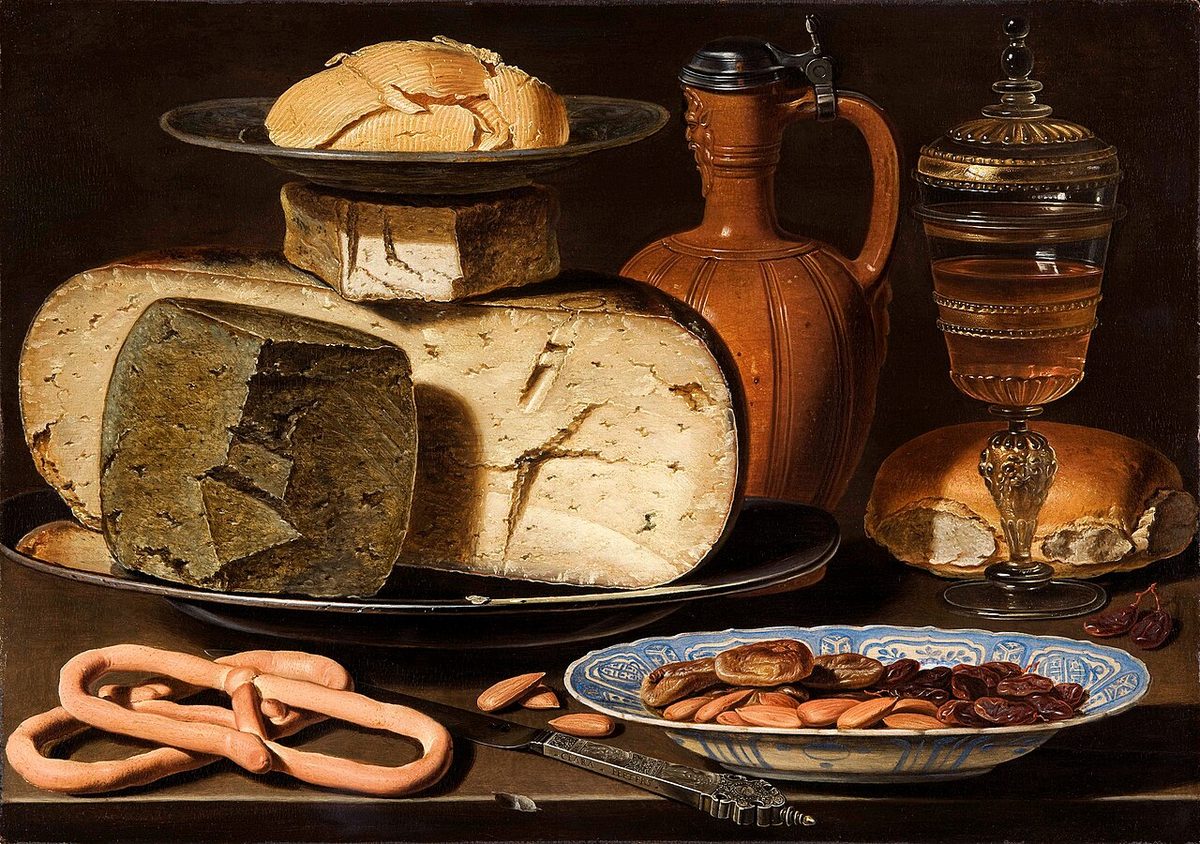
- The painting above, by the Flemish artist Clara Peeters, puts almonds and pretzels side by side on one table about 400 years before this trial did.
- Almonds and the optimization of immune responses to influenza vaccination, compared to a control snack, in healthy adults: a randomized controlled trialThe American Journal of Clinical Nutrition · The study, published online 26 October 2026; figures from the published abstract
- Snack Foods and Their Impact on Immune Optimisation to the Influenza Vaccination (NutrImmune)ClinicalTrials.gov · The trial registration: who could take part, the seroconversion definition and the strains measured
- Clara Peeters - Still Life with Cheeses, Almonds and PretzelsWikimedia Commons · The image, public domain (Mauritshuis, The Hague)
General information, not medical advice. This was one trial in healthy adults, funded by an almond industry body, and it measured antibodies, not whether people caught flu. Eating almonds is not a substitute for the flu vaccine. Anyone with a nut allergy should avoid almonds, and questions about vaccination or diet are best taken to a doctor or pharmacist.
Analysis by NutroPractic from the sources listed. Written for general readers; it does not replace advice from your own doctor.
From our articles
Read, then eat a little better
Plain-language guides on nutrition and wellness, backed by research.
Diabetes
Potatoes and blood sugar: boiled, cooled, mashed or fried, and what the cohorts and trials found
Fries were linked to 20% higher diabetes risk per three servings a week in 205,000 US adults; boiled, baked and mashed potatoes to almost none. GI by cooking method, resistant starch in grams after chilling, the glycaemic load of a potato against a cup of rice, and how to fit aloo into an Indian plate.
30 Oct 2026
Children's nutrition
Picky eaters aged 2 to 8: what feeding studies show works at the table
Fussy eating peaks between two and six and is usually a normal stage, not a parenting failure. Feeding trials show what moves it: small repeated tastes, eating together, no pressure and the right kind of reward. Here is how to use them, and the signs that mean it's more than picky eating.
30 Oct 2026
Women's health
PCOS and food: what the diet trials show for cycles, insulin and weight
PCOS affects about one woman in ten, and most are told to "lose weight" with little else. Here is what drives it, why insulin matters even in slim women, how much weight loss brings cycles back, what the low-GI and Mediterranean trials found, what inositol and metformin do, and which tests to ask for.
30 Oct 2026
Newsfeed for your website
Want this feed on your website?
Add it to any site with one copy-and-paste snippet. No sign-up, and it updates itself every hour.
Start with a virtual consultation
Tell Dr. Triveni what you want to change. You will leave with a clear next step, whether you are in Toronto, London, New York or Chennai.