Diabetes and technology · October 19, 2026
150 plates of Singapore food, weighed by a dietitian, then photographed for two AIs. A purpose-built app landed within 10 g of the carbs four times in five; ChatGPT-5 managed about seven in ten
People who dose insulin at mealtimes have to guess the carbohydrate on every plate, and a photo-reading app sounds like the answer. A hospital team in Singapore put one such app and ChatGPT-5 up against a dietitian with a kitchen scale. Both came close on a banana. On a plate of economy rice, the gap opened up.
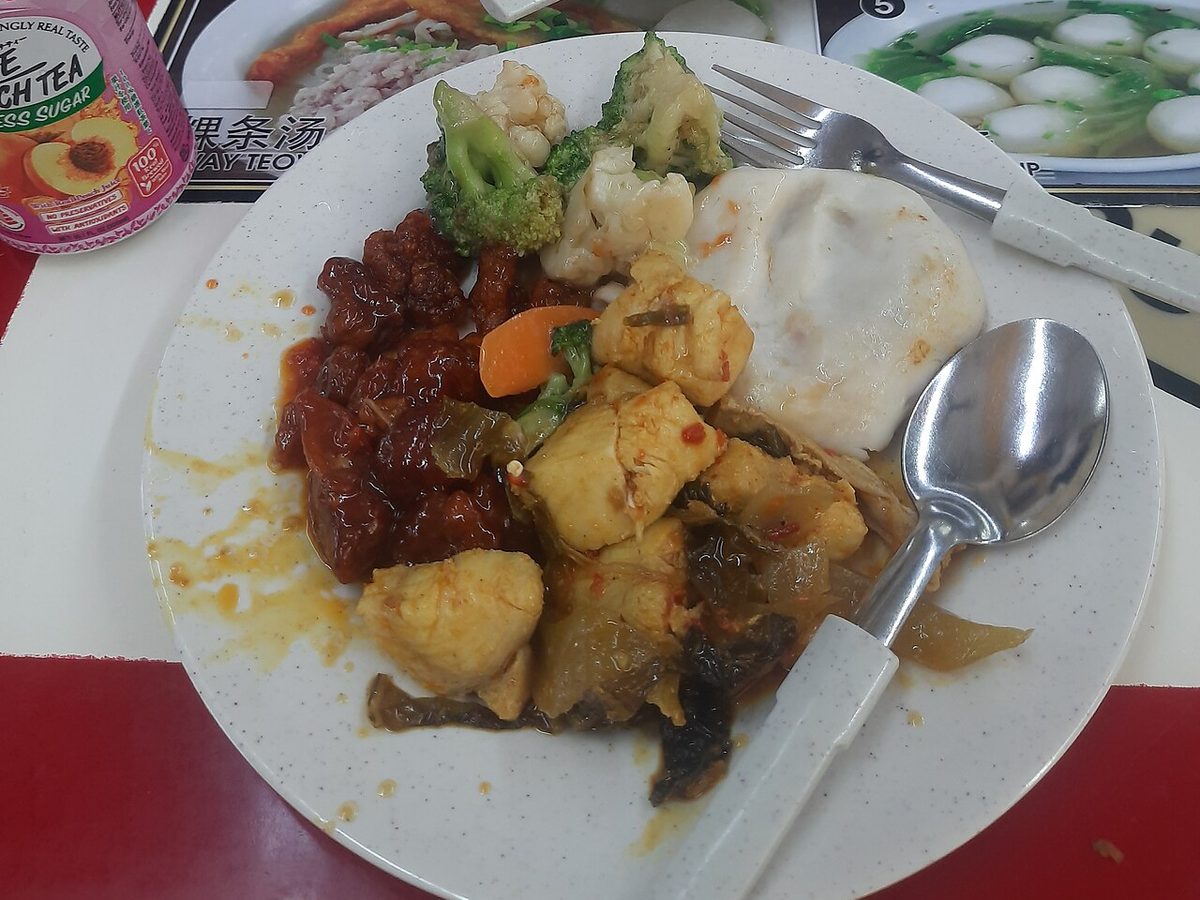
For anyone with type 1 diabetes on mealtime insulin injections, every plate is a maths problem: how many grams of carbohydrate are on it, and so how much insulin to take. Being out by around 10 g is generally thought to do little harm, but errors of about 20 g can push blood sugar too high or too low after the meal. It is hard to do by eye, and harder still when most meals are eaten out, which is why apps that read a food photo have drawn so much interest.
A study published on 14 October in Frontiers in Nutrition tested two of them on the food people in Singapore actually eat. Nurses, endocrinologists and dietitians at Tan Tock Seng Hospital and the National University of Singapore collected 162 food items in July and August 2025 from hawker centres, food courts, restaurants, homes, supermarkets and convenience stores. Twelve, mostly cakes and buns, were dropped because no nutrient database had a reliable carbohydrate value for them, leaving 150: 90 simple foods such as fruit, eggs or plain rice, and 60 composite meals with several components on one plate. Soups, drinks and saucy dishes were left out because no one can judge their portions from a picture.
Each item was weighed to the gram, and a registered dietitian worked out its carbohydrate from the weights and standard food tables, without seeing either AI's answer. The same food was photographed with an iPhone for NutriDish, an app built for Asian food that asks for a top-down and an angled shot next to a reference object such as a standard plate, a coin or the nutrition label, and matches what it sees against a database of more than two million foods. The top-down image was also uploaded to ChatGPT-5 with a single prompt, 'Please estimate the amount of carbohydrate', and the first answer was recorded.
On average the dietitian's figure was 35.2 g per item. NutriDish was off by 5.9 g on average and ChatGPT-5 by 8.7 g. NutriDish came within 10 g of the dietitian on 121 of the 150 items (80.7%), ChatGPT-5 on 104 (69.3%). Both were right on 90 items and both wrong on 15. ChatGPT-5 also leaned high, overestimating by about 2.8 g on average, while the app showed no consistent lean either way.
The plate mattered more than the tool. NutriDish was within 10 g on 91% of simple foods but only 65% of composite meals. With a nutrition label in the frame it was within 10 g nine times in ten, which is close to reading the answer off the packet; with only a coin for scale, it managed 57%.
There are good reasons to read this cautiously. NutriDish was co-designed by the hospital and BUZUD, the company behind it, which also paid for the prototype and study resources, though the authors say it had no part in the analysis. The photos were taken by trained staff under careful conditions, not by hungry people at a busy stall. ChatGPT-5 got one short prompt and one image, with no hint of the cuisine, the plate size or a second angle; the authors note that better prompting might have narrowed the gap. And no one ate the food: the study measured guesses, not insulin doses or blood sugar. The fair takeaway is narrower: photo tools can come close on simple foods, mixed plates are still where they slip, and an estimate from any of them is worth a sanity check before it decides an insulin dose.
Carbohydrate estimates from a food-photo app and ChatGPT-5 against a dietitian's weighed values, 150 foods in Singapore
150
Foods analysed: 90 simple items and 60 composite meals, from hawker centres, food courts, homes and shops
80.7% vs 69.3%
Estimates within 10 g of the dietitian's value: NutriDish vs ChatGPT-5
5.9 g vs 8.7 g
Average size of the error per item: NutriDish vs ChatGPT-5 (reference average 35.2 g)
+2.8 g
ChatGPT-5's average lean towards overestimating; NutriDish's +0.8 g was not significant
91% vs 65%
NutriDish within 10 g on simple foods vs composite meals
57%
NutriDish within 10 g when a coin was the only size reference, against 91% with a nutrition label
Study: Lian X, Lian W, Phua HP, Tan AWK, Liew H, et al., Dalan R, 'Comparative accuracy of automated carbohydrate estimation using NutriDish and ChatGPT-5 against dietitian-derived reference values', Frontiers in Nutrition, published 14 October 2026, doi 10.3389/fnut.2026.1927840 (open access, CC BY 4.0). Tan Tock Seng Hospital and National University of Singapore. 162 items collected July to August 2025; 12 excluded for lack of reference values. Reference: food weighed to the nearest gram, carbohydrate calculated by a blinded registered dietitian from FoodWorks Online, the Health Promotion Board Singapore food composition database and nBuddy, or the label for packaged foods. NutriDish (iOS) used dual-angle photos with a reference object; ChatGPT-5 was given the image through the ChatGPT Plus web interface on 8 to 14 August 2025 with one standardised prompt and one recorded answer. Mean absolute error 5.9 ± 5.3 g vs 8.7 ± 7.4 g (p < 0.001); mean absolute percentage error 22.1% vs 32.9% (p < 0.001); within ±10 g 121 vs 104 items (McNemar p = 0.017 in the results table, 0.016 in the abstract). Bland-Altman mean bias +0.80 g (95% CI −0.49 to 2.08) for NutriDish and +2.79 g (1.01 to 4.57) for ChatGPT-5. Subgroups (NutriDish only): within ±10 g 91.1% simple vs 65.0% composite; by reference object, label 90.9%, plate 82.1%, bento box or foam container 77.8%, coin 57.1%. No people took part and no glucose or insulin outcomes were measured. Funded by BUZUD Pte Ltd, which developed NutriDish in a technical partnership with the hospital; the authors state the funder had no role in design, analysis or writing.
- In a Swiss study of 53 adults and teenagers with type 1 diabetes, people's own carbohydrate guesses for hospital-cooked meals were off by 21 g on average, more than three times the photo app's average error in Singapore.
- Earlier this year a Danish team tested the previous model, ChatGPT-4o, on 60 fruits and vegetables and 60 mixed meals. It was within 10 g on about 93% of the fruit and veg but only 43% to 47% of the mixed meals.
- Singapore's national nutrition survey puts carbohydrate at 47% of adults' energy, about 279 g a day, largely from rice and noodle dishes bought at hawker centres and food courts.
- Economy rice, a plate of steamed rice topped with whatever dishes you point to at the counter, is one of the hawker meals the authors single out as hard to pin down, even for a dietitian with a database, because no two plates are alike.
- Comparative accuracy of automated carbohydrate estimation using NutriDish and ChatGPT-5 against dietitian-derived reference valuesFrontiers in Nutrition, October 2026 · The study: full text, open access
- Evaluating accuracy of ChatGPT-4o in automated carbohydrate estimation from images as a self-management tool for adolescents with type 1 diabetesJournal of Diabetes Science and Technology, February 2026 · The earlier ChatGPT test on fruit, vegetables and mixed meals
- Carbohydrate estimation accuracy of two commercially available smartphone applications vs estimation by individuals with type 1 diabetes: a comparative studyJournal of Diabetes Science and Technology, 2024 · How far off people's own estimates were, compared with two apps
General information, not medical advice. This study compared carbohydrate estimates on photographed food; it did not test whether either tool leads to safer insulin doses or better blood sugar. If you use insulin, don't change how you count carbohydrates or work out your doses on the strength of an app or chatbot alone; ask your diabetes team or dietitian how to check and use any tool you are thinking of trying.
Analysis by NutroPractic from the sources listed. Written for general readers; it does not replace advice from your own doctor.
From our articles
Our guides on this subject
Plain-language guides on nutrition and wellness, backed by research.
Diabetes
Fenugreek, cinnamon and turmeric for blood sugar: what the trials in an Indian kitchen measured
Fenugreek seed at 5-10 g a day lowered HbA1c by about 0.85 points in pooled trials, and in a 3-year Hyderabad study 23% went on to diabetes against 55%. Cinnamon trims fasting glucose by 15-25 mg/dL, but a teaspoon of cassia tops the coumarin limit. Curcumin: about 0.3-0.4 points, and rare liver injury from capsules. Doses in teaspoons, and a fair way to test it at home.
1 Nov 2026
Indian kitchen
Millets in an Indian kitchen: what they do for blood sugar, and how to cook them
Ragi, jowar, bajra and the small millets are sold as the answer to diabetes. A meta-analysis of 65 studies says they help on average, but two Chennai studies found ragi meals no better than white rice and cooked foxtail millet with a GI of 89. What actually makes the difference, and how to cook each one so it does.
30 Oct 2026
Indian kitchen
Dal and pulses in an Indian kitchen: protein, soaking, gas and blood sugar
A katori of dal gives about 6 to 10 g of protein, depending on how much raw dal goes in. What India's food tables and the ICMR-NIN 2024 guidelines say about rice with dal, how much soaking, sprouting and pressure cooking cut phytate and the sugars behind the gas, the GI of chana dal and rajma, raw rajma safety, and a worked plate for diabetes.
25 Oct 2026
Newsfeed for your website
Want this feed on your website?
Add it to any site with one copy-and-paste snippet. No sign-up, and it updates itself every hour.
Start with a virtual consultation
Tell Dr. Triveni what you want to change. You will leave with a clear next step, whether you are in Toronto, London, New York or Chennai.