Longevity · October 19, 2026
Very low vitamin D went with more deaths, strokes and amputations in 468,500 Israelis, and people who bought supplements fared better. Big trials still disagree
Researchers went through ten years of health records from an Israeli health fund and a large US network. People with very low vitamin D were more likely to die and to develop dementia, stroke, diabetes complications and kidney failure. Those whose pharmacy records showed vitamin D purchases did better, and the more they bought, the better they did. So why have the big supplement trials kept coming up empty?
Few blood tests are ordered as often as vitamin D, and few supplements are argued over as much. A study published on 8 October in the journal Aging Cell adds a very large set of numbers to that argument. Researchers in Israel and the US looked at more than 1.67 million vitamin D blood tests from over 468,500 adults in Leumit Health Services, one of Israel's four national health funds, between 2009 and 2020, and then checked their findings in TriNetX, a network of electronic health records from more than 70 US healthcare organisations.
First they dealt with the seasons. Vitamin D in the blood rose and fell through the year, peaking in late August and bottoming out in mid-February, so the team converted every result to its expected winter low before comparing people. On that scale, about one woman in five (20.4%) and one man in ten (9.9%) had severe deficiency, below 10 ng/mL (25 nmol/L).
Next they paired 12,352 adults with severe deficiency with 12,352 people above 30 ng/mL (75 nmol/L) who matched them on age, sex, smoking, weight, blood pressure, income level and community. The average age was 54 and two thirds were women. Over the following years, about 14% of the deficient group died within eight years against about 8% of the others. After adjustment the risk of death was about two and a half times higher, and the risks of foot or toe amputation, stroke, dementia, diabetic eye disease, kidney dialysis and heart attack were all higher too. In 223,175 matched pairs of US patients the same pattern held, though less steeply: a 59% higher risk of death.
One result ran the other way, and it is telling. People with very low vitamin D got skin cancer less often. That is almost certainly because they spent less time in the sun, and it is a reminder that a blood level partly measures how people live: time outdoors, physical activity, illness, weight.
To get closer to the question people actually ask, whether taking vitamin D helps, the team used pharmacy records for 247,848 members. They worked out how much each purchase would be expected to raise a person's blood level and followed people month by month. The more vitamin D people bought, the lower their risk of death: about 19% lower in the smallest category and 28% lower in the largest, with lower risks of diabetes and heart attack as well. A second statistical method designed to deal with who chooses to take supplements gave similar answers. Buying vitamin D was not linked to fewer skin cancers, which the authors argue makes a general 'healthy user' explanation less likely.
The caution is that this is still observational. A pharmacy record shows a purchase, not a pill swallowed, and vitamin D bought elsewhere wasn't counted. A sizeable benefit already at the smallest dose is the kind of pattern that can come from who buys supplements rather than from the vitamin itself. And large randomised trials, where chance alone decides who gets vitamin D, have mostly not found fewer deaths, heart attacks or cancers: VITAL in the US gave 25,871 adults 2,000 IU a day and D-Health in Australia gave 21,315 older adults a monthly dose, both for about five years. The authors' answer is that those trials mostly enrolled people who weren't deficient. That idea is reasonable but unproven. What the new data do say clearly is that a very low vitamin D result, especially in older people, is a flag worth acting on with a doctor.
Vitamin D status, supplements and later health in Israeli and US health records (adults followed for up to 10 years)
468,500+
Israeli adults with 1.67 million vitamin D tests (2009 to 2020)
20.4% vs 9.9%
Women vs men with severe deficiency (below 10 ng/mL, seasonally adjusted)
≈14% vs ≈8%
Died within eight years: severe deficiency vs above 30 ng/mL (12,352 matched pairs)
2.57×
Adjusted risk of death with severe deficiency in Israel (1.59× in 223,175 US pairs)
3.6×
Adjusted risk of foot or toe amputation with severe deficiency in Israel
28% lower
Risk of death in the highest vitamin D purchase group, from pharmacy records (247,848 people)
Study: Israel A, Weizman A, Israel S, Ashkenazi S, Ruppin E, Magen E, Merzon E, Vinker S, 'Vitamin D Deficiency, Supplementation, and Aging-Related Morbidity and Mortality Across Two Longitudinal Population Cohorts', Aging Cell 2026;25(10):e70752, published online 8 October 2026, doi 10.1111/acel.70752 (PubMed 42850752, PMC13650182, open access, CC BY 4.0). Retrospective study of electronic health records. Serum 25(OH)D was normalised to its seasonal low (peak late August, trough mid-February). Matched Leumit cohort: 12,352 with < 10 ng/mL vs 12,352 with > 30 ng/mL, exact-matched; mean age 54.4, 67% women. Outcomes counted from 6 months after the test; adjusted hazard ratios, deficient vs sufficient: death 2.57 (2.38 to 2.79), foot/toe amputation 3.59 (2.15 to 5.98), stroke 1.54 (1.32 to 1.78), dementia 1.35 (1.20 to 1.52), diabetic retinopathy 1.73 (1.42 to 2.10), dialysis 1.84 (1.13 to 2.99), heart attack 1.26 (1.10 to 1.46), skin cancer 0.57 (0.47 to 0.70). TriNetX US validation: 223,175 propensity-matched pairs (about 65% women, mean age 54); death HR 1.59 (1.55 to 1.63), dialysis 2.07, heart attack 1.37, stroke 1.36, dementia 1.14, skin cancer 0.66. Supplement analysis (Leumit, 247,848 adults aged 30 and over): pharmacy purchases converted to an expected rise in blood level and modelled month by month; death HR 0.81 (0.79 to 0.83) for a 0.2 to 5 ng/mL expected rise, 0.78 (0.75 to 0.82) for 5 to 10, 0.72 (0.68 to 0.76) for more than 10; with inverse-probability weighting 0.77, 0.74 and 0.65. Results held with 12- and 24-month lags. Estimated 10-year number needed to treat to prevent one death was about 10 in people aged 70 and over starting below 5 ng/mL, and 142 to 159 when all ages from 30 were included. 1 ng/mL = 2.5 nmol/L. Observational: the authors note residual confounding, that dispensing does not prove intake and that over-the-counter purchases elsewhere were not captured.
- Vitamin D in blood is reported in two units: ng/mL, common in the US and Israel, and nmol/L, used in the UK, Europe, Canada and Australia. Multiply ng/mL by 2.5 to convert, so 10 ng/mL is 25 nmol/L.
- Because levels swing with the seasons, the same person can test 'deficient' in February and 'fine' in August. This study corrected every result to its expected winter low before comparing anyone.
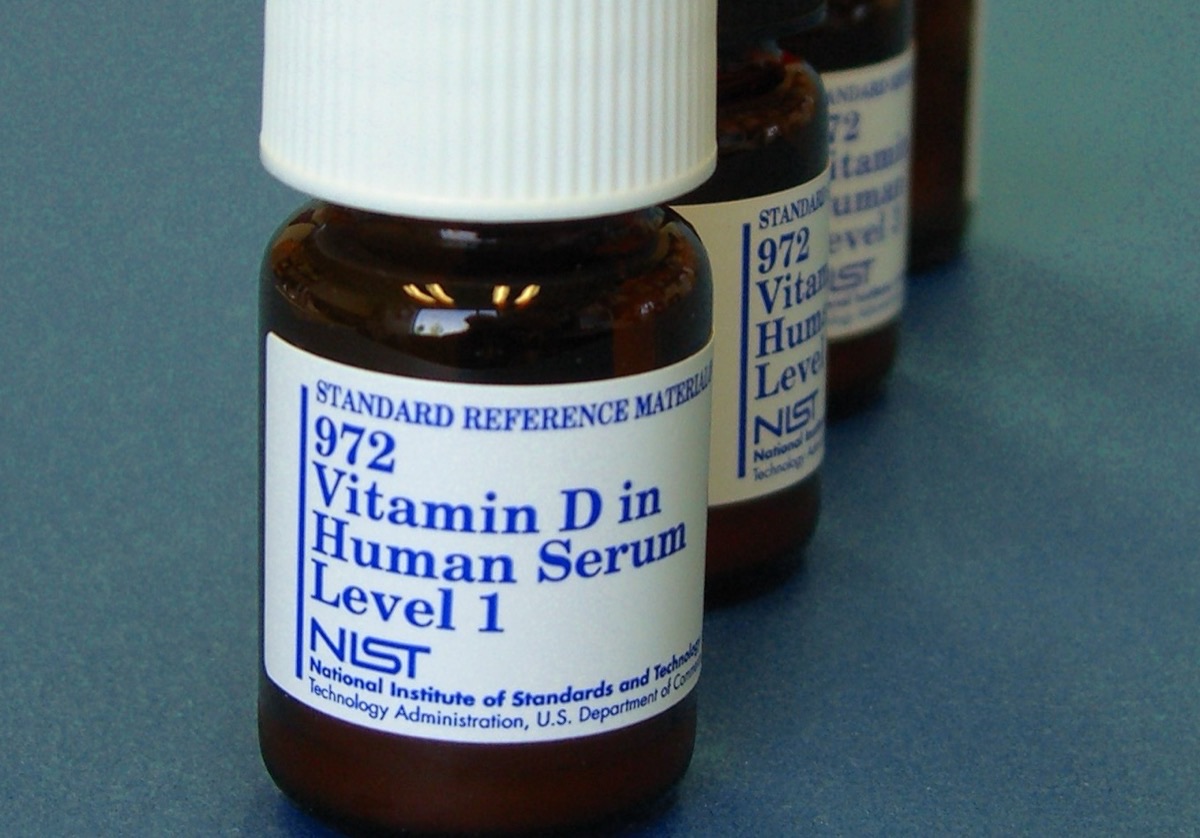
- The vials in the photo are a US reference sample of human serum with a certified vitamin D content, made so laboratories can check that their vitamin D tests read correctly.
- In the matched comparison, people with very low vitamin D had fewer skin cancers, a sign that sun exposure, not just vitamin D, was part of what the blood test was measuring.
- Vitamin D Deficiency, Supplementation, and Aging-Related Morbidity and Mortality Across Two Longitudinal Population CohortsAging Cell, October 2026 · The study: open access full text
- PubMed record and abstractPubMed (US National Library of Medicine) · Published summary
- Vitamin D Supplements and Prevention of Cancer and Cardiovascular Disease (VITAL)New England Journal of Medicine, 2019 · Randomised trial of 2,000 IU a day in 25,871 US adults
- The D-Health Trial: a randomised controlled trial of the effect of vitamin D on mortalityThe Lancet Diabetes & Endocrinology, 2022 · 60,000 IU a month in 21,315 Australians aged 60 and over
- Vitamin D: Fact Sheet for Health ProfessionalsNIH Office of Dietary Supplements · Blood levels, intakes and upper limits
General information, not medical advice. This study used health records and pharmacy purchases, so it shows links, not proof that vitamin D supplements prevent disease or death. Vitamin D can be harmful in very high doses. Ask your doctor whether a blood test or a supplement makes sense for you, and what dose.
Analysis by NutroPractic from the sources listed. Written for general readers; it does not replace advice from your own doctor.
From our articles
Our guides on this subject
Plain-language guides on nutrition and wellness, backed by research.

Cardiovascular wellness
Psyllium husk: how much soluble fibre lowers LDL cholesterol and stabilizes post-meal glucose in clinical trials
Viscous soluble fibre forms a thick gel matrix in the small intestine that binds bile acids and blunts post-meal glucose spikes. Across dozens of randomized controlled trials, 7 to 10.2 grams of psyllium daily lowers LDL cholesterol by 6% to 12% without stripping HDL, while reducing postprandial glucose surges by 15% to 25% in metabolic syndrome and type 2 diabetes. Discover the bile acid sequestration mechanism, trial meta-analyses, exact timing before meals, water ratios, and titration protocols to avoid gas and cramping.
13 Nov 2026
Supplements and vitamins
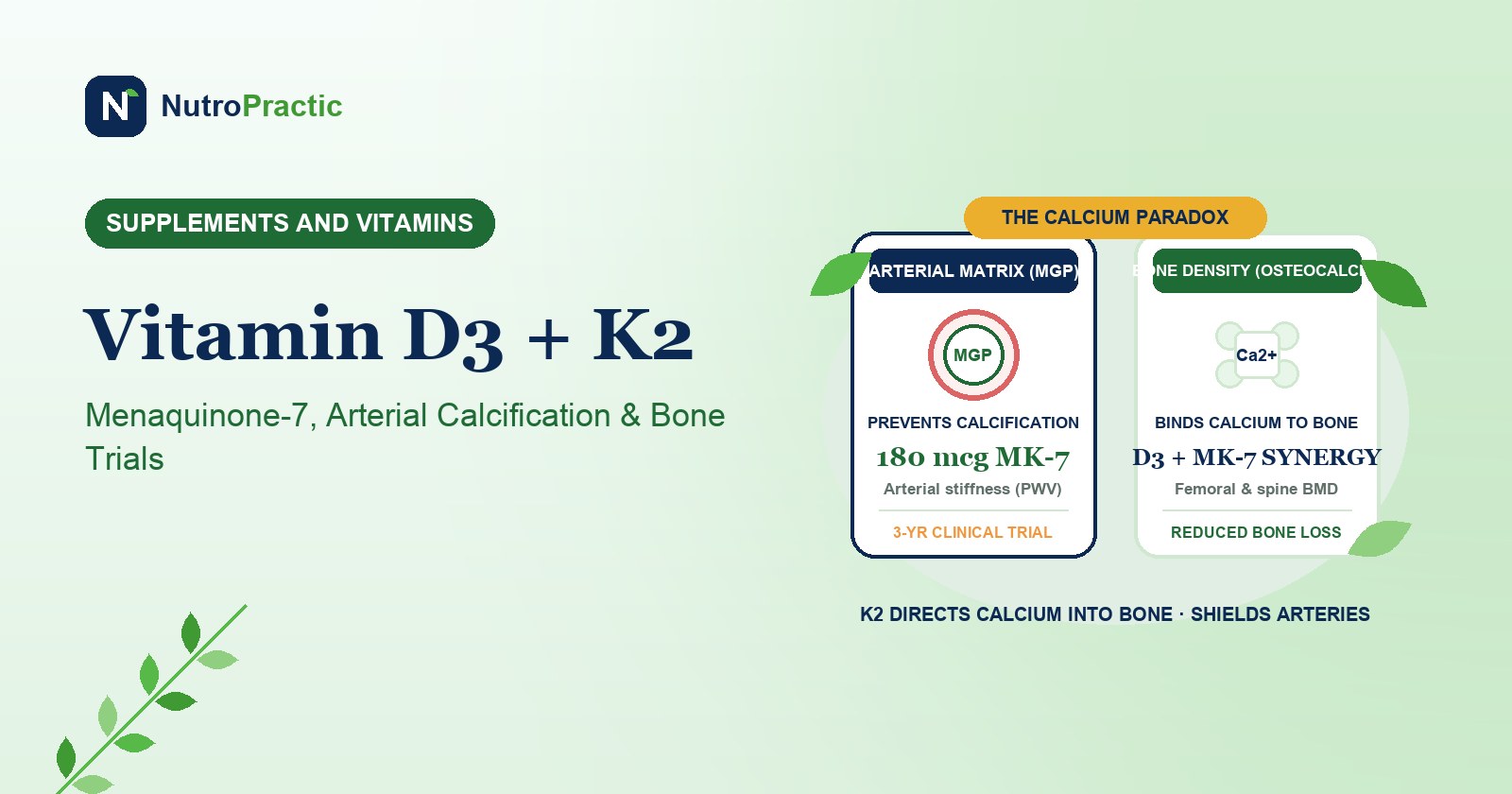
Vitamin D3 with K2: does adding menaquinone-7 actually protect arteries and bones in trials?
Vitamin D3 enhances intestinal calcium absorption, but without adequate vitamin K2, calcium can deposit in vascular walls instead of bone matrix. Clinical trials evaluating menaquinone-7 (MK-7) demonstrate improved carboxylation of Matrix Gla Protein, preserved arterial elasticity, and reduced bone mineral density loss. Discover what human clinical trials actually prove about cardiovascular calcification, bone density, MK-4 vs. MK-7 dosing, and critical drug interactions.
13 Nov 2026
Heart health
Omega-3: oily fish, walnuts or capsules? What the big trials found
A daily fish-oil capsule did not lower heart attacks and strokes overall in a trial of 25,871 Americans, yet a prescription dose of one omega-3 cut them by a quarter in another. Both results are real. What separates them, why a handful of walnuts is not the same thing as a piece of salmon, how much fish a week is enough, and what to do if you don't eat fish at all.
10 Oct 2026
Newsfeed for your website
Want this feed on your website?
Add it to any site with one copy-and-paste snippet. No sign-up, and it updates itself every hour.
Start with a virtual consultation
Tell Dr. Triveni what you want to change. You will leave with a clear next step, whether you are in Toronto, London, New York or Chennai.