Supplements · October 24, 2026
One in 20 adult supplements containing vitamin B6 tells you to take at least the US daily upper limit, and most of them aren't sold as B6 at all
A pharmacist went through every vitamin B6 label in the US government's supplement database, 11,367 adult products, and worked out the daily dose each one's own directions give. 575 reach the 100 mg upper limit, single tablets go to 500 mg, and more than half of the high-dose products are sold for sleep, mood, women's health or general wellbeing. Measured against Europe's newer limit of 12 mg, nearly two in five products are over.
Vitamin B6 is one of the few vitamins where too much has a well-known side effect: nerve damage in the hands and feet, called peripheral neuropathy, with tingling, numbness or burning. It was first described in 1983 in adults taking 2 to 6 grams a day, and later reports linked it to much smaller doses taken for months. The US upper limit for adults, set in 1998 and never revised, is 100 mg a day from food and supplements together. Other countries have since gone much lower. So how much B6 do American supplement labels actually tell people to take? A census by Brian Staiger of the University at Buffalo pharmacy school, published in Cureus on 20 October, is the first to check the whole market.
The source was the Dietary Supplement Label Database run by the US National Institutes of Health, which transcribes the Supplement Facts panel and directions of each label it collects. On 4 October 2026 it held 16,951 labels flagged as on the market that mention B6 (eight of them added in a repeat search on 13 October). After removing labels with no B6 row or no stated amount and 12 records with clear data-entry errors, and merging duplicates of the same product in different pack sizes, 11,913 products were left, 11,367 of them for adults. For each one the author worked out the largest daily dose the label's own directions allow, and checked every product at or above a US limit against its raw record.
The typical adult product directs 10 mg a day, and the middle half fall between 2.2 and 25 mg. But 575 adult products, 5.1%, direct 100 mg a day or more. Of those, 408 sit at exactly 100 mg, which with the 1.5 to 2 mg Americans get from food already takes total intake over the limit, and 167 go higher. Seventy reach at least 200 mg, and ten at least 500 mg: four single-ingredient products are one 500 mg tablet a day, five times the limit. The result held up however the dose was counted, from 3.5% of products on a single serving to 5.6% when labels rather than products were counted.
The products are often not what you'd expect. Single B6 products and B-complex products had the highest shares at or above the limit, 46% and 23%, but together they made up only 252 of the 575. The other 323 (56%) were sold as something else: multivitamins, sleep, mood and brain formulas, women's health products and many with no obvious category. Against the lower limits used abroad, 38.7% of adult products exceed Europe's 12 mg upper level, set by EFSA in 2023, 28.8% exceed the Netherlands' legal maximum of 21 mg, and 9.1% exceed the 50 mg above which Australia will require a pharmacist from June 2027. Of the products over 12 mg, 86% were not B6 or B-complex products. The census also found 22 products whose directions give a child or teenager more than the upper limit for their age, up to 250 mg a day 'for adults and children four years and older', against a limit of 40 mg for ages 4 to 8.
The author is careful about what this does and does not show. It counts labels, not sales: a best-seller and a product sold by the dozen count once each, so it says nothing about how many people actually take these doses. Some listed products may no longer be sold, and the database is not complete. The upper limit is a safety margin for the population, not a line beyond which harm is certain. The verification was done by one reviewer, the author, with every decision published, and it lowered the count rather than raising it. The paper calls for a nerve-damage warning on high-dose labels, a fresh look at the 1998 limit, and for doctors who see unexplained numbness to ask about the B6 in every product a patient takes, not only the bottle marked B6. The data and code are public. We read the full open-access paper.
Vitamin B6 doses on US supplement labels vs the US upper limit of 100 mg a day: census of the NIH Dietary Supplement Label Database, 4 October 2026
11,367
Adult supplement products with a stated vitamin B6 amount (from 16,951 on-market labels)
10 mg
Typical (median) maximum daily dose directed by an adult product; middle half 2.2 to 25 mg
575 (5.1%)
Adult products whose directions reach 100 mg a day or more (95% CI 4.7% to 5.5%); 167 go above it
56%
Share of those 575 high-dose products not sold as B6 or B-complex products (323 products)
38.7%
Adult products above Europe's upper limit of 12 mg a day (4,399 products)
22
Products whose directions give a stated child or teen age more than the upper limit for that age, up to 250 mg for ages 4 and up (limit 40 mg)
Source: Staiger B, 'Vitamin B6 Doses on United States Dietary Supplement Labels Relative to the Tolerable Upper Intake Level: A Census of the National Institutes of Health Dietary Supplement Label Database', Cureus 18(10): e118244, published 20 October 2026, doi 10.7759/cureus.118244, open access (CC BY 4.0). Snapshot of the NIH DSLD (public API v9) on 4 October 2026, plus 8 labels found with an extra spelling (pyridoxine alpha-ketoglutarate) on 13 October. Exclusions: 1,573 labels with no B6 ingredient row, 275 with no disclosed amount, 12 internally inconsistent records; 21 records with wrongly encoded servings corrected to the printed directions. 15,091 labels merged into 11,913 products (11,367 adult, 541 children's or teen, 5 infant). Maximum directed daily dose = amount per serving x largest serving x most servings per day the directions allow. Adult distribution: 10th percentile 1.4 mg, median 10 mg, IQR 2.2 to 25 mg, 90th percentile 50 mg, 99th percentile 150 mg, maximum 1,000 mg (stated as compound weight of pyridoxine alpha-ketoglutarate, about 537 mg as pyridoxine). At or above 100 mg/day: 575 (5.1%); exactly 100 mg: 408 (3.6%); above 100 mg: 167 (1.5%); at or above 200 mg: 70 (0.6%); at or above 500 mg: 10 (0.09%). Sensitivity range 3.5% (one serving only) to 5.6% (labels instead of products). By category, at or above 100 mg: single-ingredient B6 113 of 244 (46.3%), B-complex 139 of 597 (23.3%), multivitamin and mineral 51 of 2,549 (2.0%), sleep, mood, stress and brain 29 of 703 (4.1%), women's health 13 of 234 (5.6%), no named category 200 of 4,675 (4.3%). Above other thresholds: UK NHS advice 10 mg, 40.7%; EFSA UL 12 mg, 38.7%; Dutch legal maximum 21 mg, 28.8%; Australia pharmacist-only from June 2027, 50 mg, 9.1%; Australia prescription-only, 200 mg, 0.4%. Label census, not sales data: no estimate of how many people take these doses. Single reviewer for verification. The author disclosed using generative AI tools to review code, read label records and edit the manuscript. No funding; no conflicts declared. Data and code: Zenodo, doi 10.5281/zenodo.23352523.
- The US recommended intake of vitamin B6 for adults aged 19 to 50 is 1.3 mg a day. The typical adult supplement in this census directs 10 mg, nearly eight times that (our arithmetic), and the 500 mg tablets give about 385 times it.
- Europe's 12 mg limit came from a 1987 series of women with nerve symptoms who had taken under 50 mg a day for more than six months; EFSA divided that dose by four to allow for uncertainty, checked it against a study in dogs, and rounded down. The US 100 mg limit rests on small treatment studies at 100 to 300 mg a day.
- The Netherlands capped B6 in supplements at 21 mg per daily dose in October 2018, and reports of neuropathy to its drug-safety centre fell afterwards, the paper notes.
- Since 1976, US federal law has stopped the Food and Drug Administration from setting maximum strengths for vitamins and minerals in supplements, except for products meant for children under 12, pregnant or breastfeeding women, or specific diseases. B6 labels carry no required nerve-damage warning.
- Labels can understate what is in the bottle: manufacturers often add extra vitamin to cover losses over the shelf life, so the real content tends to be higher than printed, not lower, the author points out.
- Vitamin B6 Doses on United States Dietary Supplement Labels Relative to the Tolerable Upper Intake Level: A Census of the National Institutes of Health Dietary Supplement Label DatabaseCureus · The study, open access, published 20 October 2026
- Data, code and review log for the vitamin B6 label censusZenodo · The deposited snapshot and analysis (CC BY 4.0)
- Scientific opinion on the tolerable upper intake level for vitamin B6EFSA Journal · The 2023 European opinion that set the 12 mg a day limit
- Vitamin B6: Fact Sheet for Health ProfessionalsNIH Office of Dietary Supplements · US recommended intakes and upper limits by age
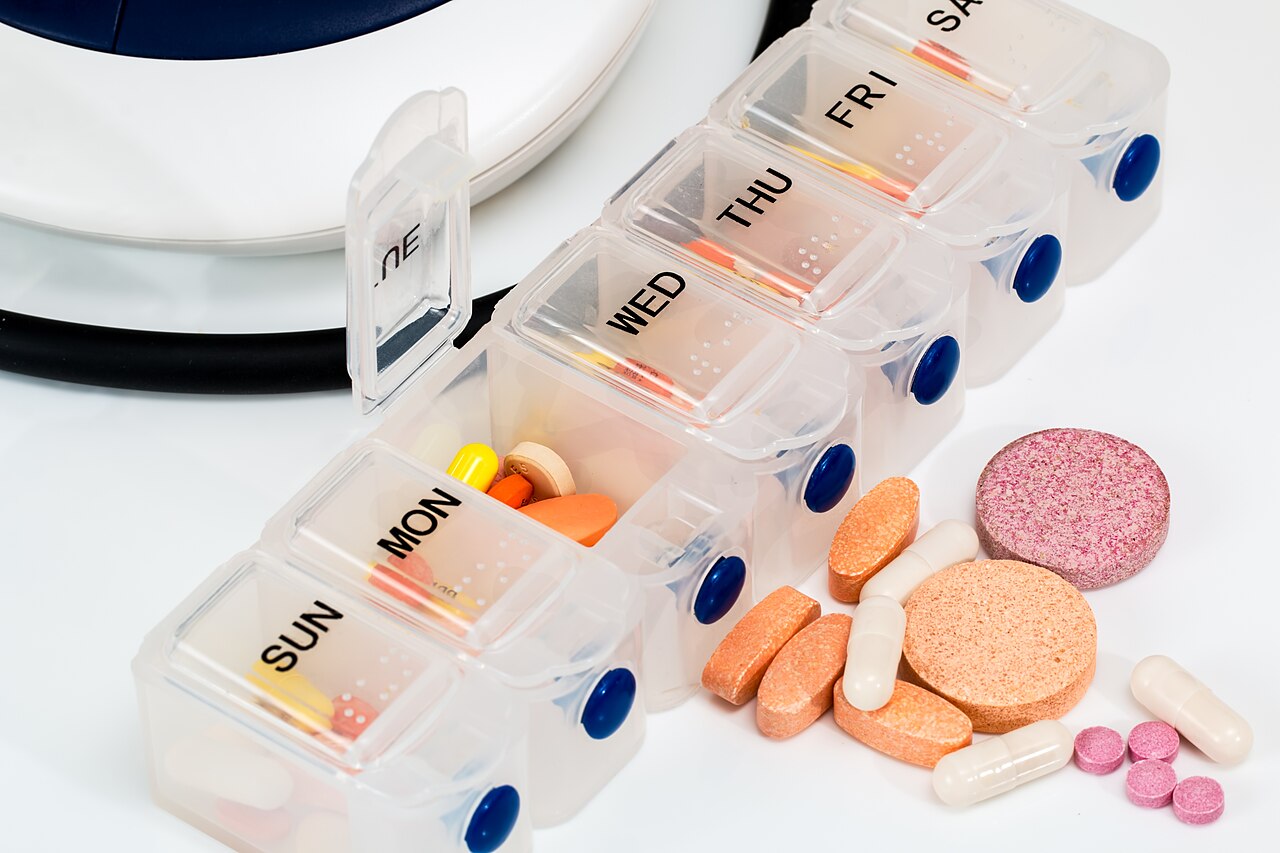
- Pill Organizer With Vitamins And MedicinesWikimedia Commons · The photo, CC0 (Stevepb)
General information, not medical advice. This study counted doses printed on labels; it did not measure harm in anyone. Don't stop a supplement or medicine your doctor prescribed without asking them. If you take several supplements, add up the vitamin B6 across all of them, and if you notice tingling, numbness or burning in your hands or feet, tell your doctor what you take.
Analysis by NutroPractic from the sources listed. Written for general readers; it does not replace advice from your own doctor.
From our articles
Our guides on this subject
Plain-language guides on nutrition and wellness, backed by research.
Supplements and vitamins
Glycine before bed: the 3 g sleep trials, what they measured, and glycine in gelatin, bone broth and collagen
The 3 g dose comes from small Japanese trials: the sleep-restriction study analysed seven men. Here is what each trial measured, the grams of gelatin, collagen, pork rinds and bone broth that hold 3 g, and the clozapine warning.
17 Nov 2026
Micronutrients
Vitamin B12 on metformin or acid-reflux medicines: who should test, and how often?
Metformin lowered B12 by 19% in a 4.3-year trial, but a PPI alone is not a rule for annual screening. Here is when to test, how to read 180 and 350 ng/L, when MMA helps, and which nerve symptoms should not wait.
9 Nov 2026
Women's health
Nausea in pregnancy: ginger, vitamin B6, small meals and when it's hyperemesis, from the trials
Only 1.8% of women in one diary study had nausea just in the morning. Ginger at 1 g a day, B6 at 30 to 75 mg and doxylamine with B6 each have trial data, while diet advice has none. The score to track it, the doses, and the signs that mean a phone call.
5 Nov 2026
Newsfeed for your website
Want this feed on your website?
Add it to any site with one copy-and-paste snippet. No sign-up, and it updates itself every hour.
Start with a virtual consultation
Tell Dr. Triveni what you want to change. You will leave with a clear next step, whether you are in Toronto, London, New York or Chennai.