Mental health · October 27, 2026
Young people in Zhejiang who ate fish, fruit and vegetables more often, and fried and sugary foods less often, were less likely to screen positive for anxiety. The survey can't say which came first
Researchers asked 584 sons and daughters of hospital staff, aged 10 to 24, how often they ate ten kinds of food and how they felt about their bodies and their mood. Each step up on a simple food score went with 35% lower odds of anxiety and 16% lower odds of depressive symptoms. A one-off survey like this can't show that the food made the difference, and low mood can change what people eat.
Anxiety and low mood are common in the teens and early twenties, and so is worry about how one's body looks. A study published on 15 October in Frontiers in Nutrition looked at whether everyday eating habits line up with all three in one group of young people in eastern China.
Between July and September 2025, researchers at Wenzhou Medical University surveyed 584 children and young adults aged 10 to 24 whose parents work in healthcare, recruited face to face through four hospitals in Zhejiang Province (most, 487 of the 609 approached, through one of them). Their average age was 18.9, two thirds were female and four in five were at university. Each said how often in the past month they ate meat, fish, vegetables, fruit, eggs, soy products, dairy, pickled foods, sugary foods and drinks, and fried foods, from rarely to almost every day. Eating the first seven more often and the last three less often gave a higher score, from 10 to 40; the middle score was 29. They also filled in standard questionnaires for anxiety (GAD-7), depressive symptoms (the two-question PHQ-2) and body satisfaction.
135 (23.1%) screened positive for anxiety and 196 (33.6%) for depressive symptoms. After allowing for age, sex, schooling, home area, family money and parents' education, sleep, social media and sitting time, exercise, weight group and parents' habits, each standard step up the food score (one standard deviation) went with 35% lower odds of anxiety, 16% lower odds of depressive symptoms and 21% higher odds of being in the more body-satisfied half. The links looked roughly straight-line, with no threshold. When the team looked at single foods, eating fruit, fish and meat more often stood out for depressive symptoms, and eating meat, fish, vegetables and fruit more often and fried food less often stood out for anxiety.
The researchers also asked whether feeling better about one's body could be part of the route between diet and mood. Statistically, body satisfaction accounted for 17.3% of the link with depressive symptoms and 6.8% of the link with anxiety, so most of the association ran some other way.
The authors are cautious. Food, mood and body image were all measured at the same moment, so the study can't tell which came first, and their own checks showed the reverse direction, with anxious or low young people eating differently, can't be ruled out. Everything was self-reported; the food score counted how often, not how much, and didn't separate lean, red and processed meat; and the models explained only a small share of who had symptoms. Sons and daughters of healthcare workers may not be typical of young people in China, and the results shouldn't be read as saying that changing a few foods would by itself improve mental health. The study had no outside funding and the authors declare no conflicts of interest.
Food frequency, body satisfaction, anxiety and depressive symptoms in 584 young people aged 10 to 24, Zhejiang, China, July to September 2025 (Frontiers in Nutrition, 15 October 2026)
584
Sons and daughters of healthcare workers aged 10 to 24 surveyed through four hospitals (average age 18.9; 67.3% female; 78.9% at university)
23.1% and 33.6%
Share who screened positive for anxiety (GAD-7 score 7 or more, 135 people) and depressive symptoms (PHQ-2 score 2 or more, 196 people)
0.65
Adjusted odds ratio for anxiety per one standard deviation higher food score: 35% lower odds (95% CI 0.52 to 0.79)
0.84
Adjusted odds ratio for depressive symptoms per one standard deviation higher food score: 16% lower odds (95% CI 0.70 to 0.99)
1.21
Adjusted odds ratio for being in the more body-satisfied half per one standard deviation higher food score (95% CI 1.02 to 1.44)
17.3% and 6.8%
Share of the link with depressive symptoms and with anxiety that ran statistically through body satisfaction
Cross-sectional survey with convenience sampling; food, mood and body image were self-reported at the same time, so it shows associations, not causes, and reverse links can't be excluded. The food score (10 to 40) counts how often ten food groups were eaten in the past month, not amounts. Screening questionnaires flag symptoms; they are not a diagnosis. Results may not apply to young people outside healthcare families. No outside funding; no conflicts of interest declared. Open access under CC BY.
- The World Health Organization counts everyone aged 10 to 24 as 'young people': adolescents are 10 to 19 and youth 15 to 24.
- The WHO estimates that about one in seven 10 to 19 year olds worldwide (14.3%) has a mental disorder, with anxiety and depression among the leading causes of illness and disability in that age group.
- The PHQ-2 used here is just two questions: how often in the past two weeks someone has had little interest or pleasure in doing things, and how often they've felt down, depressed or hopeless.
- The young people in the survey reported an average of 5.3 hours a day on social media, more than their 4.8 hours of other sitting time and 2.6 hours of physical activity.
- Sugary foods and drinks, fried foods and pickled foods counted against the score, so someone could raise it by eating them less often as well as by eating fish, fruit or vegetables more often.
- Dietary frequency, body satisfaction, anxiety symptoms, and depressive symptoms among offspring of healthcare workers in ChinaFrontiers in Nutrition · The study, open access (CC BY), published 15 October 2026; figures from its full text and tables
- Mental health of adolescentsWorld Health Organization · WHO fact sheet on how common mental disorders are among 10 to 19 year olds
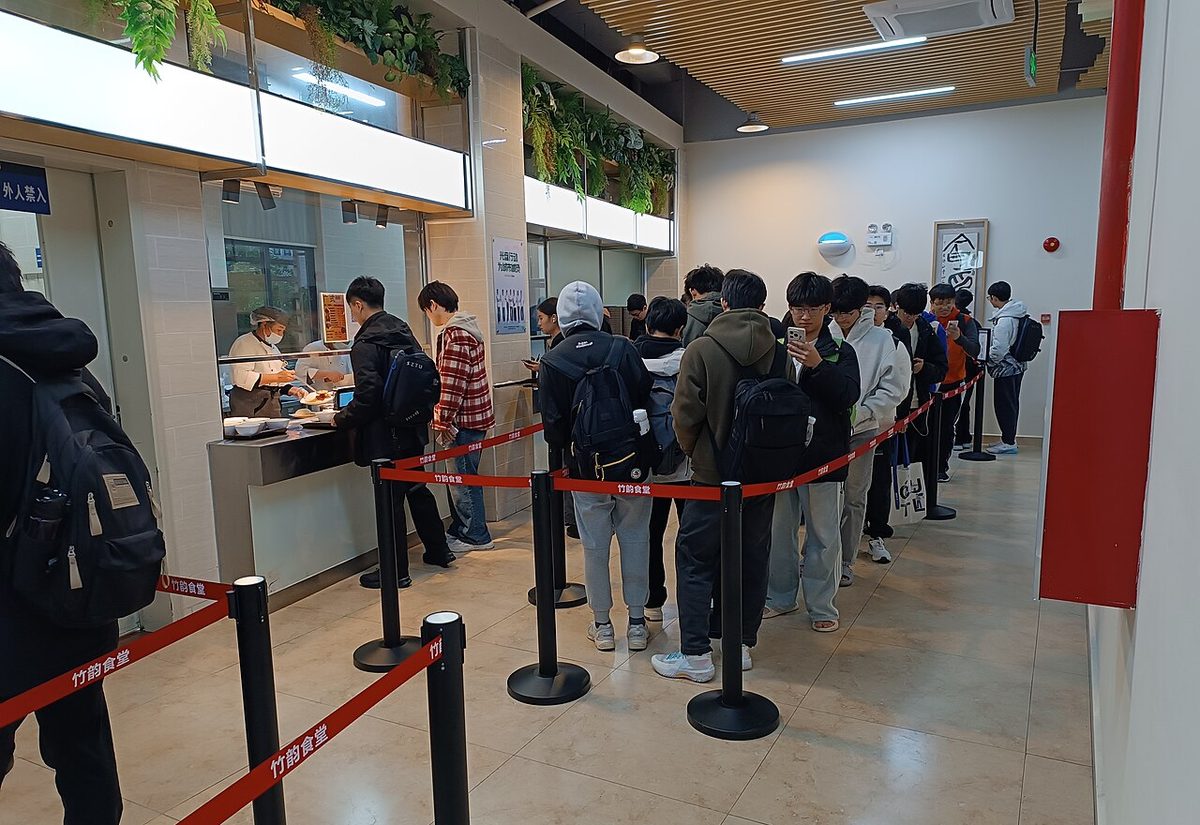
- SZ Shenzhen Pingshan Technology University Student Canteen, March 2025Wikimedia Commons · The image, CC0
General information, not medical advice. This survey found links between eating habits and mood in one group of young people; it did not test whether changing diet improves anxiety or depression. If you or a young person you care for is struggling with mood, worry or body image, talk to a doctor, counsellor or mental health service, and a registered dietitian for advice on eating.
Analysis by NutroPractic from the sources listed. Written for general readers; it does not replace advice from your own doctor.
From our articles
Our guides on this subject
Plain-language guides on nutrition and wellness, backed by research.
Everyday eating
Food label claims decoded: 'no added sugar', 'multigrain', 'natural' and 'high protein'
A no-added-sugar biscuit with only 13% fewer calories. A 7-grain loaf with refined flour listed first. A 'high protein' bar that clears the legal line at 21%. What each claim legally requires in the EU/UK, US and India, with worked reads of real packs.
2 Nov 2026
Nutrition science
Sweeteners after the WHO advice: aspartame, stevia, erythritol and what the 2023 decisions meant
In 2023 the WHO advised against using sweeteners to control weight, and its cancer agency called aspartame 'possibly carcinogenic' a few weeks later. Neither means your diet drink is dangerous, and neither means it helps. What the reviews found, how much is allowed, why erythritol is the one to watch, and what to do if you have diabetes or simply want less sugar.
18 Oct 2026

Women's health
Inositol for PCOS: the 40:1 ratio, trial doses, and food milligrams
Why do randomized trials in polycystic ovary syndrome prioritize the 40:1 myo to D-chiro inositol ratio? Here is the science behind the ovarian epimerase paradox, clinical ovulation and insulin metrics, and why cantaloupe cannot replace 4,000 mg trial powder.
21 Nov 2026
Newsfeed for your website
Want this feed on your website?
Add it to any site with one copy-and-paste snippet. No sign-up, and it updates itself every hour.
Start with a virtual consultation
Tell Dr. Triveni what you want to change. You will leave with a clear next step, whether you are in Toronto, London, New York or Chennai.