Diet and cancer · October 23, 2026
Burgers, fries and the gut bacteria that make sulfide: 95,612 older Americans who ate most like that had 2.5 times the lung cancer rate. Allow for smoking and the gap shrinks to 23%
A diet score built to track sulfur-loving gut bacteria, high in processed meat, fries and full-fat dairy and low in fruit and vegetables, went with more lung cancer in a big US screening trial. The catch: the people with the highest scores were also four times as likely to smoke, and most of the link went away once the researchers counted cigarettes.
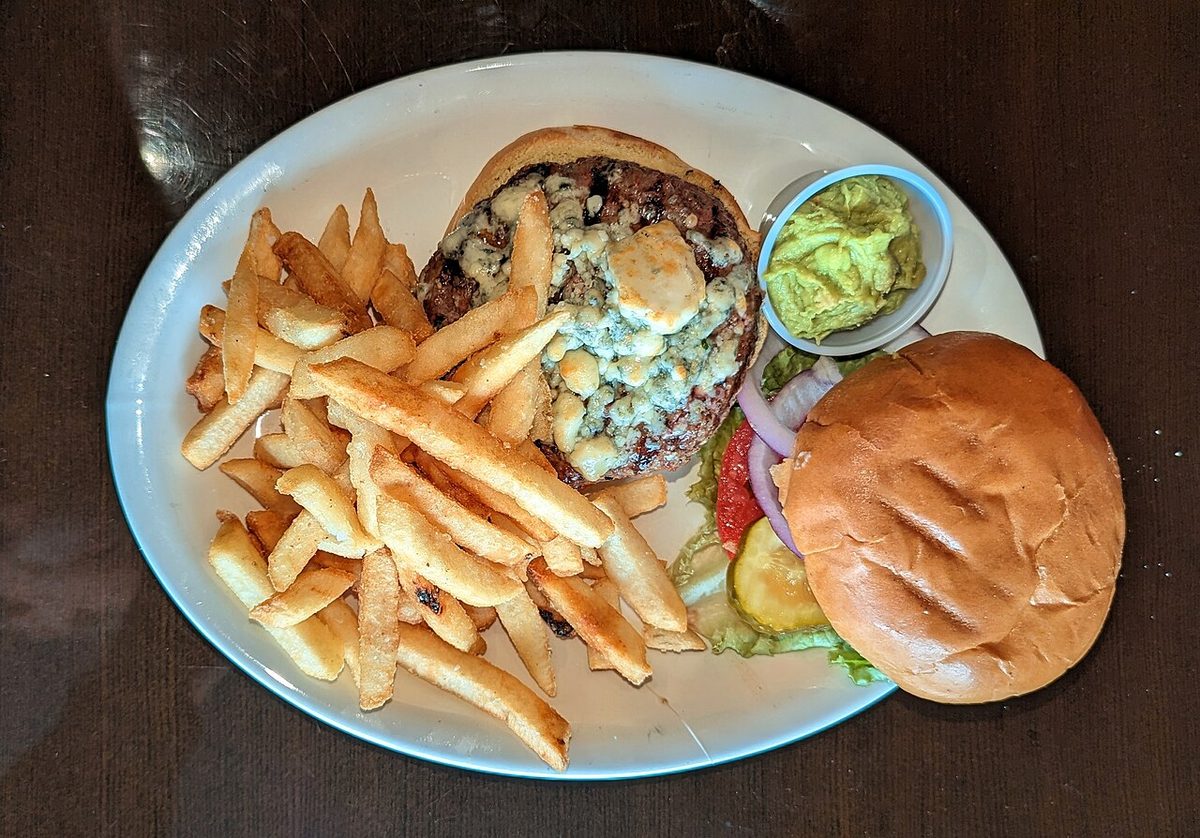
Some gut bacteria live on sulfur. Bilophila wadsworthia and members of the Desulfovibrio family turn sulfur from food into hydrogen sulfide, the gas that smells of rotten eggs, and at high levels it may weaken the gut lining and stir up inflammation. Stool tests are rare in big diet studies, so in 2021 a US team built a stand-in: a 'sulfur microbial diet' score from 25 food groups, weighted by how closely each one tracked those bacteria in people who gave both food records and stool samples. Processed and red meat, French fries and high-fat dairy push the score up; fruit, yellow vegetables and whole grains pull it down. A high score has since been linked with bowel cancer and with cancer of the gullet.
A team from Chongqing Medical University in China, the first author also at Erasmus MC in Rotterdam, has now tested the score against lung cancer. Their paper, published as an article in press in Nutrition Journal on 12 October, uses the US Prostate, Lung, Colorectal and Ovarian (PLCO) screening trial, which enrolled about 155,000 people aged 55 to 74 between 1993 and 2001. After exclusions, 95,612 people had filled in a 124-item diet questionnaire and had complete data. New lung cancers were counted to the end of 2009 (1,561 cases) and lung cancer deaths to the end of 2018 (2,109).
The raw numbers look stark. In the fifth of people with the lowest scores there were 1.20 new lung cancers per 1,000 person-years; in the highest fifth, 3.03, about two and a half times as many. Lung cancer deaths rose from 1.01 to 2.37 per 1,000 person-years. Adjusting for age, sex, race and education alone still left the top fifth with more than double the risk (hazard ratio 2.34).
Then came smoking. The high scorers were different people: 18.0% of the top fifth still smoked, against 4.4% of the bottom fifth, and they averaged 27.2 pack-years of cigarettes against 12.9. They also drank more alcohol and had more emphysema. Once smoking status, pack-years, weight, drinking, illnesses and family history went into the model, the hazard ratio fell to 1.27, and with calories added to 1.23 for new lung cancers and 1.19 for lung cancer deaths. Both were statistically significant, but only just, and on a continuous scale each step up in the score went with a 6% higher risk that did not clear the usual bar (p = 0.057).
Where the link held up says something too. It was clearest for squamous cell and small cell lung cancer, the two types most tightly tied to tobacco (top versus bottom fifth: hazard ratios 1.62 and 1.79), and absent for adenocarcinoma, the main type in people who never smoked (0.99). For lung cancer deaths, the score mattered only in people with more than 20 pack-years; in never-smokers the estimate pointed slightly the other way (0.88, not significant). The authors write that tobacco could make the lungs more sensitive to inflammation coming from the gut, but that leftover confounding by smoking, which the questionnaire captured only as status and pack-years, is an alternative explanation.
Other checks pulled the result down further. When the researchers also allowed for overall diet quality (the Healthy Eating Index), the link was no longer significant (1.18 for new cancers), which is not surprising because the two scores move closely together. A competing-risk analysis, which accounts for the many people who died of something else first, gave weaker estimates too. No single food carried the result: after correcting for multiple tests, the only food group still linked with lung cancer deaths on its own was yellow vegetables, with fewer deaths among people who ate more of them.
The limits are the usual ones for this kind of study, and the authors list them. Diet was asked about once, around three years after people joined the trial, and may have changed over the following decades. More than nine in ten participants were white Americans aged 55 or over. And nobody's gut bacteria or hydrogen sulfide were measured, so the 'microbial' part of the score is an inference from food. The authors call the link modest and the subtype and smoking results hypothesis-generating. For readers, the takeaway is not really about sulfur: the eating pattern behind a high score is the one earlier studies already linked with bowel cancer, and for lung cancer, stopping smoking remains the change that matters most.
The sulfur microbial diet score and lung cancer in 95,612 PLCO participants: before and after counting cigarettes
1.20 → 3.03
New lung cancers per 1,000 person-years, lowest versus highest fifth of the score (unadjusted)
4.4% vs 18.0%
Current smokers in the lowest and the highest fifth of the score
2.34 → 1.23
Hazard ratio for new lung cancer, top versus bottom fifth: adjusted for age, sex, race and education, then also for smoking, health, alcohol and calories
1.19
Fully adjusted hazard ratio for lung cancer death, top versus bottom fifth (95% CI 1.02 to 1.38)
1.62 / 1.79 / 0.99
Fully adjusted hazard ratios for squamous cell, small cell and adenocarcinoma, top versus bottom fifth
0.88 vs 1.12
Hazard ratio for lung cancer death per step (1 SD) up in the score: never-smokers versus people with more than 20 pack-years
Source: Luo Y, Xiao Y, Yang J, Zhou R, Tie H, 'Association of sulfur microbial diet with lung cancer incidence and lung cancer-related mortality in 95,612 American adults: a prospective cohort study from the PLCO trial', Nutrition Journal, article in press, published 12 October 2026, doi 10.1186/s12937-026-01406-7, open access (CC BY-NC-ND 4.0). Design: secondary analysis of the US PLCO Cancer Screening Trial (adults 55 to 74, enrolled 1993 to 2001 at 10 centres); 95,612 complete cases with a valid 124-item Diet History Questionnaire, completed a median 3.0 years after randomisation; mean age 65.5, 51.9% women, 91.1% non-Hispanic white. Score: 25 food groups weighted as in Wang et al. 2021; quintile cut-points -0.99, -0.13, 0.48, 1.08. Outcomes: 1,561 incident lung cancers to 31 December 2009 (844,773 person-years) and 2,109 lung cancer deaths to 31 December 2018 (1,443,711 person-years). Q5 vs Q1, Model 1 (age, sex, race, education): incidence HR 2.34 (1.98 to 2.77), mortality 2.17 (1.88 to 2.49). Model 2 (plus trial arm, BMI, smoking status, pack-years, alcohol, diabetes, hypertension, emphysema, family history of any cancer and of lung cancer, supplemental beta-carotene): 1.27 (1.07 to 1.50) and 1.20 (1.04 to 1.38). Model 3 (plus energy intake, primary): 1.23 (1.03 to 1.47, P-trend 0.023) and 1.19 (1.02 to 1.38, P-trend 0.039); per SD 1.06 (1.00 to 1.12, p 0.057) and 1.05 (1.00 to 1.10, p 0.066). Fine-Gray: 1.19 (1.00 to 1.42) and 1.12 (0.97 to 1.30). Plus HEI-2015: 1.18 (0.94 to 1.47) and 1.17 (0.97 to 1.42). Subtypes (Q5 vs Q1): squamous 299 cases HR 1.62 (1.06 to 2.50), small cell 210 cases 1.79 (1.05 to 3.06), adenocarcinoma 575 cases 0.99 (0.75 to 1.32); P-heterogeneity 0.011. Mortality per SD by pack-years: 0 = 0.88 (0.76 to 1.03), >0 to 20 = 0.97 (0.84 to 1.14), >20 = 1.12 (1.06 to 1.18); P-interaction 0.002, FDR-adjusted 0.025. Q1 vs Q5 at baseline: current smokers 4.4% vs 18.0%, pack-years 12.9 vs 27.2, alcohol 8.0 vs 13.4 g/day, emphysema 1.4% vs 3.3%, energy 2,080.9 vs 1,719.3 kcal/day. Yellow vegetables per SD HR 0.91 (0.86 to 0.97) for lung cancer death, the only component significant after FDR correction. Funding: China Scholarship Council (first author). Competing interests: none declared. HR = hazard ratio, shown with 95% confidence intervals; SD = standard deviation.
- The sulfur microbial diet score was first built in 2021 from people who gave both food questionnaires and stool samples, and in the same paper a higher score went with more bowel cancer.
- Hydrogen sulfide is the gas that gives rotten eggs their smell. The study authors stress that its effects in the body depend on how much is around and where.
- People with the lowest scores ate more calories on average (about 2,081 kcal a day against 1,719 in the top fifth), so a 'better' score here did not mean eating less.
- Lung cancer deaths outnumbered recorded lung cancers in this study (2,109 against 1,561) because deaths were tracked for nine years longer than new diagnoses.
- Adenocarcinoma, the type with no link here, is the main lung cancer in people who have never smoked; squamous cell and small cell cancers, where the link was strongest, are the types most closely tied to tobacco.
- Association of sulfur microbial diet with lung cancer incidence and lung cancer-related mortality in 95,612 American adults: a prospective cohort study from the PLCO trialNutrition Journal · The study, open access (article in press), with results by quintile, subtype and smoking
- Association Between the Sulfur Microbial Diet and Risk of Colorectal CancerJAMA Network Open · The 2021 study that built the sulfur microbial diet score from food and stool data
- Prostate, Lung, Colorectal, and Ovarian (PLCO) Cancer Screening Trial dataUS National Cancer Institute, Cancer Data Access System · The trial whose data the study used
- Hamburger with blue cheese, guacamole, and other toppings, plus French fries - MassachusettsWikimedia Commons · The photo, CC0
General information, not medical advice. This is an observational study that found an association, not proof that any food causes lung cancer, and smoking may explain much of it. If you smoke or used to smoke, ask your doctor about support to stop and whether lung cancer screening is right for you.
Analysis by NutroPractic from the sources listed. Written for general readers; it does not replace advice from your own doctor.
From our articles
Our guides on this subject
Plain-language guides on nutrition and wellness, backed by research.

Gut health
Probiotic capsules: which ones have trial evidence, what they can do, and when to skip them
Children on antibiotics: 8% got diarrhoea with a probiotic, 19% without. Older hospital patients: 10.8% with, 10.4% without. Which capsules have evidence, what three guidelines say about IBS, what a course costs per case prevented, and who shouldn't take them.
2 Nov 2026
Gut health
Gluten-free without coeliac disease: who actually benefits, and what the blinded gluten challenges found
In blinded trials only 16% of people who said gluten made them ill reacted to gluten rather than placebo, and in Oslo fructans caused more bloating than gluten. Who really needs to avoid it, how to get tested before you stop, how much gluten is in a slice of bread or a roti, and what gluten-free food costs (159% more in the UK) and lacks.
1 Nov 2026

Gut health
Lactose intolerance: how much milk most people can actually tolerate, and which dairy is easiest
Most adults who don't digest lactose well still handle about 12 g at once, roughly a 250 ml glass of milk, in blinded trials. What the 12 g studies found, a lactose table for milk, yoghurt, cheese, chai and dahi, how lactase tablets and A2 milk compare, why the famous 68% figure was retracted, and how to keep calcium up if you cut back.
25 Oct 2026
Newsfeed for your website
Want this feed on your website?
Add it to any site with one copy-and-paste snippet. No sign-up, and it updates itself every hour.
Start with a virtual consultation
Tell Dr. Triveni what you want to change. You will leave with a clear next step, whether you are in Toronto, London, New York or Chennai.