Nuts and blood sugar · October 22, 2026
Same handful of peanuts, three ways: eaten whole, ground to butter or blended into milk with white bread. The blood sugar spike shrank every time, but blood fats did not
In a Singapore trial, 15 healthy adults ate two slices of white bread alone or with 42.5 g of peanuts or cashews as whole nuts, nut butter or homemade nut milk. Every nut meal cut the glucose peak. Blood fats rose with all of them and ran highest after nut butter, lowest after whole nuts.
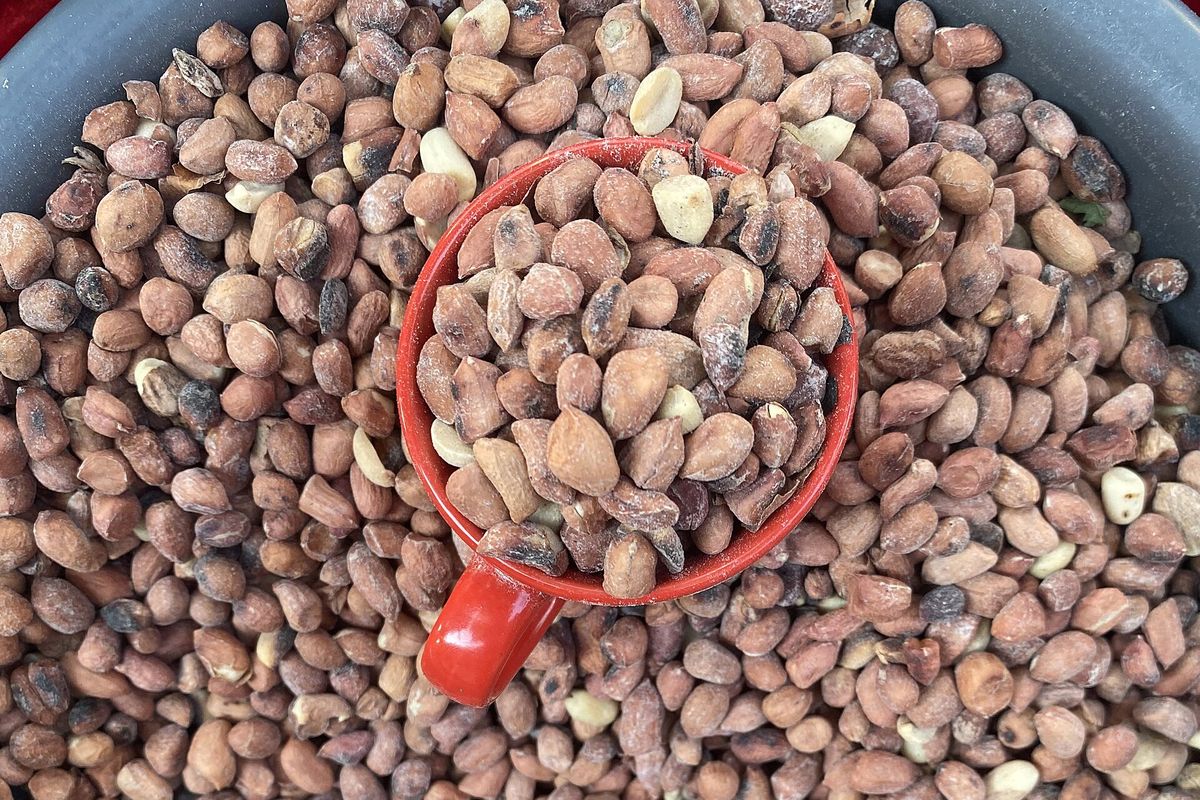
Advice to eat nuts with your carbs usually treats a nut as a nut. But a spoon of peanut butter, a handful of peanuts and a glass of peanut milk are not the same thing once they reach the gut: grinding and blending break open the cells that hold the oil. A small trial published in Frontiers in Nutrition on 21 October asked whether that changes what happens in the blood after a high-carbohydrate meal. It was run at the Glycemic Index Research Unit of Temasek Polytechnic in Singapore by Saihah Mohamed Salleh, Sharifah Fatanah Bte Syed Abdullah and Kalpana Bhaskaran.
Fifteen healthy, normal-weight adults (eight men and seven women, average age 34, average BMI 21.4) came in after an overnight fast for eight morning sessions, at least two days apart, between September and December 2018. Twice they ate two slices of plain white bread (57 g) on its own. In the other six sessions, in random order, they ate the same bread with 42.5 g of peanuts or cashews, the US standard 1.5-ounce serving, either whole, ground in a food processor into a smooth butter, or blended with 120 ml of water into an unfiltered nut milk. The nuts were shop-bought unsalted dry-roasted peanuts and baked cashews. Finger-prick blood was taken over the next four hours for glucose, insulin and triglycerides, the main fat carried in the blood.
Every nut meal blunted the sugar spike. The bread alone sent glucose up sharply in the first 45 minutes; at that point all six nut meals were significantly lower, and peanut butter and peanut milk were already lower at 30 minutes. Over the first two hours, the window used in standard glycemic index testing, the glucose area under the curve was lower than bread alone for every nut form, and lower for peanuts than for cashews, which the authors link to peanuts carrying more protein (11.8 g against 8.6 g per serving) and fewer carbohydrates. That peanut-cashew gap was not statistically significant. Insulin ran slightly higher with nuts than with bread alone, but none of those differences were significant either.
The fat story went the other way. After bread alone, triglycerides barely moved. After every nut meal they rose significantly, peaked at about two hours (three hours for whole peanuts) and had still not returned to fasting levels when testing stopped at four hours. Form mattered here: over four hours the triglyceride response was 51% higher with peanut butter and 41% higher with peanut milk than with whole peanuts, and 53% and 46% higher with cashew butter and cashew milk than with whole cashews. The authors had expected the milk to give the biggest rise, but the butter did; they suggest that blending in a home food processor, without the heat and high pressure of factory nut milk, left more of the oil droplets intact. In formal tests only one of these comparisons reached significance, with whole peanuts giving lower triglycerides than peanut butter at two and three hours.
This is a short test in 15 lean, healthy people, so it says nothing about people with diabetes or overweight, or about what eating nuts every day does over months. The nut meals were not matched for calories: adding nuts took the plate from 150 to about 405 kcal and from 1 g to over 20 g of fat, so the results describe realistic meals rather than the effect of form alone. Particle size and gut hormones were not measured, the trial was not registered, and the data are almost eight years old. A rise in blood fats after a fatty meal is normal, and long-term studies link regular nut eating with lower heart risk, which the authors stress. Their practical suggestion is modest: with a high-carbohydrate meal, whole nuts may be the better choice for anyone watching both blood sugar and blood fats. The study had no outside funding. We read the full open-access paper.
White bread with 42.5 g of peanuts or cashews as whole nuts, nut butter or nut milk: 4-hour blood responses in 15 healthy adults (Singapore)
15
Healthy normal-weight adults, 8 sessions each (bread alone twice, six nut meals in random order)
6 of 6
Nut meals with a significantly lower glucose peak at 45 minutes than white bread alone
+51% / +41%
Triglyceride response with peanut butter / peanut milk vs whole peanuts over 4 hours
+53% / +46%
Same for cashew butter / cashew milk vs whole cashews
150 → 409 kcal
Two slices of white bread alone vs with the peanut serving (fat 1 g → 22.5 g)
4 hours
Triglycerides were still above fasting levels after every nut meal when testing stopped
Study: Mohamed Salleh S, Bte Syed Abdullah SF, Bhaskaran K, 'Acute study of the glycemic, insulinemic and triglyceride responses on white bread with peanuts and cashews in different forms (whole nut, nut butter and nut milk)', Frontiers in Nutrition 13 (2026), published 21 October 2026, doi 10.3389/fnut.2026.1838715, open access (CC BY 4.0). Randomised crossover design at the Glycemic Index Research Unit, Temasek Polytechnic, Singapore; data collected September to December 2018; ethics approval Temasek Polytechnic IRB (IRB170102); not registered in a trial database (the authors describe it as a non-therapeutic physiological study). 15 healthy adults aged 21–59 (8 men, 7 women; 13 Chinese, 2 Malay; mean age 34 ± 3.4 years, BMI 21.4 ± 0.4 kg/m², SE), no dropouts. Test meals: 57 g Gardenia enriched white bread alone (twice, averaged) or with 42.5 g Planters dry-roasted peanuts or Nature's Wonders baked cashews, whole, ground to butter, or blended with 120 ml water (unfiltered milk). Meal composition (lab-analysed): bread 150 kcal, 31.2 g available carbohydrate, 1.0 g fat; with peanuts 409 kcal, 35.8 g, 22.5 g fat, 17.4 g protein; with cashews 404 kcal, 41.5 g, 20.8 g fat, 14.2 g protein. Capillary blood at 0–240 min. Glucose: all nut meals significantly lower at 45 min (adjusted p < 0.05); 2-h glucose iAUC lower than bread for all nut forms and lower for peanuts than cashews (peanut vs cashew difference not significant); over 4 h, peanut butter was similar to bread and cashew butter and milk higher, because glucose after bread alone fell below baseline after 2 h. Insulin iAUC slightly higher for all nut meals, no significant differences. Triglyceride 4-h iAUC significantly higher than bread for all nut meals in the results section (one passage of the discussion says whole nuts were not; we follow the results and Figure 2); butter and milk 51% and 41% above whole peanuts, 53% and 46% above whole cashews (pooled 52% and 44%); peanuts 15% above cashews; iAUC differences among nut meals not significant; whole peanuts significantly lower than peanut butter at 120 and 180 min. Palatability 4.2–4.8 on a 7-point scale, no significant differences. Exact iAUC values appear only in figures, so we quote the percentages the paper states. Funding: none declared.
- The homemade nut milks were not strained, so all the fibre and fat in the 42.5 g of nuts went into the glass, just with 120 ml of water added.
- On the University of Sydney glycemic index database the paper cites, peanuts score 13 and cashews 25, both low compared with white bread.
- Two hours after the bread-only meal, blood glucose dipped below its fasting level before rising a little again after three hours, which is why the team judged the sugar response on the first two hours.
- Per 42.5 g serving, the lab found the cashews had about 62% more sugar than the peanuts (2.55 g against 1.57 g), and the peanuts about 46% more fibre (2.81 g against 1.93 g).
- Volunteers rated each meal on a 1 to 7 scale; scores ran from 4.2 for bread with peanut milk to 4.8 for whole cashews and cashew butter, close enough that taste was unlikely to change how people chewed.
- Acute study of the glycemic, insulinemic and triglyceride responses on white bread with peanuts and cashews in different forms (whole nut, nut butter and nut milk)Frontiers in Nutrition · The paper, open access
- Roasted peanuts in a bowlWikimedia Commons · The photo, CC0
General information, not medical advice. This was a four-hour test in 15 healthy, normal-weight adults, so it cannot show how nuts in any form affect people with diabetes, high triglycerides or heart disease over time. If you manage blood sugar or blood fats, or have a nut allergy, talk to a doctor or registered dietitian before changing what you eat.
Analysis by NutroPractic from the sources listed. Written for general readers; it does not replace advice from your own doctor.
From our articles
Our guides on this subject
Plain-language guides on nutrition and wellness, backed by research.

Cardiovascular wellness
Psyllium husk: how much soluble fibre lowers LDL cholesterol and stabilizes post-meal glucose in clinical trials
Viscous soluble fibre forms a thick gel matrix in the small intestine that binds bile acids and blunts post-meal glucose spikes. Across dozens of randomized controlled trials, 7 to 10.2 grams of psyllium daily lowers LDL cholesterol by 6% to 12% without stripping HDL, while reducing postprandial glucose surges by 15% to 25% in metabolic syndrome and type 2 diabetes. Discover the bile acid sequestration mechanism, trial meta-analyses, exact timing before meals, water ratios, and titration protocols to avoid gas and cramping.
13 Nov 2026
Diabetes
Sourdough and blood sugar: what the glucose tests found against white and wholemeal bread
Sourdough did not beat white bread on average in a 20-person crossover trial, and half responded better to white. A trial-by-trial look at fermentation, flour, portions, GI and how to test your own loaf fairly.
6 Nov 2026
Diabetes
Vinegar before meals: what the trials measured on blood sugar, and how much is enough
Two teaspoons to a tablespoon with a starchy meal trims the glucose peak at 30 minutes, and the gap fades by two hours. HbA1c reviews range from -0.39 to -1.53, and we explain which to trust. Two gummies hold about 50 mg of acetic acid against 750 mg in a tablespoon.
5 Nov 2026
Newsfeed for your website
Want this feed on your website?
Add it to any site with one copy-and-paste snippet. No sign-up, and it updates itself every hour.
Start with a virtual consultation
Tell Dr. Triveni what you want to change. You will leave with a clear next step, whether you are in Toronto, London, New York or Chennai.