Brain health · October 8, 2026
A handful of peanuts a day for four months changed how older brains responded to insulin, in memory regions in particular
In a Dutch crossover trial, 31 healthy adults aged 60 to 75 ate 60 g of unsalted, skin-roasted peanuts every day for 16 weeks and, in a separate 16 weeks, none. Brain scans after a puff of insulin up the nose showed a better blood-flow response in memory-related areas after the peanut period, with no change in liver fat or metabolic blood markers.
Insulin is best known for managing blood sugar, but the brain responds to it too. In healthy brains, insulin helps regulate blood flow to areas that are working hard, and researchers think that a blunted brain response to insulin, sometimes called brain insulin resistance, may play a part in age-related memory decline. A team at Maastricht University Medical Center in the Netherlands wanted to know whether an everyday food could shift that response. Their answer was published in the journal Food & Function on 30 September 2026.
The trial enrolled 31 healthy men and women aged 60 to 75 (average age 67, average BMI 26.7). Each person went through two 16-week periods in random order, separated by a washout of at least eight weeks: one in which they ate 60 g of unsalted, skin-roasted peanuts every day, and one in which they ate none. At the end of each period the researchers measured blood flow in the brain with an MRI technique called arterial spin labelling, before and after giving a spray of insulin into the nose, a route that lets insulin reach the brain without changing blood sugar much. How much blood flow changed after the spray was used as the measure of the brain's insulin responsiveness.
After the peanut period, the response to insulin was better in one cluster of the right side of the brain that takes in parts of the lingual gyrus, the hippocampus, the parahippocampal gyrus and the posterior cingulate gyrus, areas involved in memory and visual processing. Liver fat and the metabolic blood markers the team measured did not change. An earlier report from the same trial, published in Clinical Nutrition in 2025, found that the peanut period raised overall brain blood flow by 3.6%, improved delayed verbal recall by 5.8% (about 1.4 more words remembered) and lowered systolic blood pressure by about 5 mmHg, while other tests of thinking speed and planning did not change.
The authors suggest that the mix of unsaturated fats, fibre, vitamins, minerals and plant compounds in peanuts, and their high content of L-arginine, which the body uses to make the blood-vessel relaxant nitric oxide, could explain the effects. The trial was small, short and done in healthy, mostly well older adults, the brain finding was limited to one region rather than the whole brain, and participants knew when they were eating peanuts. It was funded by The Peanut Institute Foundation, an industry-backed body. Whether the change in brain insulin responsiveness translates into better memory over years, or into lower dementia risk, was not tested.
Sixteen weeks of peanuts
31
Healthy adults aged 60 to 75 (average 67), each eating peanuts for one 16-week period and none for another
60 g a day
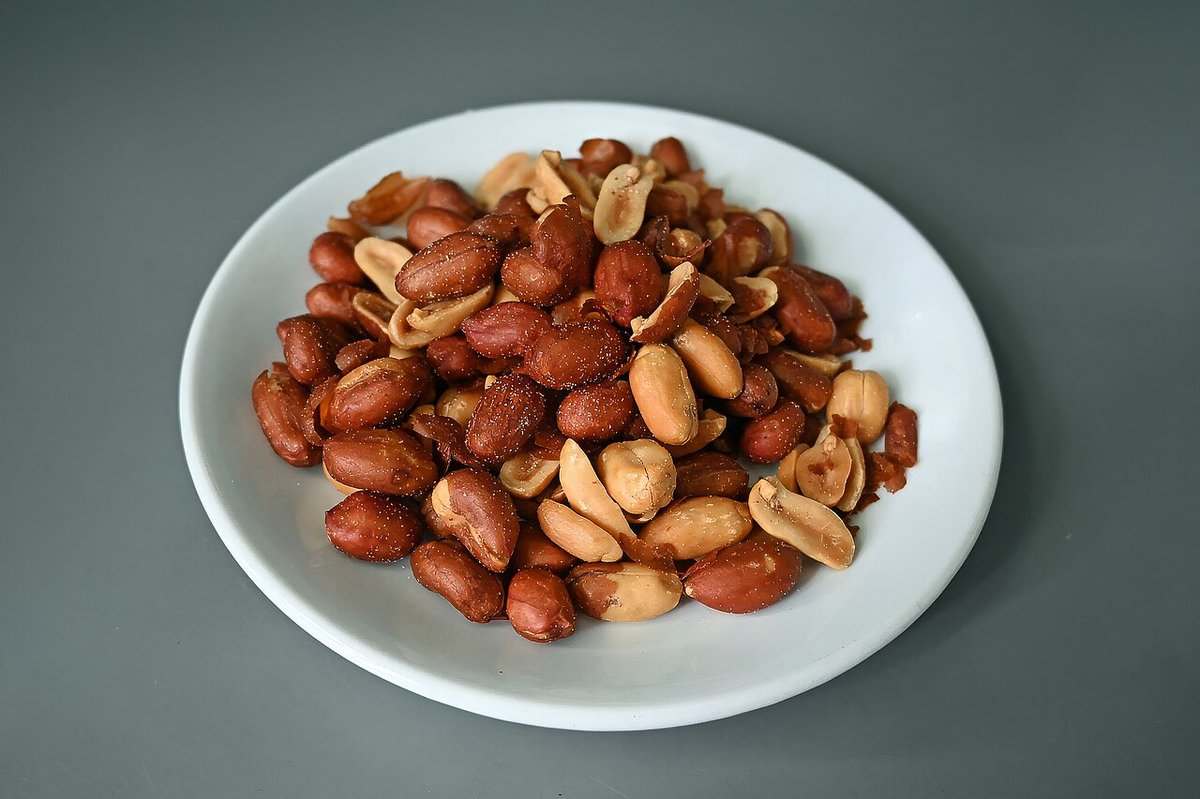
Unsalted, skin-roasted peanuts, roughly two small handfuls
1 region
Cluster on the right side of the brain, including the hippocampus, where blood flow responded better to insulin after the peanut period
+3.6%
Overall brain blood flow after the peanut period compared with no peanuts (earlier report from the same trial)
+5.8%
Delayed verbal recall, about 1.4 more words remembered (earlier report from the same trial)
Brain insulin findings from the open-access paper in Food & Function (first published 30 September 2026, CC BY 3.0) and the Maastricht University Medical Center release of 5 October 2026; blood flow, memory and blood pressure figures from the same trial's report in Clinical Nutrition (2025). Trial registered as NCT05724654. Funded by The Peanut Institute Foundation.
- Despite the name, peanuts are not true nuts: they are legumes, related to beans, peas and lentils, and the pods ripen underground.
- Insulin sprayed into the nose can travel along nerve pathways from the nasal lining into the brain, which is why researchers use it to study the brain's response to insulin without giving an injection.
- The trial was registered in 2023 with brain blood flow and brain insulin sensitivity as its two main outcomes, so the insulin result reported now was planned from the start rather than found after the fact.
- Daily consumption of unsalted, skin-roasted peanuts beneficially affects regional brain insulin responsiveness in older adults: results of a longer-term randomized controlled trialFood & Function, Royal Society of Chemistry, 30 September 2026 · Open access; the brain insulin findings
- New research finds daily peanut consumption beneficially affects brain insulin responsivenessEurekAlert!, 5 October 2026 · Release naming the brain regions and the funder
- Longer-term skin-roasted peanut consumption improves brain vascular function and memory: a randomized, single-blind, controlled crossover trial in healthy older adultsClinical Nutrition, 2025 · Earlier report from the same trial: participants, blood flow, memory and blood pressure figures
- Effects of Peanut Consumption on Brain Function (NCT05724654)ClinicalTrials.gov · Trial registration: design, outcomes and eligibility
- Roasted Peanuts (photo)Choo Yut Shing, via Wikimedia Commons · CC BY 2.0 image
General information, not medical advice. Peanuts can cause severe allergic reactions; do not eat them if you are allergic. Sixty grams of peanuts adds a substantial number of calories, so if you are watching your weight, have diabetes or another condition, talk to your doctor or a qualified dietitian before making changes to your diet.
Analysis by NutroPractic from the sources listed. Written for general readers; it does not replace advice from your own doctor.
Newsfeed for your website
Want this feed on your website?
Add it to any site with one copy-and-paste snippet. No sign-up, and it updates itself every hour.
Start with a virtual consultation
Tell Dr. Triveni what you want to change. You will leave with a clear next step, whether you are in Toronto, London, New York or Chennai.