Malnutrition · October 25, 2026
Stronger nutrition drinks for frail, underfed over-70s at home would save France €74 a patient a year, says a spreadsheet model paid for by a company that sells them
A cost model counted about 800,000 French people over 70 who are frail and malnourished and worked out that the most concentrated prescription drinks beat standard ones, mostly through shorter hospital stays. The drinks really are cheaper per day, because fewer bottles are needed. But the savings come from assumptions, not patients, and the paper's own numbers raise a few questions.
When an older person stops eating enough because of illness, doctors in many countries prescribe small bottles of nutrition drink: a few hundred calories and a good dose of protein in 200 ml. French guidelines ask for at least 400 kcal and 30 g of protein a day from them. Some drinks pack that into fewer bottles than others. Is the stronger kind worth it? A cost analysis published in Frontiers in Nutrition on 14 October says yes, and puts a figure on it for France.
It is a model, not a trial. Nobody was given a drink for this paper. The authors built an Excel cost calculator from national population figures, 2024 reimbursement prices and published studies, then asked what one year would cost the French public health system for people over 70 who live at home, are frail and have disease-related malnutrition. They count 799,487 such people and assume 40% get drinks, 73% of those the most concentrated kind (1.8 to 2.5 kcal per ml, 20 to 28 g of protein a bottle) and 27% a standard kind (up to 1.5 kcal per ml). Every scenario assumes 30 days of drinks, the minimum French guidelines recommend, though the authors cite real-world use averaging 97 days.
Because each concentrated bottle carries more, a patient needs about 1.1 to 1.3 bottles a day to reach the model's target of 500 kcal and 30 g of protein, against 1.7 to 1.8 standard bottles. So a month of the strong drinks cost €88 to €91 at 2024 prices, against €91 to €108 for standard ones. Add the modelled hospital costs and the totals per patient come out at €388 with concentrated drinks, €462 with standard drinks and €2,376 with none. Across France the authors put the saving from today's mix, compared with standard drinks only, at €17.4 million a year, and say a move to 80% concentrated drinks would save another €1.7 million.
The bigger number in the table is the one the headline skips: in this model, giving any drink at all cuts the expected cost of complications from €2,376 to €366 a patient, about 85%. That gap, and the smaller one between drink types, come from the hospital admission rates and lengths of stay the authors took from earlier European studies, filling gaps with indirect comparisons. The €17.4 million is about 1.3% of the €1.29 billion the model spends on this group with standard drinks alone. Testing each input 20% up or down, an arbitrary range the authors themselves call exploratory, left the strong drinks cheaper every time.
Read the paper closely and some things don't fit. The analysis was funded by Nutricia, a maker of these drinks; the first two authors work for Nutricia and the other two for Clarivate, which was paid to build the model and write the paper. Yet the conflict of interest statement says the work had no commercial or financial relationships that could be seen as a conflict. The conclusion says savings more than offset higher product costs, while the paper's own tables show the concentrated drinks costing less (€89 against €96 a patient). And the 799,487 count, described as people who are frail and malnourished, is exactly 7.5% of all 10.66 million over-70s living at home, not of the 1.9 million the paper counts as frail; we could not tell from the text which was meant. None of this means the drinks don't help underfed older people; trials and guidelines say they can. It means this €74 is a sum worked out by the seller's side, waiting for real patient data.
Concentrated vs standard oral nutrition drinks for frail, malnourished over-70s at home in France: a one-year cost model (Frontiers in Nutrition, 14 October 2026)
799,487
Over-70s at home in France the model counts as frail with disease-related malnutrition
40%
Share assumed to get nutrition drinks; 73% of them the most concentrated kind (2024 market data)
€89 vs €96
Average cost of 30 days of drinks per patient: concentrated vs standard
€388 vs €462
Modelled one-year cost per patient, drinks plus complications: concentrated vs standard (€2,376 with no drinks)
€17.4 million
Modelled yearly saving for France from today's mix vs standard drinks only, about 1.3% of the €1.29 billion total
30 vs 97 days
Days of drinks assumed in the model vs average real-world use cited by the authors
Source: Carot V, Dular A, Le Novere M, Schmitt L, 'Economic value of high-energy, high-protein oral nutritional supplements in disease-related malnutrition in the French community setting', Frontiers in Nutrition 2026, 13, published 14 October 2026, doi 10.3389/fnut.2026.1952501. Cost analysis from the French public payer perspective, one-year horizon, no discounting, deterministic Excel calculator; no patients enrolled. Population (Table 1): 10,659,820 over-70s living at home; 1,899,609 frail (25.2% of those 75+, 5.1% of 70–74); 799,487 described as frail and malnourished (the paper applies 7.5%; 7.5% of 10,659,820 = 799,487); 40% on drinks = 319,795 (86,345 standard, 233,450 concentrated). Products (Table 2, 2024 reimbursement prices excluding VAT, 200 ml bottles, target 500 kcal and 30 g protein a day, 30 days): concentrated €2.24 a bottle, 1.3 a day, €88.42 a month (47% of use) and €2.83, 1.1 a day, €91.29 (26%); standard €1.82, 1.7 a day, €91.00 (12%) and juice-style €1.98, 1.8 a day, €108.00 (14%). Per patient (Table 3): drinks €0 / €96 / €89, complications €2,376 / €366 / €299, total €2,376 / €462 / €388 for none / standard / concentrated; saving €74 (€7 drinks, €67 complications). Population (Table 4): total €1,899,796,973 with no drinks, €1,287,779,945 standard only, €1,270,423,661 at the 2024 mix; saving €17,356,283. Moving to 80% concentrated (Table 5): a further €1,664,301. One-way sensitivity analysis ±20% on key inputs; hospital admission rates and length of stay were the biggest drivers. Hospitalisation inputs from published European studies with indirect treatment comparisons (details in the supplement). Funding: Nutricia; Clarivate received a consultancy fee for model development and medical writing. Affiliations: Nutricia Nutrition Clinique, France (VC); Nutricia Global, Netherlands (AD); Clarivate Analytics, London (ML, LS). The paper's conflict of interest statement declares no commercial or financial relationships.
- Since 2019 the GLIM criteria, agreed by clinical nutrition societies worldwide, have asked for one visible sign (weight loss, low body mass index or low muscle mass) and one cause (eating too little or absorbing too little, or illness and inflammation) before calling someone malnourished.
- The European clinical nutrition society ESPEN's 2019 guideline on older adults says nutrition drinks for malnourished older people should give at least 400 kcal and 30 g of protein a day and be kept up for at least a month: the same threshold the French model starts from.
- Malnutrition isn't only about being thin. An overweight person who has been ill, eating little and losing muscle can meet the criteria too, which is one reason screening relies on weight loss and appetite as well as weight.
- Economic value of high-energy, high-protein oral nutritional supplements in disease-related malnutrition in the French community settingFrontiers in Nutrition · The cost analysis, open access, published 14 October 2026; figures from its full text and tables
- GLIM criteria for the diagnosis of malnutrition – A consensus report from the global clinical nutrition communityClinical Nutrition · The 2019 consensus definition of malnutrition
- ESPEN guideline on clinical nutrition and hydration in geriatricsClinical Nutrition · The 2019 European guideline on nutrition drinks for older adults
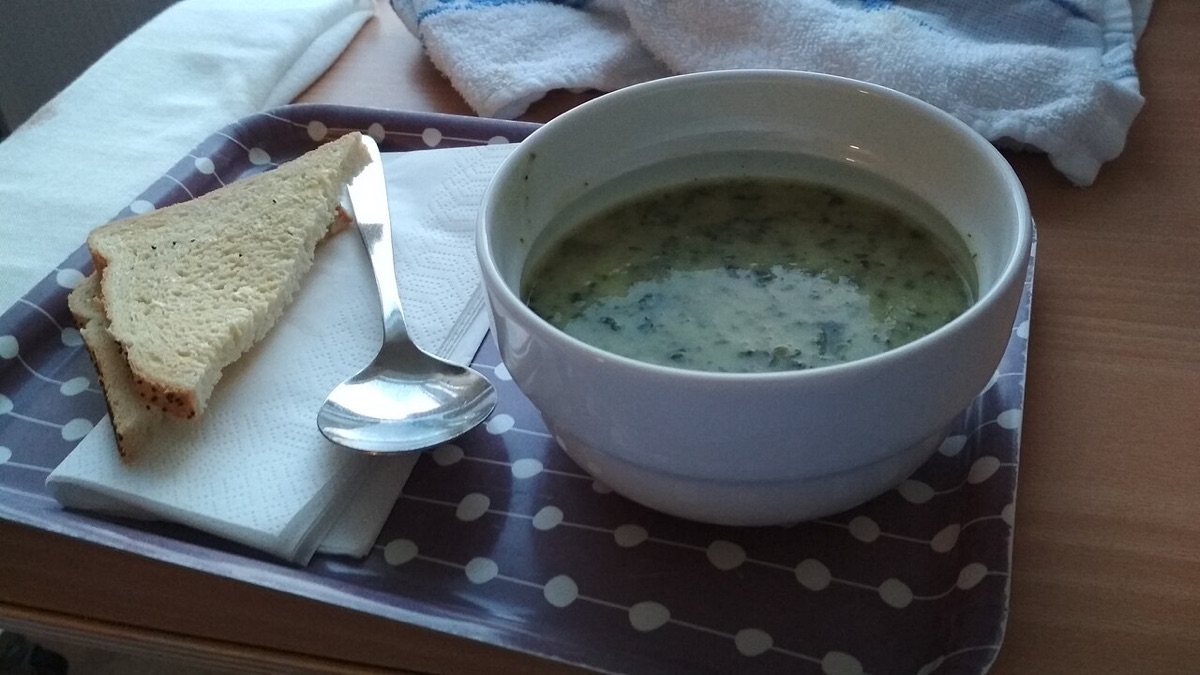
- Stavanger University Hospital food 2020Wikimedia Commons · The photo, CC BY 4.0
General information, not medical advice. If you or someone you care for is losing weight without trying, eating much less than usual or has been prescribed nutrition drinks, talk to the doctor or a registered dietitian about how much to take, for how long and which kind suits them.
Analysis by NutroPractic from the sources listed. Written for general readers; it does not replace advice from your own doctor.
From our articles
Our guides on this subject
Plain-language guides on nutrition and wellness, backed by research.

Medicines and nutrition
CoQ10 and statins: what the muscle symptom trials found, and who might benefit
Statin-associated muscle symptoms lead up to 30% of patients to discontinue life-saving cholesterol therapy. While statins deplete circulating CoQ10 by 16% to 54%, randomized clinical trials show mixed results for myalgia relief. Explore the trials, ubiquinone vs ubiquinol bioavailability, recommended doses, and clinical guideline recommendations.
14 Nov 2026

Women's wellness and nutrition
Creatine for women: cognitive performance, menstrual cycle phases, and bone density beyond muscle building
Creatine is widely stereotyped as a bodybuilding supplement for men, but female physiology tells a very different story. Women exhibit 70% to 80% lower endogenous creatine stores, reduced dietary intake, and cyclical fluctuations in brain creatine kinase across the follicular and luteal phases. Robust clinical trials demonstrate that 3 to 5 grams of daily creatine monohydrate enhances cognitive performance during sleep deprivation, augments clinical response in unipolar depression, preserves femoral neck bone geometry in postmenopausal women, and causes cellular intracellular hydration rather than subcutaneous bloating.
13 Nov 2026

Healthy ageing
Creatine beyond the gym: what it does for older adults and women, and what it doesn't
Across 22 trials, adults in their late fifties to seventies who took creatine while doing resistance training gained about 1.4 kg more lean mass than those who trained without it. Two two-year trials found it did nothing for bone density after menopause. Where the evidence is solid, where it's early (memory, short nights), how much to take, and who should leave it alone.
10 Oct 2026
Newsfeed for your website
Want this feed on your website?
Add it to any site with one copy-and-paste snippet. No sign-up, and it updates itself every hour.
Start with a virtual consultation
Tell Dr. Triveni what you want to change. You will leave with a clear next step, whether you are in Toronto, London, New York or Chennai.