Gut health · October 28, 2026
Low-FODMAP, plain diet advice or advice plus a 16:8 eating window: 81 Istanbul adults with IBS tried one for two weeks, and all three groups finished in almost the same place
The low-FODMAP group's symptom score fell twice as far as the plain-advice group's, 103 points against 51. But that group also started out the worst, and after two weeks the three groups' scores were within 8 points of each other. Once the researchers allowed for where people started, the low-FODMAP edge was gone. The fasting group had more relief from belly pain, but it was also eating about 250 kcal a day less.

People with irritable bowel syndrome usually get one of two kinds of food advice. The best-studied is the low-FODMAP diet, which for a few weeks cuts out short-chain carbohydrates that are poorly absorbed and ferment in the gut, found in foods such as garlic, onion, wheat, beans, some fruit and milk. The simpler option is general advice like that in the UK NICE guideline: regular meals, plenty of water, no more than three portions of fruit and three cups of tea or coffee a day, and less alcohol and fizzy drinks. Time-restricted eating, where all food goes into a fixed daily window, has lately been suggested as a third idea. A study published on 26 October in the journal Nutrients is the first, its authors say, to put all three side by side.
The work was done at Acibadem Kozyatagi Hospital, a private hospital in Istanbul, with Acibadem Mehmet Ali Aydinlar University, between February and November 2024. Everyone had IBS diagnosed by a gastroenterologist at the same clinic under the Rome IV criteria, was aged 18 to 65 and was not already on an elimination diet. Patients the gastroenterologist had already referred for a low-FODMAP diet went into that group; the rest were randomly split between the adapted NICE advice and the same advice with a 16:8 schedule, eating only between 11:00 and 19:00 or 12:00 and 20:00. A certified dietitian built a meal plan for each person to match their energy needs. Eighty-one people finished, 27 in each group, average age 37, 70% women, and most (62 of 81) had the constipation type of IBS.
After two weeks, symptom scores on the standard 0 to 500 IBS scale had fallen in all three groups. The low-FODMAP group went from an average of 296 to 193, a drop of 103 points. The plain-advice group went from 241 to 189, down 51, and the fasting group from 262 to 197, down 64. On those raw changes the low-FODMAP diet beat plain advice. A drop of 50 points or more, the usual mark of a meaningful change, was reached by 22 of 27 people on low-FODMAP (81%), 17 on the fasting plan (63%) and 12 on plain advice (44%).
The catch is in the starting line. Because the low-FODMAP group was not randomised, it began with clearly worse symptoms and lower quality-of-life scores, and people who start worse have more room to improve and tend to drift back towards average on their own. When the researchers compared the end scores while allowing for each person's starting score, there was no significant difference among the three diets, either in symptoms or in quality of life, and the response rates no longer differed either. The adjusted gap between low-FODMAP and plain advice was 22 points, with a range running from 60 points better to 16 points worse. A higher starting score, not the diet, was what predicted who improved by 50 points.
Some details still differed before that adjustment. Bloating eased most on low-FODMAP, which fits the idea that fermenting carbohydrates produce gas and stretch the gut. Belly pain, both how bad and how often, eased more on low-FODMAP and on the fasting plan than on plain advice; on plain advice, pain severity barely moved. But the fasting group also ate least, about 1,224 kcal a day against roughly 1,444 to 1,497 kcal in the others, so the authors cannot say whether timing or simply eating less helped. Everyone lost a little weight, about 0.9 to 1.3 kg. Quality of life rose in all three groups, but by only 2.8 to 7.9 points on a 100-point scale, and no one reached remission in two weeks.
The authors call the results hypothesis-generating rather than proof. Two weeks is short, at the low end of the two-to-six-week restriction phase Monash University suggests, and the reintroduction stage that a real low-FODMAP diet depends on was not part of it. There was no group left on their usual diet, so placebo, natural ups and downs and the effect of seeing a dietitian every week can't be separated out. Nobody was blinded, every outcome was self-reported, and the trial was registered only after it had finished. Fibre intake was low in the low-FODMAP and fasting groups, about 14 to 15 g a day, which would matter if either were kept up for longer. Their practical point is that a dietitian-led plan of any of the three kinds came with similar short-term improvement, and that larger, fully randomised trials are needed to tell them apart.
Two weeks of three diets for IBS, 81 adults in Istanbul (27 per group)
296 → 193
Low-FODMAP: average symptom score (0-500 scale), a fall of 103 points
241 → 189
Adapted NICE advice: average symptom score, a fall of 51 points
262 → 197
NICE advice plus a 16:8 eating window: a fall of 64 points
81% / 44% / 63%
Improved by 50 points or more on low-FODMAP / NICE / NICE plus 16:8; not significant once starting scores were allowed for
22 points
Adjusted gap, low-FODMAP vs NICE advice, at the end; the range ran from 60 better to 16 worse (not significant)
1,224 kcal
Average daily intake on the 16:8 plan, against 1,444 (low-FODMAP) and 1,497 (NICE)
Three-arm, partly randomised study: only the NICE and NICE plus 16:8 groups were randomised; the low-FODMAP group was made up of patients already referred for that diet and started with worse symptoms. No usual-diet control group, no blinding, self-reported outcomes, two weeks only, with no reintroduction phase; mostly constipation-type IBS; registered at ClinicalTrials.gov after completion. Symptom scores are the IBS Symptom Severity Score (75-174 mild, 175-299 moderate, 300+ severe). Open access (CC BY). No external funding; the authors declare no conflicts of interest.
- FODMAP stands for fermentable oligosaccharides, disaccharides, monosaccharides and polyols. The diet was developed at Monash University in Melbourne, which still runs the main food-testing programme and app.
- Garlic and onion are two of the richest everyday sources of fructans, one of the FODMAP groups, which is why they are among the first foods cut in the restriction phase.
- A low-FODMAP diet is meant to have three stages: a short restriction, then bringing foods back one group at a time, then a personal long-term diet. It isn't meant to be followed strictly for good.
- Under the Rome IV criteria, IBS means belly pain on at least one day a week, on average, over the last three months, linked to bowel movements or to a change in how often or what they look like, with symptoms that began at least six months earlier.
- In this study the plain-advice group's anxiety scores fell slightly over the two weeks, the only group where that happened; on average, all three groups started at or above the usual cut-off for anxiety symptoms.
- Short-Term Effects of a Low-FODMAP Diet, Adapted NICE Dietary Advice, and Adapted NICE Dietary Advice Combined with Intermittent Fasting on Symptoms and Quality of Life in Irritable Bowel Syndrome: A Three-Arm, Non-Randomized Controlled Dietary Intervention StudyNutrients · The study, open access, published 26 October 2026; figures and limitations from the full text and tables
- NCT07829666ClinicalTrials.gov · The trial's registration, posted after the study ended
- Irritable bowel syndrome in adults: diagnosis and management (CG61)National Institute for Health and Care Excellence (NICE) · The UK guideline the plain-advice diet was adapted from
- About FODMAPs and IBSMonash University · What FODMAPs are and the three stages of the diet
- Rome IV CriteriaRome Foundation · The diagnostic criteria for IBS used in the study
- Garlic Bulbs (Unsplash)Wikimedia Commons · The image, CC0 (Matthew Pilachowski)
General information, not medical advice. Belly pain and changes in bowel habit can have causes other than IBS, so get a diagnosis first. A low-FODMAP diet or a fasting schedule is best tried with a doctor or registered dietitian, and neither should be followed strictly for long without guidance.
Analysis by NutroPractic from the sources listed. Written for general readers; it does not replace advice from your own doctor.
From our articles
Our guides on this subject
Plain-language guides on nutrition and wellness, backed by research.

Gut health
Probiotic capsules: which ones have trial evidence, what they can do, and when to skip them
Children on antibiotics: 8% got diarrhoea with a probiotic, 19% without. Older hospital patients: 10.8% with, 10.4% without. Which capsules have evidence, what three guidelines say about IBS, what a course costs per case prevented, and who shouldn't take them.
2 Nov 2026
Gut health
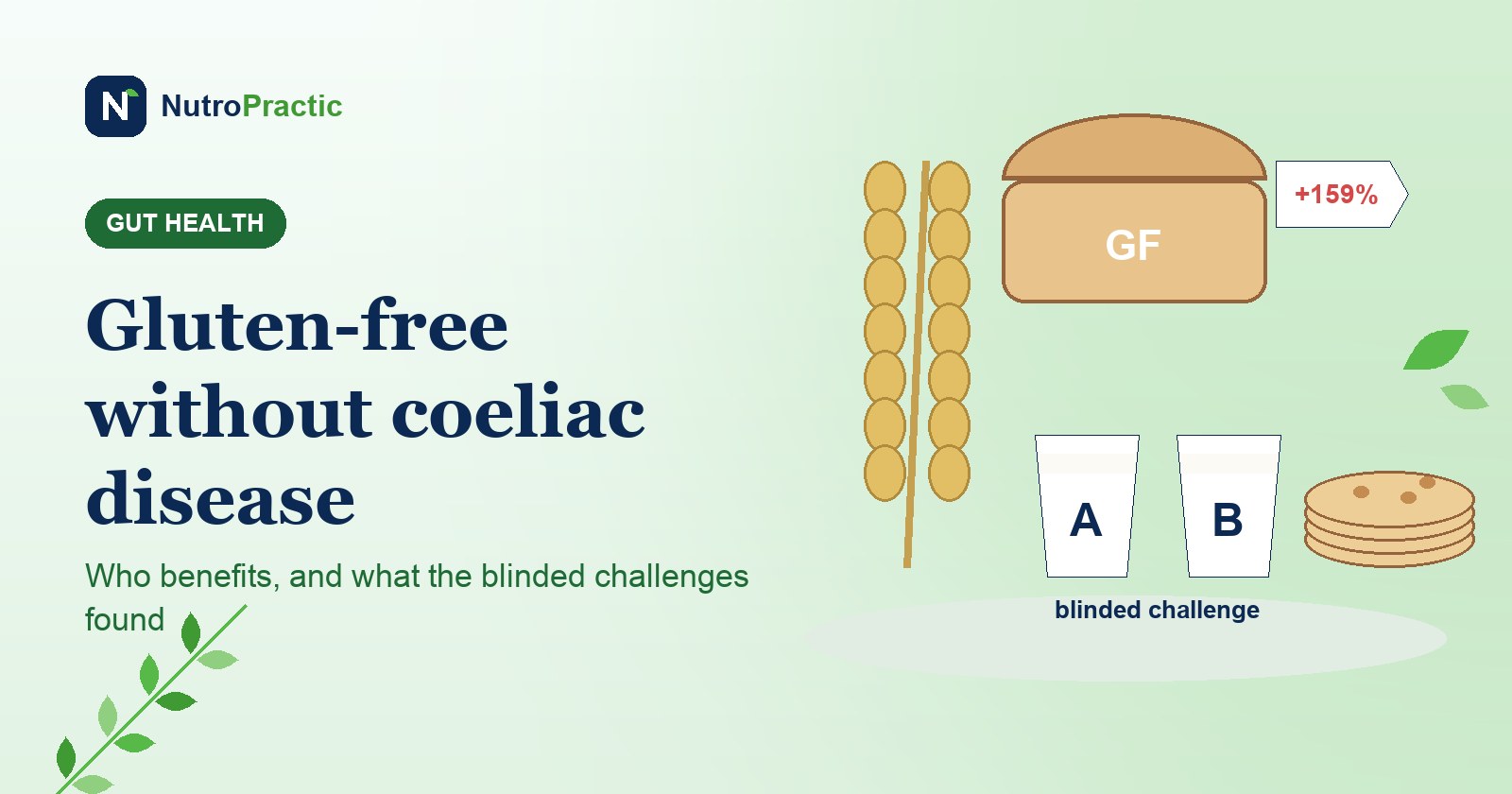
Gluten-free without coeliac disease: who actually benefits, and what the blinded gluten challenges found
In blinded trials only 16% of people who said gluten made them ill reacted to gluten rather than placebo, and in Oslo fructans caused more bloating than gluten. Who really needs to avoid it, how to get tested before you stop, how much gluten is in a slice of bread or a roti, and what gluten-free food costs (159% more in the UK) and lacks.
1 Nov 2026

Nutrition science
Intermittent fasting and time-restricted eating: what the head-to-head trials found
When trials give an eating window and plain calorie cutting the same calories, weight, blood sugar and cholesterol end up in much the same place. The window works by helping some people eat less. What the trials found, early versus late windows, the muscle catch, who shouldn't fast, and a 12-hour default.
30 Oct 2026
Newsfeed for your website
Want this feed on your website?
Add it to any site with one copy-and-paste snippet. No sign-up, and it updates itself every hour.
Start with a virtual consultation
Tell Dr. Triveni what you want to change. You will leave with a clear next step, whether you are in Toronto, London, New York or Chennai.