Type 1 diabetes · October 24, 2026
352 Japanese adults with type 1 diabetes, five years of follow-up: those whose diets leaned from carbohydrate towards plant protein and fat had fewer heart attacks, strokes and deaths. The catch is in the maths, and the top scorers ate more carbohydrate in grams
A Tokyo team scored the diets of 352 adults with type 1 diabetes on how far they tilted away from carbohydrate and towards protein and fat, then counted serious events over about five years. Each extra point on the plant-based version of the score went with 15% lower risk. But the link only appeared once the analysis allowed for how much people ate overall, and with 35 events in total, the numbers are small.

People with type 1 diabetes live with carbohydrate in a way most of us never have to. Every meal's carbohydrate has to be matched with insulin, so carbohydrate counting sits at the centre of dietary advice. What gets less attention is what the rest of the plate is made of, and whether the balance of carbohydrate, protein and fat matters for the heart in the long run. Heart and blood vessel disease is still a leading cause of death in type 1 diabetes, and blood sugar control alone does not explain all of that risk. A team from Juntendo University in Tokyo and the Aso Clinic in Shizuoka looked at diet in their own type 1 cohort; the paper was published in the Journal of Diabetes Investigation on 16 October.
Between December 2019 and September 2021 the Juntendo-Aso Type 1 Diabetes (JAT-1) study enrolled 352 adults, average age 51, average HbA1c 7.9%, who had had diabetes for about 15 years. They filled in a validated diet history questionnaire covering 58 foods and drinks. From it the researchers built three low-carbohydrate diet scores, each from 0 to 30: points for eating less carbohydrate and more protein and fat (the total score), or the same with only plant-derived protein and fat counted (the plant score), or only animal-derived (the animal score). The group as a whole was already on the low side for Japan: carbohydrate made up 49% of their energy, against the 55 to 60% the authors cite for the general Japanese population. The scores measure where someone sits within this group, not a strict low-carb or keto diet.
Over a median of almost five years, 35 people (9.9%) had a heart attack or other ischaemic heart event (8), a stroke or brain bleed (7), serious artery disease in the legs (7) or died of any cause (13). In the main analysis, allowing for age, sex, eye and kidney complications, earlier heart or artery disease, blood pressure and total calorie intake, each extra point on the total score went with 10% lower risk, each point on the plant score with 15% lower risk and each point on the animal score with 7% lower risk. Five points more on the plant score, a little over one standard deviation, went with a hazard ratio of 0.44. The plant result held when people with earlier heart disease were left out and when events in the first year were dropped.
Here is the catch. With age and sex alone, or with the health measures added one by one, none of the three scores was linked to the outcome. The links only appeared once total calorie intake went into the model. That matters because people who ate more food overall also scored higher: in the top third of the plant score, people ate on average 234 g of carbohydrate a day against 174 g in the bottom third, along with much more protein and fat. So the result is about the share of energy coming from carbohydrate versus plant protein and fat, among people eating similar amounts, not about eating fewer grams of carbohydrate. The authors say total energy may need to be considered alongside diet composition, and that the scores describe nutrient patterns, not a healthy plant-based diet as such.
The limits are large, and the authors list them. This is an observational study, so it cannot show that the diet caused the difference. Diet was asked once, by questionnaire. Thirty-five events is a small number, and the outcome lumped heart attacks, strokes and deaths from any cause (including pneumonia and sepsis) together, so it cannot say which drove the link; 64 people were lost to follow-up, mostly because they changed hospital. Japanese adults with type 1 diabetes are leaner than many Western patients and eat differently. The study was funded by a Japan Society for the Promotion of Science grant; one author reports lecture fees and research funding from many drug and device companies, and the others declare none. Anyone with type 1 diabetes thinking of cutting carbohydrate should do it with their diabetes team, because insulin doses, low blood sugar and ketones all change with it. We read the full open-access paper.
Low-carbohydrate diet scores and heart events or death in 352 adults with type 1 diabetes, JAT-1 cohort, Japan (published 16 October 2026)
352
Adults with type 1 diabetes followed for a median of almost five years (1,487.7 person-years)
35
Had a heart attack or other ischaemic heart event, stroke, serious leg artery disease or died (9.9%)
49.3%
Share of energy from carbohydrate in the group, already below the 55 to 60% the authors cite for Japan
0.85
Hazard ratio per point on the plant low-carbohydrate score (95% CI 0.76 to 0.94), after adjusting for calories
0.90 / 0.93
Hazard ratios per point on the total and animal scores, also after adjusting for calories
174 g vs 234 g
Carbohydrate a day in the bottom versus top third of the plant score: the top scorers ate more food overall
Source: Sato J, Mita T, Negami T, et al., 'Association between low-carbohydrate diet scores and macrovascular events or all-cause mortality in adults with type 1 diabetes in Japan', Journal of Diabetes Investigation, published online 16 October 2026, doi 10.1111/jdi.70468, open access (CC BY-NC 4.0). Prospective cohort (Juntendo-Aso Type 1 Diabetes, JAT-1) at two clinics, enrolled December 2019 to September 2021: 352 adults, mean age 51.4, 41.5% men, BMI 22.9, diabetes duration 14.8 years, HbA1c 7.9%. Diet: brief-type self-administered diet history questionnaire (58 items); mean intake 1,705 kcal a day, carbohydrate 49.3%, protein 16.0%, fat 29.3% of energy. Scores 0 to 30: carbohydrate in 11 descending categories plus protein and fat (total, plant-derived or animal-derived) in 11 ascending categories each. Outcome: first ischaemic heart disease, cerebrovascular disease, peripheral artery disease or death from any cause; median follow-up 1,799 days; 35 events (8 heart, 7 cerebrovascular, 7 peripheral artery, 13 deaths); 64 lost to follow-up. Main Cox model adjusted for age, sex, retinopathy, nephropathy, previous macrovascular disease, systolic blood pressure and total energy intake: hazard ratio per point, total 0.90 (0.82 to 0.98), plant 0.85 (0.76 to 0.94), animal 0.93 (0.87 to 0.996). Without the energy adjustment (age and sex only, or sequentially adjusted for the clinical factors) no score was significantly associated. Plant score exploratory: per SD (3.97 points) 0.52 (0.33 to 0.79); per 5 points 0.44 (0.25 to 0.74); excluding baseline macrovascular disease 0.86 (17 events); 1-year landmark 0.87 (23 events). Plant score tertiles: carbohydrate 174.3 to 234.3 g a day, protein 51.9 to 82.3 g, fat 40.1 to 73.2 g from lowest to highest. Funding: JSPS KAKENHI JP23K10809. One author reports honoraria and research funding from industry; the others declare no conflicts.
- In 10,101 Americans with newly diagnosed type 2 diabetes from the Nurses' Health Study and Health Professionals Follow-up Study, low-carbohydrate patterns built on vegetable sources were linked to lower death rates, while the animal-based version showed no significant link.
- The same Tokyo group earlier reported that in Japanese adults with type 2 diabetes the total and animal low-carbohydrate scores were linked to fewer heart events or deaths.
- In this cohort, the lowest band of carbohydrate intake, the one that scored the full 10 points, was still 48 to 118 g a day: far from a ketogenic diet.
- The UK DAFNE trial in 2002 taught 169 adults with type 1 diabetes to match insulin to whatever carbohydrate they chose to eat; six months later their HbA1c was 8.4% against 9.4% in those still waiting for the course, with no rise in severe low blood sugar.
- Association between low-carbohydrate diet scores and macrovascular events or all-cause mortality in adults with type 1 diabetes in JapanJournal of Diabetes Investigation (Wiley) · The study, open access, published online 16 October 2026
- Low-Carbohydrate Diet Scores and Mortality Among Adults With Incident Type 2 DiabetesDiabetes Care · US cohort study, 2023, on plant- and animal-based low-carbohydrate scores
- Training in flexible, intensive insulin management to enable dietary freedom in people with type 1 diabetes: dose adjustment for normal eating (DAFNE) randomised controlled trialBMJ · The DAFNE trial, 2002
- Tofu 1Wikimedia Commons · The photo, CC BY 2.0 (Toukou Sousui)
General information, not medical advice. This was an observational study of 352 adults in Japan and shows a link, not cause and effect. If you have type 1 diabetes, change the carbohydrate in your diet only with your diabetes team: insulin doses, low blood sugar and ketones all need watching.
Analysis by NutroPractic from the sources listed. Written for general readers; it does not replace advice from your own doctor.
From our articles
Our guides on this subject
Plain-language guides on nutrition and wellness, backed by research.

Cardiovascular wellness
Psyllium husk: how much soluble fibre lowers LDL cholesterol and stabilizes post-meal glucose in clinical trials
Viscous soluble fibre forms a thick gel matrix in the small intestine that binds bile acids and blunts post-meal glucose spikes. Across dozens of randomized controlled trials, 7 to 10.2 grams of psyllium daily lowers LDL cholesterol by 6% to 12% without stripping HDL, while reducing postprandial glucose surges by 15% to 25% in metabolic syndrome and type 2 diabetes. Discover the bile acid sequestration mechanism, trial meta-analyses, exact timing before meals, water ratios, and titration protocols to avoid gas and cramping.
13 Nov 2026

Indian kitchen
Dal and pulses in an Indian kitchen: protein, soaking, gas and blood sugar
A katori of dal gives about 6 to 10 g of protein, depending on how much raw dal goes in. What India's food tables and the ICMR-NIN 2024 guidelines say about rice with dal, how much soaking, sprouting and pressure cooking cut phytate and the sugars behind the gas, the GI of chana dal and rajma, raw rajma safety, and a worked plate for diabetes.
25 Oct 2026
Supplements and vitamins
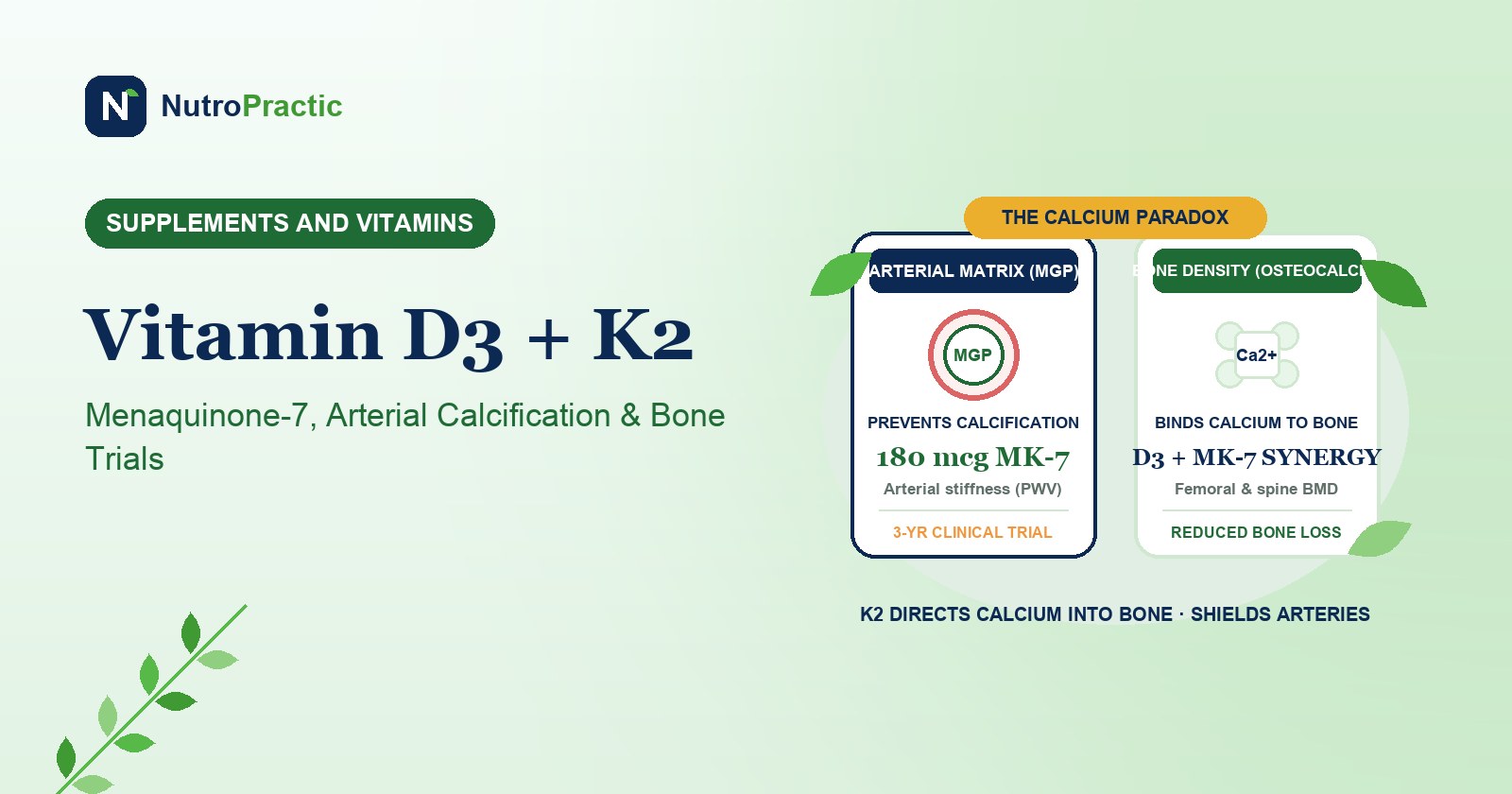
Vitamin D3 with K2: does adding menaquinone-7 actually protect arteries and bones in trials?
Vitamin D3 enhances intestinal calcium absorption, but without adequate vitamin K2, calcium can deposit in vascular walls instead of bone matrix. Clinical trials evaluating menaquinone-7 (MK-7) demonstrate improved carboxylation of Matrix Gla Protein, preserved arterial elasticity, and reduced bone mineral density loss. Discover what human clinical trials actually prove about cardiovascular calcification, bone density, MK-4 vs. MK-7 dosing, and critical drug interactions.
13 Nov 2026
Newsfeed for your website
Want this feed on your website?
Add it to any site with one copy-and-paste snippet. No sign-up, and it updates itself every hour.
Start with a virtual consultation
Tell Dr. Triveni what you want to change. You will leave with a clear next step, whether you are in Toronto, London, New York or Chennai.