Sustainable eating · October 22, 2026
Same food budget, better plate: re-mixing what 2,615 Japanese adults already ate raised nutrient scores up to 36% and cut the carbon by up to a third. The greenest version left young men short of vitamins, and nine in ten still ate too much salt
Researchers in Tokyo and Wageningen took eight days of weighed food records from adults across Japan and asked a computer to build healthier, lower-emission diets out of meals real people were already eating, at no more than 5% extra cost. Here is what had to change on the plate, and what no amount of re-mixing could fix.
Most advice on eating more sustainably starts from an imagined ideal diet and asks people to move towards it. A team from Toho University, the University of Tokyo, Chiba University, Wageningen University and the Dutch public health institute RIVM went the other way. They started from what people in Japan actually eat and asked how far those same eating patterns could be pushed towards better nutrition and lower greenhouse gas emissions without making the shopping more expensive.
Their data came from the MINNADE survey, run for Japan's health ministry between 2016 and 2020 in 32 of the country's 47 prefectures. Volunteers weighed every food and drink on a kitchen scale for eight days, two in each season, and research dietitians checked the records. The new analysis, published on 13 October in the European Journal of Nutrition, used 2,615 adults: 1,445 aged 18 to 49 and 1,170 aged 50 to 74. Each diet was given a nutrient score, an estimated carbon footprint from farm to distribution centre, and a price based on national retail prices.
The method, called data envelopment analysis, first picks out the people whose diets are already the best balance of foods to eat more of (fruit, vegetables, pulses, nuts, dairy, fish, whole grains) against foods to eat less of (red and processed meat, salt, sugary drinks, alcohol). That was 18% of younger men, 11% of younger women and about 22% of older adults. Everyone else got three alternative diets built as blends of those real ones: one for the best nutrient score, one for the lowest emissions, and one aiming at both. Each had to keep the same calories and cost no more than 105% of the person's own diet; with no extra money allowed at all, 196 people had no possible solution.
Every version raised the nutrient score, by 13.5% to 35.9%, and shortfalls in most vitamins and minerals fell. The low-emission and combined diets cut greenhouse gases by 12.6% to 32.7%, and they came out 2% to 21% cheaper. On the plate that meant more fruit, whole grains, pulses and dairy and less red and processed meat, sugary drinks and alcohol, with the biggest changes needed by people under 50. Among younger men, the share eating too little fibre dropped from 91% to 62% on the combined diet, and too little potassium from 74% to 31% on the nutrient-first one.
Two things did not work out. In younger men, the lowest-emission diet leaned so hard on refined grains such as white rice that more of them fell short on riboflavin (41% to 66%), vitamin C (33% to 50%), vitamin A and protein than on their own diets. And salt did not move at all: 85% to 91% of every group went over Japan's sodium goal in every scenario, because even the best real diets in the sample were salty. The volunteers were better educated than average and probably more health-minded, the food prices dated from 2013, and the results are model diets on paper, not a trial of anyone eating them. The authors say they are a starting point for Japan's next food guide, not a recommendation in themselves.
Optimised versus observed diets of 2,615 Japanese adults, with cost capped at 105% (MINNADE survey, 2016–2020)
2,615
Adults with eight days of weighed food records over four seasons, aged 18–49 (1,445) and 50–74 (1,170)
+13.5% to +35.9%
Rise in the nutrient score (NRF9.3) across the three optimised diets and four age-sex groups; largest in under-50s
−12.6% to −32.7%
Cut in diet greenhouse gas emissions in the low-emission and combined diets; the nutrient-first diet barely changed emissions
−2% to −21%
Change in daily food cost in the low-emission and combined diets; the nutrient-first diet cost about the same
85–91%
Adults over Japan's sodium goal, unchanged in every scenario and every group
41% → 66%
Men under 50 short on riboflavin on their own diet versus the lowest-emission diet; vitamin C 33% → 50%
Study: Sugimoto M, Okubo H, Kikuchi Y, Biesbroek S, Temme EHM, Katagiri R, 'Optimizing Japanese dietary patterns to improve nutritional quality, reduce environmental impact under affordability constraints in younger and older adults from the nationwide MINNADE study', European Journal of Nutrition 2026, 65(8):282, published 13 October 2026, doi 10.1007/s00394-026-04129-x (open access, CC BY; read in full). Data: MINNADE survey, three rounds November 2016 to August 2020, volunteers in 32 prefectures recruited non-randomly by 453 research dietitians, one person per household; 8-day weighed dietary records (two non-consecutive days per season). Analysed: 711 men and 734 women aged 18–49, 565 men and 605 women aged 50–74. Intakes standardised to 2,500 kcal (men) and 2,000 kcal (women). Diet quality: Nutrient Rich Food Index 9.3 against the Dietary Reference Intakes for Japanese 2025 (WHO 5% of energy limit for added sugar). Emissions and other impacts: IDEA v3.4.1 life-cycle database, cradle to regional distribution centre. Cost: National Retail Price Survey 2013 plus one supermarket's prices. Method: data envelopment analysis (SHARP-type); efficient diets 131 younger and 131 older men, 79 younger and 134 older women; optimised diets built as blends of efficient diets for everyone else, three models (MaxNRF, MinGHGE, OPT2G), with same energy, foods to increase only up and foods to decrease only down, vitamin A capped at the 95th percentile, cost at most 105% of observed (196 had no solution at 100%). 102 people with no feasible solution excluded, leaving 2,038 compared. Results: NRF9.3 +13.5% to +35.9% in all models and groups; greenhouse gas emissions −20.9% to −32.7% (MinGHGE) and −12.6% to −25.1% (OPT2G); cost −7.7% to −20.6% (MinGHGE) and −2.2% to −13.5% (OPT2G), similar or slightly lower in MaxNRF. Younger men (n = 572): inadequate fibre 91% observed, 62% OPT2G; potassium 74% observed, 31% MaxNRF; calcium 79% observed, 34% MaxNRF; on MinGHGE, protein below the goal 31% → 54%, vitamin A 73% → 88%, vitamin C 33% → 50%, riboflavin 41% → 66%. Older men on MinGHGE: inadequate thiamine 0% → 7%. Younger women (observed, n = 616): inadequate iron 38%, calcium 60%, fibre 82%. Sodium above the goal 85–91% in every group and scenario; saturated fat above the goal in over 60% of women in every model. Pairwise McNemar tests with Bonferroni correction (P < 0.0083). Funding: Japan's Ministry of Health, Labour and Welfare and JSPS KAKENHI; one author's university department is a social cooperation programme with Ajinomoto Co., which the authors state had no role in the study. Dataset not public (Consumer Affairs Agency, Japan).
- Volunteers weighed every food and drink on the same model of digital kitchen scale, on two days in each of spring, summer, autumn and winter, so the records catch seasonal eating rather than one snapshot.
- Japan's dish-based food guide, the Japanese Food Guide Spinning Top, dates from 2005 and has not been substantially updated since. It has no environmental advice, which is one gap this study aims to help fill.
- Data envelopment analysis was invented in the late 1970s to compare how efficiently organisations such as bank branches or schools turn inputs into outputs. Here each person's diet is treated as a little factory turning food into nutrients.
- Because every optimised diet is a blend of meals real people in the same age and sex group already ate, the method avoids the odd results of older diet models, such as calling for implausibly large amounts of one cheap, nutrient-dense food.
- In Japan, riboflavin (vitamin B2) comes mainly from meat, fish, eggs and dairy, which is why cutting those hardest for the climate showed up first as a riboflavin shortfall in young men.
- Optimizing Japanese dietary patterns to improve nutritional quality, reduce environmental impact under affordability constraints in younger and older adults from the nationwide MINNADE studyEuropean Journal of Nutrition · The paper: full text, open access
- Optimizing Japanese dietary patterns (full text in PubMed Central)PubMed Central · Free full text with tables
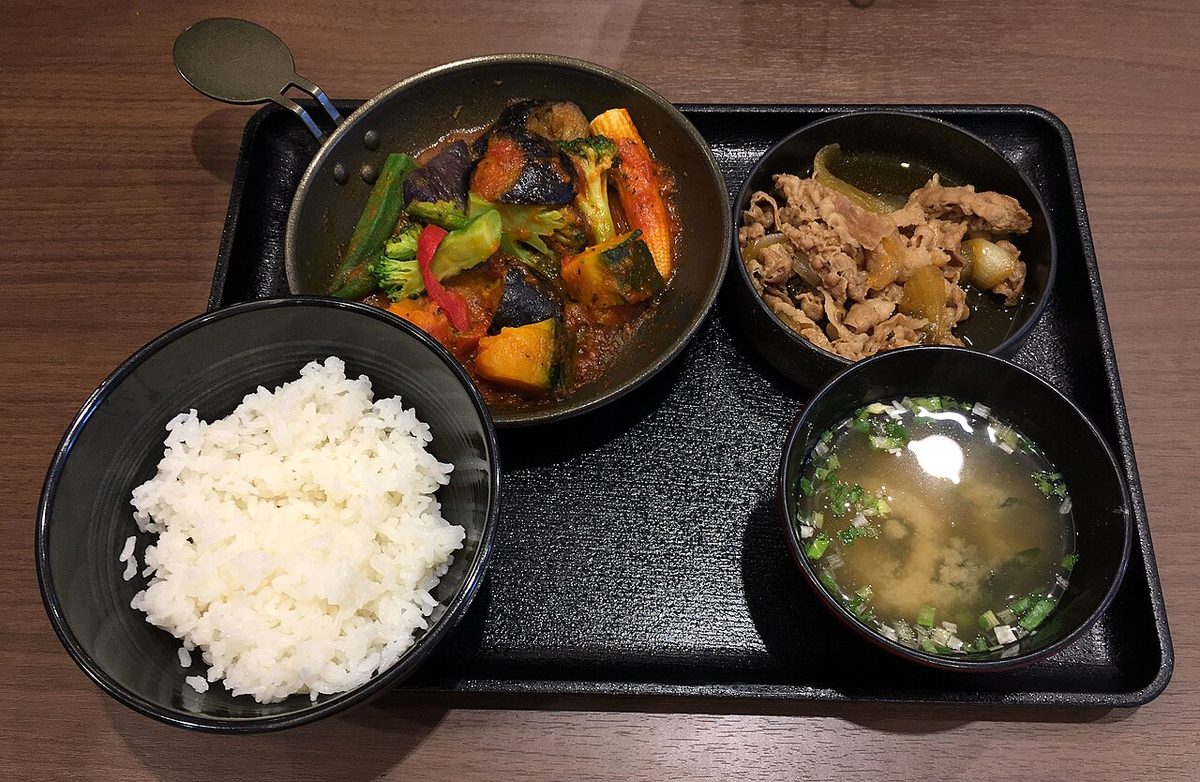
- Vegetable beef teishoku of YoshinoyaWikimedia Commons · The photo, CC0
General information, not medical advice. This study built model diets on paper from food records; nobody was asked to eat them, and it does not tell you what you personally should eat. Cutting back on animal foods can leave gaps in protein, riboflavin and other nutrients, so if you plan a big change to your diet, especially if you are pregnant, older, or have a health condition, talk to your doctor or a registered dietitian.
Analysis by NutroPractic from the sources listed. Written for general readers; it does not replace advice from your own doctor.
From our articles
Our guides on this subject
Plain-language guides on nutrition and wellness, backed by research.

Heart and blood pressure
Beetroot juice and dietary nitrate: what the blood-pressure trials measured, and who should be careful
Drinking 250 ml of beetroot juice dropped clinic systolic blood pressure by 7.7 mmHg in 4-week clinical trials. Here is how tongue bacteria convert dietary nitrate to nitric oxide, why antiseptic mouthwash blocks it completely, and the oxalate kidney stone warning.
18 Nov 2026

Everyday eating
Electrolyte powders: sodium and sugar per bottle, and when water is enough
Packets deliver 300 to 1,000 mg sodium and up to 11 g sugar. Here is how popular drink mixes compare with actual sweat losses—and who actually needs them.
10 Nov 2026

Everyday eating
Instant noodles: the sodium in the whole packet, and what actually reduces it
Three official labels range from 750 to 1,520 mg sodium per packet. Here is the whole-pack arithmetic, what the broth study measured, and how to turn noodles into a more complete meal.
6 Nov 2026
Newsfeed for your website
Want this feed on your website?
Add it to any site with one copy-and-paste snippet. No sign-up, and it updates itself every hour.
Start with a virtual consultation
Tell Dr. Triveni what you want to change. You will leave with a clear next step, whether you are in Toronto, London, New York or Chennai.