Eating behaviour · October 23, 2026
Intuitive eating is four habits, not one. In 545 students, eating for hunger rather than mood went with fewer sweets, while 'no forbidden foods' went with more cake and fast food
Two dietitians at Selçuk University in Türkiye asked 545 students how they eat, what they eat and whether they can always afford food. Choosing food for how it makes the body feel went with more vegetables, meat, eggs and beans. Giving yourself permission to eat anything went the other way. Almost four in ten students were short of food, and that blurred the picture further.
Intuitive eating is often sold as the friendly alternative to dieting: stop counting, listen to your body, eat when you are hungry and stop when you are full. The questionnaire researchers use to measure it, the Intuitive Eating Scale-2, splits it into four separate habits. Unconditional permission to eat means no food is off limits. Eating for physical rather than emotional reasons means eating because you are hungry, not because you are bored, sad or stressed. Reliance on hunger and fullness cues means trusting those signals to tell you how much. And body and food choice congruence means picking foods that make your body feel and work well.
Ayşegül Özkan and Nazan Aktaş, dietitians at Selçuk University in Konya, wanted to know whether those four habits pull a person's plate in the same direction, and whether they still work when money for food is tight. Their study, based on the first author's master's thesis, came out in the British Journal of Nutrition on 15 October, open access.
They recruited university students aged 19 to 24 from across Türkiye through class groups and social media. Of 561 who answered the online survey, 16 were dropped for finishing it implausibly fast, leaving 545: average age 21.6, about three in four women. Each filled in the intuitive eating questionnaire, the UN Food and Agriculture Organization's eight-question food insecurity scale and a 51-item food frequency questionnaire from Türkiye's national nutrition survey, which turns a year of eating into scores for eight food groups. The authors then fitted statistical models separately for men and women, and for students who were food secure or only mildly short of food against those who were moderately or severely short.
The habit that looked most like healthy eating was choosing food for how it makes the body feel. In men it went with more dairy, more meat, eggs and legumes, and more vegetables and fruit. In women it went with more meat, eggs and legumes. Eating for hunger rather than emotion went with fewer sweets in men and in women, and with less fast food in women. Permission to eat anything pointed the other way. In women it went with more sugars and sweets, more fast food, more grain foods and fewer vegetables and fruit, and in men it went with more sweets.
Trusting hunger and fullness signals was the odd one out. In men, and in students short of food, it went with eating more sweets, and in the food-short group with eating less meat, eggs and legumes. The authors suggest that when food comes in a feast-or-famine pattern, the body's signals become a less reliable guide, and what ends up on the plate depends on what is cheap and to hand.
Food shortage was common. On the FAO scale, 38.5% of the students were moderately or severely food insecure. In the past year 31.2% said they had been hungry but not eaten for lack of money or other resources, and 14.5% had gone a whole day without eating, against 8.4% and 2.6% of all adults in Türkiye's 2019 national survey. Students who were shorter of food scored lower on intuitive eating overall and on each of its four parts. Men reported more food insecurity than women and scored lower on intuitive eating. Students who were overweight or obese also scored lower than those in the normal or underweight range.
The links were real but small. Where the four habits were linked to a food group, together they explained only about 2% to 8% of the differences in how often students ate it, so most of what students ate came down to other things: money, where they lived, what was nearby, taste. It was a single survey, everything was self-reported, weight and height included, the students were not a random sample, and the models were not adjusted for things like age or living arrangement. It shows patterns, not cause and effect.
The practical point is narrower than 'intuitive eating works' or 'it doesn't'. Its parts behave differently. Dropping food rules on its own went with more cake and fast food in this group; noticing why you are eating and how food makes you feel went with better choices. And for students who cannot count on their next meal, the authors argue that eating advice is no substitute for getting them reliable access to food.
Intuitive eating, food insecurity and diet: 545 university students in Türkiye
545
Students aged 19 to 24 in the final sample (74% women, average age 21.6), surveyed online
38.5%
Moderately or severely food insecure on the FAO Food Insecurity Experience Scale
14.5%
Went a whole day without eating in the past year for lack of money or resources (2.6% of all adults in Türkiye's 2019 national survey)
−0.32
Correlation between food insecurity score and overall intuitive eating score (p < 0.001); every one of the four habits fell as food insecurity rose
3.38 vs 3.18
Average intuitive eating score, women vs men, on a 1 to 5 scale (p < 0.001)
2% to 8%
Share of the differences in a food group's intake explained by the four habits, where a link was found: real but small
Source: Özkan A, Aktaş N, 'Intuitive eating and dietary intake: associations by food insecurity status', British Journal of Nutrition, published online 15 October 2026, doi:10.1017/S0007114526108794 (open access, CC BY). Cross-sectional online survey; diet, weight and height self-reported; structural equation models by sex and by food insecurity status, not adjusted for confounders. No specific funding; the authors declared no conflicts of interest.
- The four habits are measured with 23 statements scored from 1 ('strongly disagree') to 5 ('strongly agree'). Permission to eat has six statements, eating for physical rather than emotional reasons eight, trusting hunger and fullness six, and choosing foods for how the body feels three.
- Women scored higher than men on permission to eat and on trusting hunger and fullness cues. The two sexes scored about the same on eating for hunger rather than emotion and on choosing foods for how the body feels.
- Students who were overweight or obese scored lower on intuitive eating overall (2.96 and 3.04) than those of normal weight (3.42) or underweight (3.62).
- The UN Food and Agriculture Organization's food insecurity scale asks eight yes-or-no questions about the past 12 months, from worrying about running out of food to going a whole day without eating.
- Among students who were food secure or only mildly short of food, the habits explained 8.1% of the differences in how often they ate fast food, the largest share of any food group in the study.
- Intuitive eating and dietary intake: associations by food insecurity statusBritish Journal of Nutrition (Cambridge University Press) · The study, open access, with the full tables and path diagrams
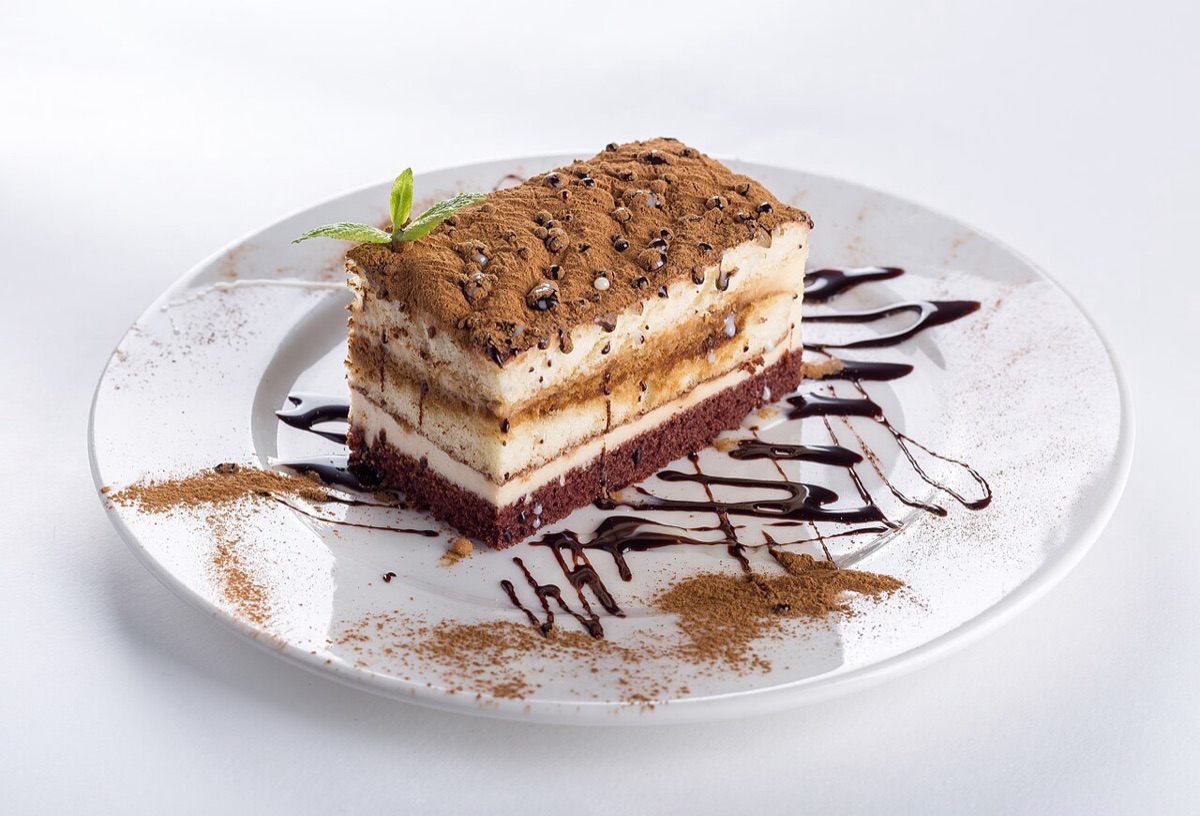
- Piece of chocolate cake on a white plate decorated with chocolate sauceWikimedia Commons · The photo, CC0
General information, not medical advice. This was a one-off survey of university students that shows links, not cause and effect. If you are working on your eating habits, have or have had an eating disorder, or are struggling to afford food, talk to your doctor, a registered dietitian or a local support service.
Analysis by NutroPractic from the sources listed. Written for general readers; it does not replace advice from your own doctor.
From our articles
Our guides on this subject
Plain-language guides on nutrition and wellness, backed by research.
Everyday eating
Calories on the menu: what restaurant labelling studies found, and how to order well when eating out
Menu calorie labels arrived in the US in 2018 and England in 2022. Studies of millions of orders found drops of about 4 to 6%, and none at all in some places. What a restaurant meal really carries (977 kcal for a UK chain main course alone), a worked evening out, what eating out often does in long-term studies, and five ordering habits that save hundreds of calories.
22 Oct 2026
Global data
Diabetes, obesity, child malnutrition and hunger, 1980 to 2050: what the numbers show
How diabetes, obesity, child malnutrition and hunger have changed since 1980, with sourced figures and a basic projection to 2050. Click a condition to explore the chart and its facts.
5 Oct 2026

Women's health
Inositol for PCOS: the 40:1 ratio, trial doses, and food milligrams
Why do randomized trials in polycystic ovary syndrome prioritize the 40:1 myo to D-chiro inositol ratio? Here is the science behind the ovarian epimerase paradox, clinical ovulation and insulin metrics, and why cantaloupe cannot replace 4,000 mg trial powder.
21 Nov 2026
Newsfeed for your website
Want this feed on your website?
Add it to any site with one copy-and-paste snippet. No sign-up, and it updates itself every hour.
Start with a virtual consultation
Tell Dr. Triveni what you want to change. You will leave with a clear next step, whether you are in Toronto, London, New York or Chennai.