Child health · October 19, 2026
141 babies treated for severe vitamin B12 deficiency at one Indian children's hospital. Within months of treatment, 31 of the 112 who could be followed had developed epilepsy
A baby who is breastfed by a mother short of vitamin B12 can slip behind, go pale and floppy, and lose skills they already had. The injections that follow usually bring them back. A cohort from Chandigarh followed these children for about four years and counted what the injections could not undo.

In food, vitamin B12 comes almost entirely from animal products, and a baby's supply depends on the mother: what she had stored in pregnancy, then what reaches her breast milk. When a mother is short, an exclusively breastfed baby can run out within the first year. In parts of the Indian subcontinent, where many mothers are vegetarian, paediatricians know the picture well: a pale, listless baby with darkened skin and changes in the hair who is falling behind or losing skills, often with tremors. Injections of B12 bring the blood back to normal. Whether the brain catches up is a different question.
A brief research report published on 8 October in Frontiers in Nutrition looks at one part of that question. Doctors at the Postgraduate Institute of Medical Education and Research in Chandigarh enrolled 141 consecutive children with symptomatic infantile B12 deficiency between January 2021 and June 2023, treated them, and kept following them until March 2026. Four died early on and 25 were lost to follow-up. Of the 112 who remained, 31 (28%) went on to develop epilepsy, diagnosed by the international criteria of at least two unprovoked seizures or a recognised epilepsy syndrome, over a median follow-up of 51 months.
The seizures came after treatment, not before it. Only 5 of the 31 had any seizures while they were deficient. Epilepsy began on average 4.7 months after the deficiency was diagnosed, and every case in the cohort appeared within the first 10 months of follow-up. Nearly half, 15 children, had epileptic spasms, the brief clusters of jerks that make up infantile epileptic spasms syndrome, a serious epilepsy of infancy. All 15 had their spasms stop with hormone treatment, one needing a second drug, but five of them went on to other seizure types that medicines could not control.
By the last contact, 21 of the 31 children with epilepsy were seizure-free or well controlled, 8 had drug-resistant epilepsy and 2 had died of epilepsy-related complications. Seizures during the deficiency itself were the strongest warning sign: children who had them were about four times as likely to develop epilepsy later. Children with a better developmental score at follow-up were less likely to, and the group with epilepsy already scored lower before their seizures began, which the authors read as a sign that epilepsy marks the most severe, longest-running deficiencies. One detail stands out for anyone relying on a single blood test: in the children who developed epilepsy, the B12 level was below the laboratory's cut-off in only 17 of 31, while homocysteine, a compound that builds up when B12 is short, was high in all 30 tested.
This is a small study from one referral hospital, and the children who reach a paediatric neurology service are likely to be the sickest. Almost one child in five could not be followed, and the authors point out that a few more cases among them would change the 28% noticeably; the 95% confidence interval already runs from 19% to 36%. There was no comparison group of children without deficiency, so the study can't say how much of the epilepsy B12 caused. The paper also has loose ends: the abstract gives a mean age at epilepsy onset of 19.0 months and the table 19.9, and one figure legend describes the developmental-score result the opposite way round from the statistical model.
Still, the direction of the evidence is hard to ignore. Treating the deficiency fixes the blood, but this cohort adds to earlier reports that a brain starved of B12 in its first year can carry the damage for years afterwards. The authors' answer is prevention: B12 for mothers during pregnancy and breastfeeding, dietary advice, and screening of babies at high risk. That applies well beyond India: anyone pregnant or breastfeeding who eats few or no animal foods, or who has a condition that blocks B12 absorption, has a reason to talk to their doctor about their B12 before the baby is born.
Epilepsy after treated infantile vitamin B12 deficiency: a prospective cohort at a children's hospital in Chandigarh, India
141
Children with symptomatic infantile B12 deficiency enrolled, January 2021 to June 2023
31 of 112
Children with complete follow-up who developed epilepsy (28%, 95% CI 19% to 36%)
4.7 months
Average time from diagnosis of the deficiency to the start of epilepsy; all cases within 10 months
15 of 31
Children whose epilepsy was epileptic spasms; all 15 had their spasms resolve on treatment
21 / 8 / 2
Children with epilepsy at last contact: controlled or resolved / drug-resistant / died
4.3×
Hazard of later epilepsy in children who had seizures during the deficiency (HR 4.27, 95% CI 1.6 to 11.5)
Study: Kumar P, Manjunathan S, Vyas S, Sahu JK, Sankhyan N, 'Epilepsy as a consequence of infantile vitamin B12 deficiency: observations from a prospective cohort study and a review of the literature', Frontiers in Nutrition, brief research report, published 8 October 2026, doi 10.3389/fnut.2026.1903748 (open access, CC BY). Postgraduate Institute of Medical Education and Research, Chandigarh, and Dr. Yashwant Singh Parmar Government Medical College, Nahan, India. Follow-up of a prospective cohort (parent study: Pediatric Neurology 2026, doi 10.1016/j.pediatrneurol.2025.12.012) of 141 consecutive children, followed to March 2026; 4 died early and 25 were lost to follow-up, leaving 112; median follow-up 51 months (IQR 45 to 55). Epilepsy by the 2014 ILAE definition. Of the 31 with epilepsy: 28 exclusively breastfed, 17 with serum B12 below 211 pg/mL, 30 of 30 tested with homocysteine above 15 µmol/L, 5 with seizures at diagnosis; generalised seizures in 24 (spasms 15, clonic 6, tonic-clonic 3), focal in 7. Multivariable Cox model with multiple imputation: seizures at diagnosis HR 4.27 (95% CI 1.6 to 11.5); follow-up developmental quotient HR 0.94 per point (0.89 to 0.99). Mean age at epilepsy onset is given as 19.0 months in the text and 19.9 months in Table 2; mean age at diagnosis as 12.4 months in the abstract and 14 (11 to 18) months in Table 1. No comparison group. The authors declare no funding for this report and no conflicts of interest; the parent study was supported by an institute research grant.
- In a German national survey for 2021 and 2022, babies who had not been screened for B12 deficiency at birth were diagnosed with symptomatic deficiency in their first year about four times as often (14 in 584,800) as screened babies (4 in 688,200).
- Diet isn't the only route. In 48 babies with severe B12 deficiency in Austria and Switzerland, 12 of their mothers had a condition that affects B12, such as pernicious anaemia, which stops the gut absorbing it; the authors called for B12 checks in pregnancy.
- Among 162 babies with epileptic spasms at a hospital in Rishikesh, India, 21 turned out to have nutritional B12 deficiency, and every one of their mothers had a low B12 level herself.
- In the same Chandigarh cohort's first report, the brain MRI was abnormal in 137 of the 141 children at diagnosis, and about two in three of those reassessed still had a developmental score below 50 after treatment.
- Epilepsy as a consequence of infantile vitamin B12 deficiency: observations from a prospective cohort study and a review of the literatureFrontiers in Nutrition, October 2026 · The study: full text, open access
- Neurological consequences of infantile vitamin B12 deficiency: a prospective cohort studyPediatric Neurology, 2026 · The first report from the same 141 children: development and brain scans
- Vitamin B12 deficiency newborn screeningPediatrics, 2024 · German national surveillance of screened and unscreened babies
- Newborn screening alone cannot prevent most cases of severe vitamin B12 deficiency in the first year of lifeNutrients, 2025 · Austria and Switzerland: mothers' health and the case for checks in pregnancy
- Nutritional vitamin B12 deficiency-associated infantile epileptic spasms syndromeSeizure, 2023 · The Rishikesh study of babies with spasms
General information, not medical advice. This study followed children who were already seriously ill with B12 deficiency at one hospital; it does not show how often milder deficiency leads to epilepsy. If you are pregnant or breastfeeding and eat few or no animal foods, or have a condition that affects B12 absorption, ask your doctor or midwife about checking and supplementing B12. If a baby is losing skills, very pale or listless, or has jerks or tremors, see a doctor promptly.
Analysis by NutroPractic from the sources listed. Written for general readers; it does not replace advice from your own doctor.
From our articles
Our guides on this subject
Plain-language guides on nutrition and wellness, backed by research.
Micronutrients
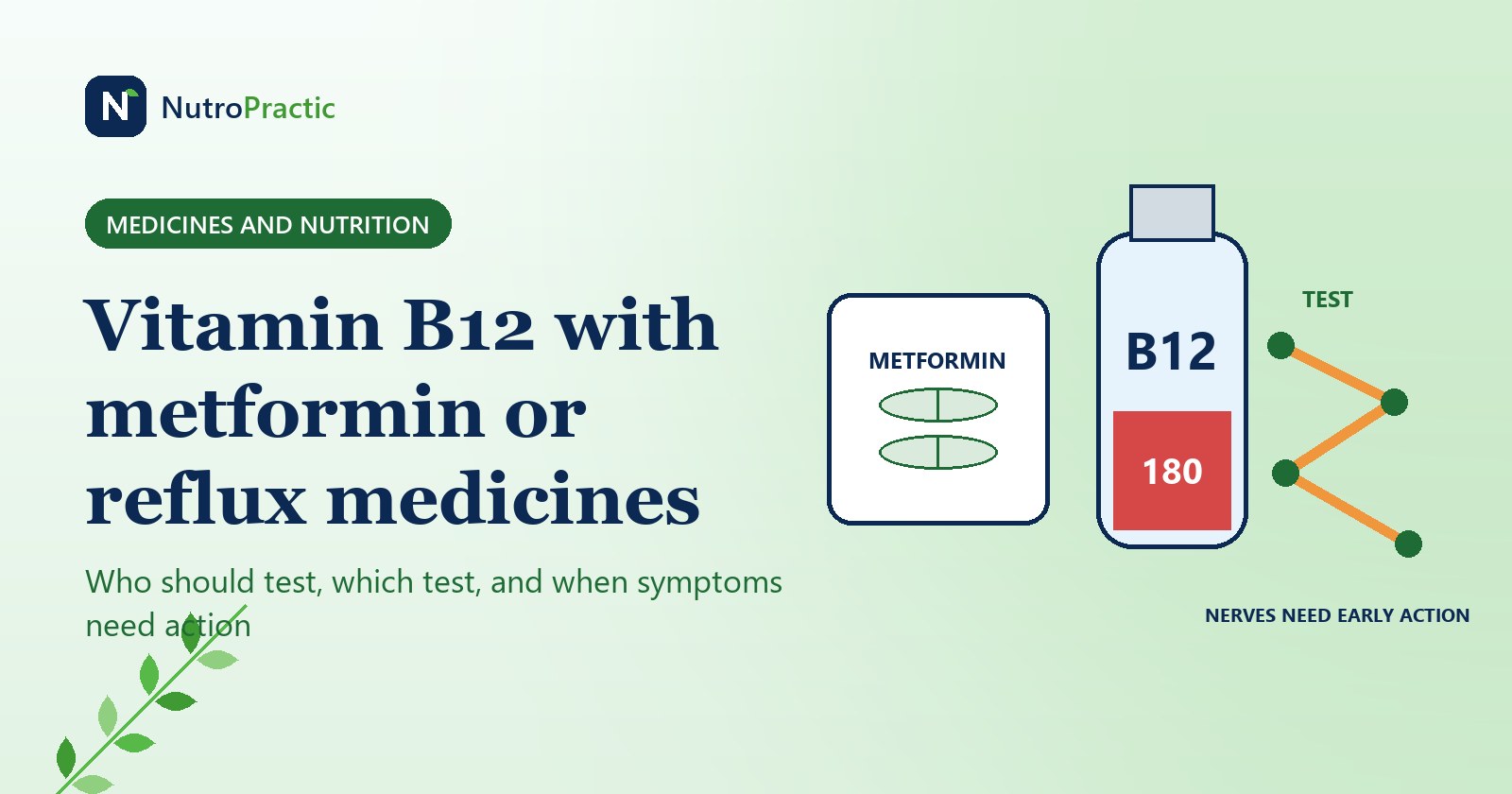
Vitamin B12 on metformin or acid-reflux medicines: who should test, and how often?
Metformin lowered B12 by 19% in a 4.3-year trial, but a PPI alone is not a rule for annual screening. Here is when to test, how to read 180 and 350 ng/L, when MMA helps, and which nerve symptoms should not wait.
9 Nov 2026
Women's health
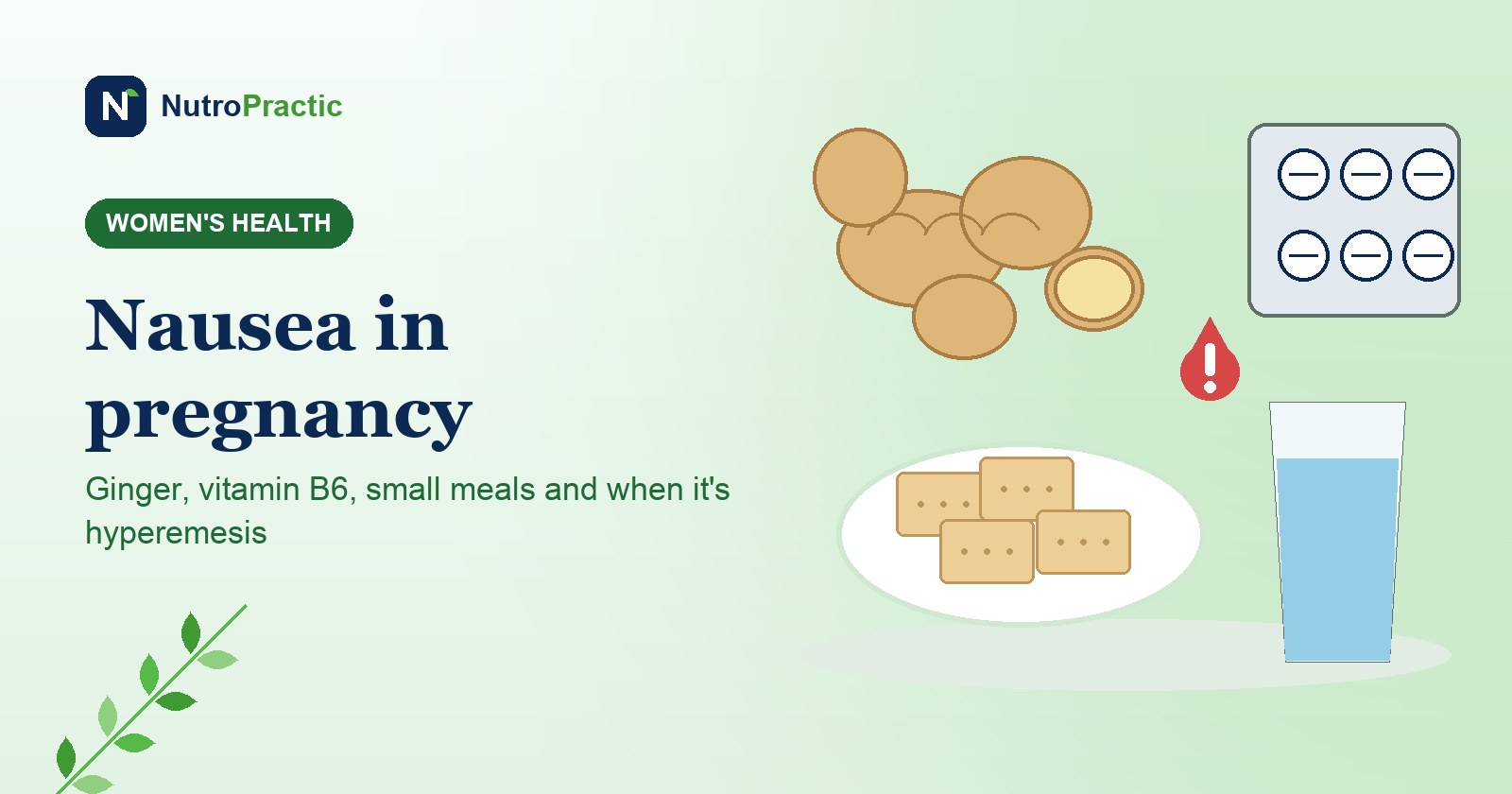
Nausea in pregnancy: ginger, vitamin B6, small meals and when it's hyperemesis, from the trials
Only 1.8% of women in one diary study had nausea just in the morning. Ginger at 1 g a day, B6 at 30 to 75 mg and doxylamine with B6 each have trial data, while diet advice has none. The score to track it, the doses, and the signs that mean a phone call.
5 Nov 2026

Women's health
Folic acid before pregnancy: why it has to start before you know, and who needs the higher dose
The neural tube closes 26 to 28 days after conception, about six weeks after the last period and before many people know they are pregnant. Folic acid cut neural tube defects by about 72% in the 1991 MRC trial, yet only about a third of women take it beforehand. The dose, who needs 4 or 5 mg, what changed for higher BMI, fortified flour from the US to the UK's 2026 law, folate foods and the B12 link.
25 Oct 2026
Newsfeed for your website
Want this feed on your website?
Add it to any site with one copy-and-paste snippet. No sign-up, and it updates itself every hour.
Start with a virtual consultation
Tell Dr. Triveni what you want to change. You will leave with a clear next step, whether you are in Toronto, London, New York or Chennai.