Heart defects · October 25, 2026
Of 197 young children born with a heart defect in north-west Pakistan, 44% were underweight and 40% too short for their age. The babies aged six to eleven months were faring worst, and the heart defect itself did not predict who was thin. Household money did
Doctors at three hospitals in Bannu weighed and measured every child under five who came in with a confirmed heart defect over six months. Undernutrition ran far above the national figures. Which defect a child had made no clear difference; family income and a father's job did.
A heart that was built with a hole between its chambers, or with a vessel left open that should have closed after birth, has to work harder than it should. Babies with these defects burn more energy, tire while feeding, and often need fluid limits and medicines that dull the appetite. So undernutrition is a familiar companion of congenital heart disease. A team of doctors and researchers from Pakistan, China and Saudi Arabia set out to measure how common it is among young children in one corner of north-west Pakistan, and what marks out the ones who fall behind. Their study was published in Frontiers in Nutrition on 16 October.
Between December 2024 and May 2025, three teaching hospitals in Bannu District, Khyber Pakhtunkhwa, enrolled 197 children aged 6 to 59 months whose defect had been confirmed by an echocardiogram. Children with other conditions that hold back growth, such as Down syndrome or cystic fibrosis, were left out. Trained doctors weighed and measured each child twice and scored them against the WHO growth standards. Most families were rural (81%), most fathers worked as labourers or farmers, and 72% of mothers had never been to school. The commonest defects were a hole between the lower chambers (35%) and an open ductus arteriosus (23%).
The numbers are stark. 44.2% of the children were underweight, 40.1% were stunted (too short for their age) and 35.5% were wasted (too thin for their height). For comparison, Pakistan's 2017-18 national survey found 23% of all under-fives underweight and 7% wasted, so wasting was about five times as common in these children. The youngest group, babies of six to eleven months, were the furthest behind: their average weight and length scores both fell below the WHO cut-off for undernutrition, while children over two did somewhat better.
When the team looked for what set the thinnest children apart, the type of heart defect did not come out as a significant factor for any of the three measures, nor did being on heart medicines. Social factors did. Children from households earning at least 40,000 Pakistani rupees a month (roughly US$140) had about half the odds of wasting and of being underweight. Children whose fathers had government jobs had lower odds of being underweight than those of labourers and farmers. Boys had about twice the odds of wasting that girls did. Nothing the team measured explained who was stunted.
This is a snapshot, not a follow-up, so it cannot say what caused what. It comes from public hospitals in one district, and the authors note that better-off families tend to use private clinics, so they are under-represented. Heart failure, oxygen levels, feeding difficulties and the timing of surgery were not recorded, which may be why the defect type showed no link. With 197 children and many factors tested, some links may be chance and real ones may have been missed. The authors call for weighing and measuring every child at the time a heart defect is found, feeding advice for families, and linking heart clinics with community growth checks. The study was funded by research grants in China and Saudi Arabia, and the authors declare no conflicts. We read the full open-access paper.
Undernutrition in 197 children aged 6-59 months with congenital heart disease, three hospitals in Bannu, Pakistan, December 2024 to May 2025 (Frontiers in Nutrition, 16 October 2026)
44.2%
Underweight (weight-for-age more than 2 SD below the WHO median)
40.1%
Stunted (too short for their age)
35.5%
Wasted (too thin for their height), against 7% of all Pakistani under-fives in the 2017-18 national survey
−2.46
Average weight-for-age score of babies aged 6-11 months, the worst of any age group (−2 marks undernutrition)
0.45
Odds ratio for wasting in households earning 40,000 rupees a month or more, compared with less
2.1
Odds ratio for wasting in boys compared with girls
Source: Khan MI, Haq I, Awais M, Zakki SA, Akhtar S, Nabi MAG, Aboagarib EAA, Kolhar M, Huang X, Hu X, 'Addressing the burden and associated factors of undernutrition in under-five children with congenital heart disease in Pakistan: evidence from a multicenter cross-sectional study', Frontiers in Nutrition 2026;13, published 16 October 2026, doi 10.3389/fnut.2026.1953133, open access (CC BY). Cross-sectional study at Khalifa Gul Nawaz Teaching Hospital, District Headquarter Teaching Hospital and Women and Children Teaching Hospital, Bannu; 197 children with echocardiographically confirmed CHD, consecutive recruitment, mean age 23.1 months (SD 16.8), 58.9% boys, 80.7% rural, mean household income PKR 43,015 a month. Lesions: VSD 34.5%, PDA 23.4%, ASD 21.3%, tetralogy of Fallot 14.2%, TGA 5.1%, coarctation 1.5%; 68.0% on cardiac medicines, 20.3% after surgery or catheter intervention. WHO 2006 standards, WHO Anthro and SPSS 22. Mean z-scores: HAZ −1.82, WAZ −1.84, WHZ −1.09; age 6-11 months WAZ −2.46, HAZ −2.08. Adjusted odds ratios: wasting, male sex 2.10 (95% CI 1.10-3.98), income ≥PKR 40,000 0.45 (0.24-0.84); underweight, income ≥PKR 40,000 0.52 (0.29-0.94), father a government employee 0.30 (0.09-0.98) vs farmers/labourers; mother's higher education 0.22 (0.05-1.01, p = 0.05, borderline). No factor was significant for stunting, and no defect type was significant for any outcome. National comparison (38% stunted, 23% underweight, 7% wasted) is the Pakistan DHS 2017-18 as cited by the authors. The 'about five times' comparison and the dollar conversion (about 280 rupees to the US dollar) are ours. Funding: Xiamen Medical and Health Key Program, Shanghai Science and Technology Commission, Natural Science Foundation of Fujian Province, Xiamen health science project and King Faisal University.
- Congenital heart disease is the most common birth defect worldwide, affecting about 1.5 million newborns a year, according to figures cited by the authors.
- The WHO growth standards used in this study were built from about 8,500 healthy, breastfed children followed in Brazil, Ghana, India, Norway, Oman and the United States between 1997 and 2003.
- Stunting reflects long-term shortfalls, while wasting is a sign of recent or acute weight loss. A child can be one, both or neither.
- WHO guidance treats an upper-arm circumference under 115 mm in a child aged 6 to 59 months as a sign of severe acute malnutrition. The children in this study averaged 120 mm.
- Addressing the burden and associated factors of undernutrition in under-five children with congenital heart disease in Pakistan: evidence from a multicenter cross-sectional studyFrontiers in Nutrition · The study, open access, published 16 October 2026, with the full tables
- Pakistan Demographic and Health Survey 2017-18, Final ReportThe DHS Program · The national child nutrition figures used for comparison
- WHO Multicentre Growth Reference Study (MGRS)World Health Organization · How the WHO child growth standards were made
- Guideline: updates on the management of severe acute malnutrition in infants and childrenWorld Health Organization · The 115 mm arm circumference cut-off (2013)
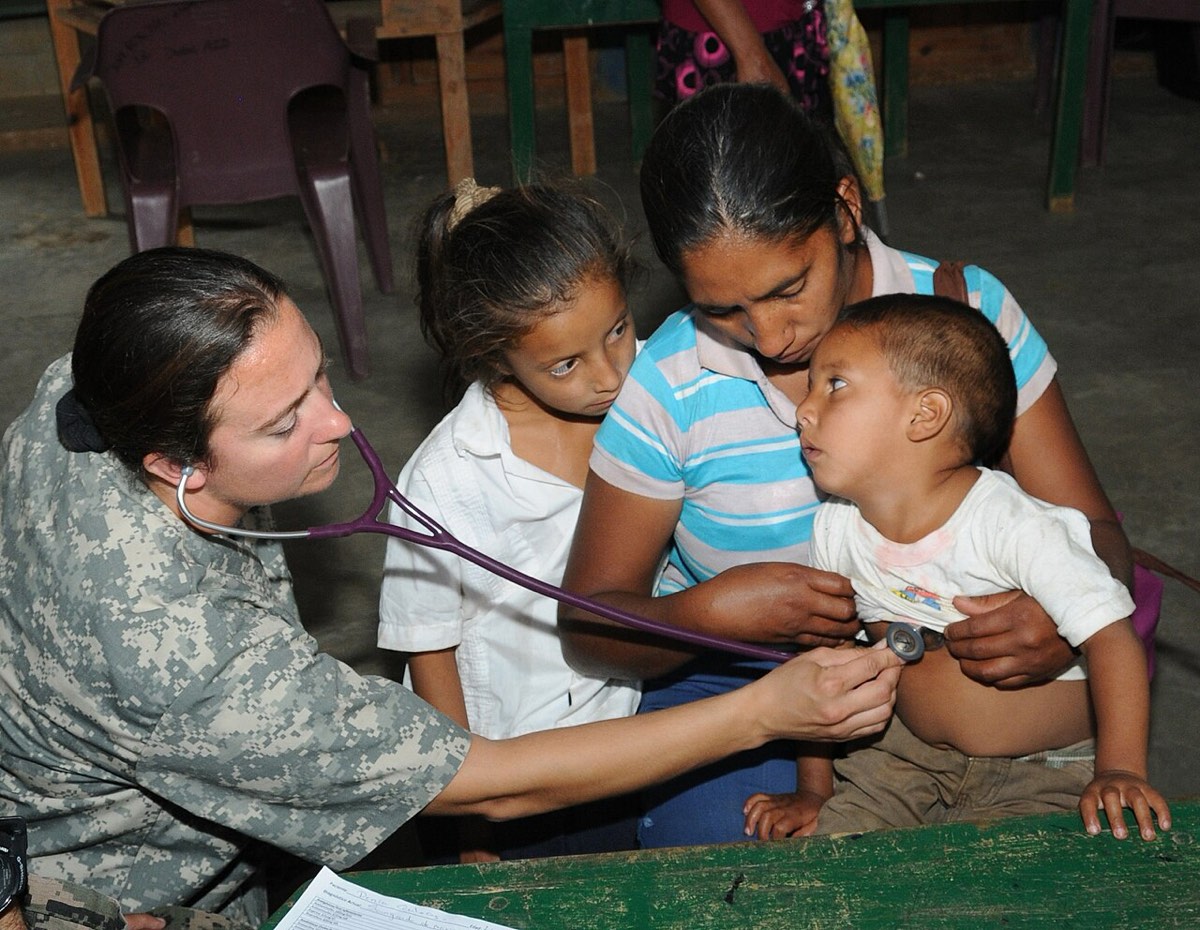
- Joint Task Force-Bravo's Medical Element provides care to nearly 1,000 in Honduran villageWikimedia Commons · The photo, public domain (US government work)
General information, not medical advice. This study describes children in one district at one point in time and cannot show cause and effect. If your child has a heart condition and you are worried about their feeding or growth, talk to their doctor or care team.
Analysis by NutroPractic from the sources listed. Written for general readers; it does not replace advice from your own doctor.
From our articles
Our guides on this subject
Plain-language guides on nutrition and wellness, backed by research.
Global data
Diabetes, obesity, child malnutrition and hunger, 1980 to 2050: what the numbers show
How diabetes, obesity, child malnutrition and hunger have changed since 1980, with sourced figures and a basic projection to 2050. Click a condition to explore the chart and its facts.
5 Oct 2026

Women's health
Inositol for PCOS: the 40:1 ratio, trial doses, and food milligrams
Why do randomized trials in polycystic ovary syndrome prioritize the 40:1 myo to D-chiro inositol ratio? Here is the science behind the ovarian epimerase paradox, clinical ovulation and insulin metrics, and why cantaloupe cannot replace 4,000 mg trial powder.
21 Nov 2026

Everyday eating
Extra virgin olive oil polyphenols: the EU health claim, smoke point myths, and cooking stability
Does extra virgin olive oil degrade when cooked? What does the EU 5 mg polyphenol health claim require, how does oleocanthal act like ibuprofen, and why does oxidative stability matter more than smoke point in domestic frying? Here is the clinical and culinary data.
21 Nov 2026
Newsfeed for your website
Want this feed on your website?
Add it to any site with one copy-and-paste snippet. No sign-up, and it updates itself every hour.
Start with a virtual consultation
Tell Dr. Triveni what you want to change. You will leave with a clear next step, whether you are in Toronto, London, New York or Chennai.