Nutrigenetics & metabolic health · November 23, 2026
Gene variants in the FADS cluster determine how much omega-3 levels rise after supplementation: 16-week RCT
In a randomized trial of breast cancer survivors, common genetic variations in the fatty acid desaturase cluster dictated individual plasma EPA and DPA increases, explaining why patients respond differently to the same dose of fish oil.

Postmenopausal women undergoing aromatase inhibitor (AI) therapy for hormone-receptor-positive breast cancer frequently suffer from debilitating treatment-induced musculoskeletal symptoms, dyslipidemia, and systemic vascular inflammation. While supplemental long-chain omega-3 polyunsaturated fatty acids (n-3 LC-PUFAs), specifically eicosapentaenoic acid (EPA) and docosahexaenoic acid (DHA), are frequently prescribed to quiet joint stiffness and lipid abnormalities, clinical trials report notoriously heterogeneous therapeutic responses among patients.
Human synthesis and elongation of polyunsaturated fatty acids are catalyzed by enzymes encoded by the fatty acid desaturase (FADS) gene cluster on chromosome 11. To investigate whether inherited single-nucleotide polymorphisms (SNPs) within this cluster drive individual variations in lipid response, clinical oncologists conducted a 16-week, three-arm randomized controlled trial enrolling 69 postmenopausal breast cancer survivors on active AI therapy.
Participants were randomized to receive either an anti-inflammatory dietary intervention, a daily marine and plant oil supplement (delivering concentrated EPA, DHA, and evening primrose gamma-linolenic acid), or a control regimen. Genotyping was performed for three key regulatory SNPs within the FADS cluster: rs174537, rs174576, and rs174602. Plasma phospholipid fatty acid profiles were rigorously mapped at baseline and at 16 weeks using gas-liquid chromatography.
Significant gene–diet interactions were revealed. While n-3 supplementation elevated circulating EPA across all participants, patients carrying minor alleles for rs174537 exhibited substantially greater increases in plasma EPA compared with major allele homozygotes. Even more strikingly, significant increases in both EPA and docosapentaenoic acid (DPA) were strictly confined to minor allele carriers of rs174576. In contrast, general dietary counseling without targeted supplementation produced minimal genotype-dependent shifts. The authors emphasized that baseline nutrigenetic testing may soon help clinicians personalize omega-3 dosages to ensure optimal anti-inflammatory protection.
16-week nutrigenetic RCT of n-3 PUFAs in breast cancer survivors
69
postmenopausal breast cancer survivors on aromatase inhibitor therapy
rs174537 & rs174576
FADS SNPs showing significant gene-supplement interactions (p < 0.05)
EPA & DPA
plasma long-chain omega-3 increases strongly governed by genotype
16 weeks
duration of parallel three-arm clinical intervention
Randomized controlled clinical trial published in Nutrients (Vol. 18, Issue 22, 17 November 2026).
- The FADS1 and FADS2 genes encode delta-5 and delta-6 desaturases, the rate-limiting enzymes that insert double bonds into plant-derived alpha-linolenic acid to synthesize EPA.
- Evolutionary biologists have shown that FADS gene cluster variants underwent strong positive selection during human adaptation to diverse ancestral agricultural and maritime diets.
- Docosapentaenoic acid (DPA, 22:5n-3) serves as an intermediary between EPA and DHA, and functions as an independent precursor to specialized pro-resolving mediators (SPMs) that turn off acute inflammation.
- Gene–Diet Interactions Within the FADS Cluster Modulate n-3 PUFA Profiles in Postmenopausal Breast Cancer Survivors Receiving Aromatase Inhibitor Therapy: A Randomized Controlled TrialNutrients · Open-access randomized controlled trial published 17 November 2026.
- File:Raw salmon fillets.jpgWikimedia Commons · Photo by cyclonebill, CC BY-SA 2.0.
Educational summary of nutrition research, not personal medical advice. Speak to your doctor or dietitian before changing your diet or supplements, especially if you are pregnant, take medicines or have a medical condition.
Analysis by NutroPractic from the sources listed. Written for general readers; it does not replace advice from your own doctor.
From our articles
Our guides on this subject
Plain-language guides on nutrition and wellness, backed by research.
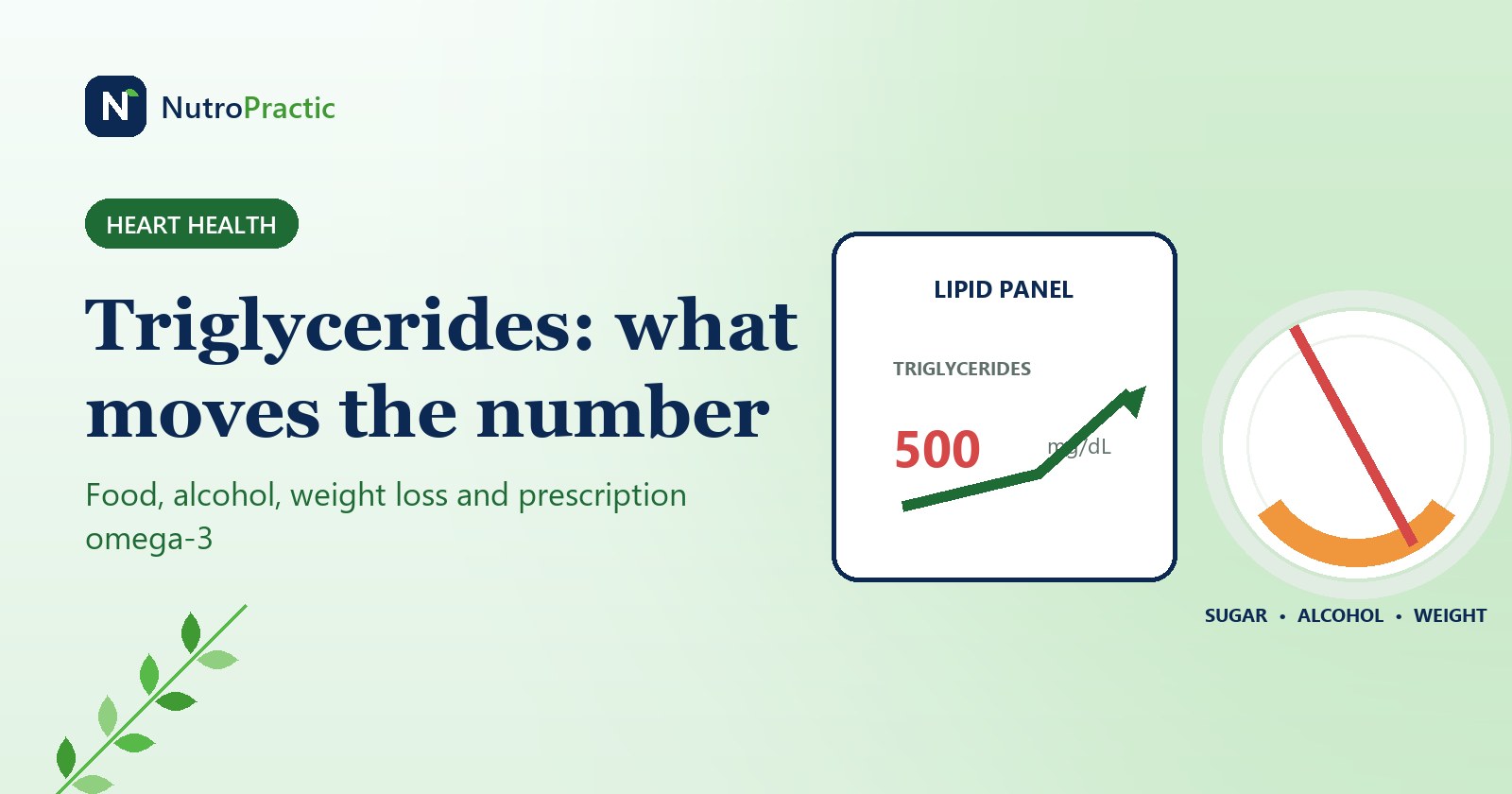
Heart health
Triglycerides: what food, alcohol, weight loss and omega-3 actually change
A 5-10% weight loss often lowers triglycerides by about 20-30%, as can 4 g/day of prescription omega-3. Here is what 150, 500 and 1,000 mg/dL mean, which changes have numbers behind them, and when a result needs prompt care.
9 Nov 2026

Heart health
Omega-3: oily fish, walnuts or capsules? What the big trials found
A daily fish-oil capsule did not lower heart attacks and strokes overall in a trial of 25,871 Americans, yet a prescription dose of one omega-3 cut them by a quarter in another. Both results are real. What separates them, why a handful of walnuts is not the same thing as a piece of salmon, how much fish a week is enough, and what to do if you don't eat fish at all.
10 Oct 2026

Women's health
Inositol for PCOS: the 40:1 ratio, trial doses, and food milligrams
Why do randomized trials in polycystic ovary syndrome prioritize the 40:1 myo to D-chiro inositol ratio? Here is the science behind the ovarian epimerase paradox, clinical ovulation and insulin metrics, and why cantaloupe cannot replace 4,000 mg trial powder.
21 Nov 2026
Newsfeed for your website
Want this feed on your website?
Add it to any site with one copy-and-paste snippet. No sign-up, and it updates itself every hour.
Start with a virtual consultation
Tell Dr. Triveni what you want to change. You will leave with a clear next step, whether you are in Toronto, London, New York or Chennai.