Coeliac disease · October 21, 2026
Strict gluten-free and still bloated: two in three Dutch adults with coeliac disease had gut symptoms that fit an IBS-type disorder
A gluten-free diet is the only treatment for coeliac disease, and most people expect it to settle their gut. A survey of 1,001 adults who had kept to the diet for at least a year found that 64.8% still met the criteria for at least one disorder of gut-brain interaction, such as irritable bowel syndrome, about twice the rate in the general Dutch population. Sticking to the diet more strictly made no difference.

Coeliac disease is an immune reaction to gluten, the protein in wheat, barley and rye, that damages the lining of the small intestine. It affects around 1% of people worldwide, more women than men. The only treatment is a strict gluten-free diet for life, and for most people it lets the gut heal. Yet many keep having bloating, pain, constipation or diarrhoea years after they cut out gluten: a recent meta-analysis cited by the authors put the share with persistent symptoms after six months on the diet at between 12.5% and 50%.
One possible explanation is a second condition alongside the coeliac disease: a disorder of gut-brain interaction (DGBI), the group of conditions once called functional gut disorders, of which irritable bowel syndrome (IBS) is the best known. These are diagnosed from symptom patterns using the Rome criteria, and involve a more sensitive gut, changes in how it moves, the gut microbes and how the brain processes signals from the gut. Until now most studies in coeliac disease looked only at IBS, often without a comparison group.
Researchers from the University of Gothenburg in Sweden, Amsterdam University Medical Centers and the Dutch Coeliac Society, with colleagues in the US, Israel, Canada and Portugal, ran an online survey through the Dutch Coeliac Society in June and July 2025. It was presented as a general health survey, not a survey about gut symptoms, to avoid drawing in mainly people with problems. They included 1,001 adults with a doctor's diagnosis of coeliac disease who had been gluten-free for at least a year (77% for five years or more); 79% were women and the median age was 50. People with inflammatory bowel disease, bowel cancer, diverticulitis, ulcers or bowel surgery were left out. Everyone filled in the Rome IV questionnaire, which checks for all 22 DGBIs. The comparison group was 1,896 Dutch adults without coeliac disease from the Rome Foundation's global survey in 2017. The study was published in the United European Gastroenterology Journal on 16 October.
64.8% of the people with coeliac disease met the criteria for at least one DGBI, against 31.3% of the comparison group. After adjusting for age, sex, psychological distress and other body symptoms, the odds were 3.2 times higher. Bowel disorders made up most of it (59.8% against 27.0%). IBS was the most common single diagnosis, in 18.2% against 3.9%, and the strongest link, with adjusted odds 4.5 times higher, followed by functional bloating and distension (6.1% against 1.4%). Functional constipation was also more common (16.2% against 9.4%). A third of those affected had symptoms in two or more parts of the gut.
The pattern looked much like DGBI in the general population: more common in women (69.4% against 47.5% of men) and in younger people (73.6% at 18 to 34 against 55.7% at 65 and over), and tied to more anxiety and low mood and a lower quality of life. What did not matter was coeliac-specific: years on the diet, age at diagnosis, and how strictly people said they kept to it. 65.3% of those who reported 100% adherence over the past year met the criteria, about the same as the 64.8% of those who kept to it less than 95% of the time. Restricting the analysis to the strictest group, or using a second comparison group recruited in 2025, gave similar results. People with a DGBI also used more medicines: 14.8% took something for constipation, against 4.5% of those without one.
The survey has real limits. Diagnoses and diet were self-reported, and the authors could not rule out hidden gluten exposure or gut lining that had not fully healed, which needs a biopsy to check. Members of a patient society answering a health survey may be more likely to have symptoms, and the comparison group was surveyed before the COVID-19 pandemic, which may itself have raised DGBI rates. It is a single snapshot, so it cannot show whether symptoms began before or after diagnosis. The authors suggest the lower fibre of a gluten-free diet may add to constipation and bloating, and that the usual DGBI treatments, such as a low-FODMAP diet or probiotics, may help people with both conditions, though the evidence for that is sparse. The study was partly funded by the Dutch Coeliac Society; the comparison survey was funded by drug companies with no role in this study, and several authors declare industry fees.
Rome IV disorders of gut-brain interaction in 1,001 Dutch adults with coeliac disease on a gluten-free diet for at least a year, compared with 1,896 adults from the general population
64.8% vs 31.3%
Met the criteria for at least one disorder of gut-brain interaction: coeliac group vs comparison group (adjusted odds ratio 3.2, 95% CI 2.6 to 3.8)
18.2% vs 3.9%
Irritable bowel syndrome, the strongest link (adjusted odds ratio 4.5, 95% CI 3.3 to 6.2)
6.1% vs 1.4%
Functional bloating and distension (adjusted odds ratio 3.9, 95% CI 2.4 to 6.4)
16.2% vs 9.4%
Functional constipation (adjusted odds ratio 1.4, 95% CI 1.1 to 1.8)
69.4% vs 47.5%
Women vs men with coeliac disease who met the criteria for any of these disorders
65.3% vs 64.8%
Met the criteria: people who kept to the diet 100% of the time vs those under 95% of the time
14.8% vs 4.5%
Took medicine for constipation: people with coeliac disease with vs without a gut-brain disorder
33%
Share of those affected who had symptoms in two or more parts of the gut
Study: van Gils T, Törnblom H, van Overveld F, Palsson OS, Sperber AD, Bangdiwala SI, Trindade IA, Benninga MA, Bouma G, Simrén M, 'Symptom Profiles Compatible With Disorders of Gut-Brain Interaction in Individuals With Coeliac Disease on a Long-Term Gluten-Free Diet', United European Gastroenterology Journal 2026;14(8):e70311, published 16 October 2026, doi 10.1002/ueg2.70311 (open access, CC BY 4.0; read in full on PubMed Central, PMC13675726). Cross-sectional online survey run through the Dutch Coeliac Society, June–July 2025; included: physician-diagnosed coeliac disease by serology and/or biopsy, gluten-free for at least 1 year, passed quality checks. Reference group: Dutch arm of the Rome Foundation Global Epidemiology Study, November–December 2017. Rome IV diagnostic questionnaire for all 22 DGBIs; PHQ-4, PHQ-12 and PROMIS-10 for distress, other body symptoms and quality of life. Adjusted odds ratios are adjusted for sex, age, non-GI somatic symptom severity and psychological distress (Table 3). Adherence was self-reported (the Dutch CDAT questionnaire proved unreliable in this cohort). Sensitivity analyses with at least 95% adherence and a second reference group gave adjusted odds ratios of 1.9 to 3.2. The 33% overlap figure is from Figure 1 and the medicine figures from Table 4. The 1,001 respondents equal 6.2% of the society's 16,119 adult members, though non-members could also take part. Funding: partly the Dutch Coeliac Society; the reference survey was funded by Ironwood, Shire, Allergan and Takeda, who had no role. Side facts are from the paper.
- Disorders of gut-brain interaction are very common: by the Rome IV criteria about 40% of adults worldwide have at least one, according to the Rome Foundation's 33-country survey.
- A DGBI is normally not diagnosed when another disease explains the symptoms, but experts agree one can exist alongside a gut disease that is under control, such as coeliac disease on a gluten-free diet.
- The newer Rome V criteria came out in 2026, after this survey was run, so the team used Rome IV.
- A Swedish registry study found only 2.7% of people with coeliac disease were given an IBS diagnosis over about 11 years of follow-up, far below the 18.2% who met the IBS criteria in this survey. The authors think IBS often goes unrecorded once coeliac disease is known.
- 22.9% of the people with coeliac disease in this survey had a parent, brother or sister with it too, against 1.6% of the comparison group.
- Symptom Profiles Compatible With Disorders of Gut-Brain Interaction in Individuals With Coeliac Disease on a Long-Term Gluten-Free DietUnited European Gastroenterology Journal, October 2026 · The paper: full text, open access
- Full text on PubMed CentralPubMed Central, US National Library of Medicine · Methods, tables and limitations
- Coeliac diseaseWikipedia · Causes, diagnosis and the gluten-free diet
- Irritable bowel syndromeWikipedia · Symptoms, diagnosis and treatment of IBS
- Crispy Grains, Sourdough with Old Grains, Gluten-Free Bread with SeedsWikimedia Commons · The photo, CC BY 2.0 (Lou Stejskal)
General information, not medical advice. This was a self-reported survey and cannot show what causes the symptoms. Ongoing gut symptoms on a gluten-free diet can have several causes, including hidden gluten, gut lining that has not healed and other conditions, so anyone with coeliac disease who still has symptoms should see their doctor or a dietitian before assuming it is IBS or changing their diet or treatment.
Analysis by NutroPractic from the sources listed. Written for general readers; it does not replace advice from your own doctor.
From our articles
Our guides on this subject
Plain-language guides on nutrition and wellness, backed by research.

Gut health
Probiotic capsules: which ones have trial evidence, what they can do, and when to skip them
Children on antibiotics: 8% got diarrhoea with a probiotic, 19% without. Older hospital patients: 10.8% with, 10.4% without. Which capsules have evidence, what three guidelines say about IBS, what a course costs per case prevented, and who shouldn't take them.
2 Nov 2026
Gut health
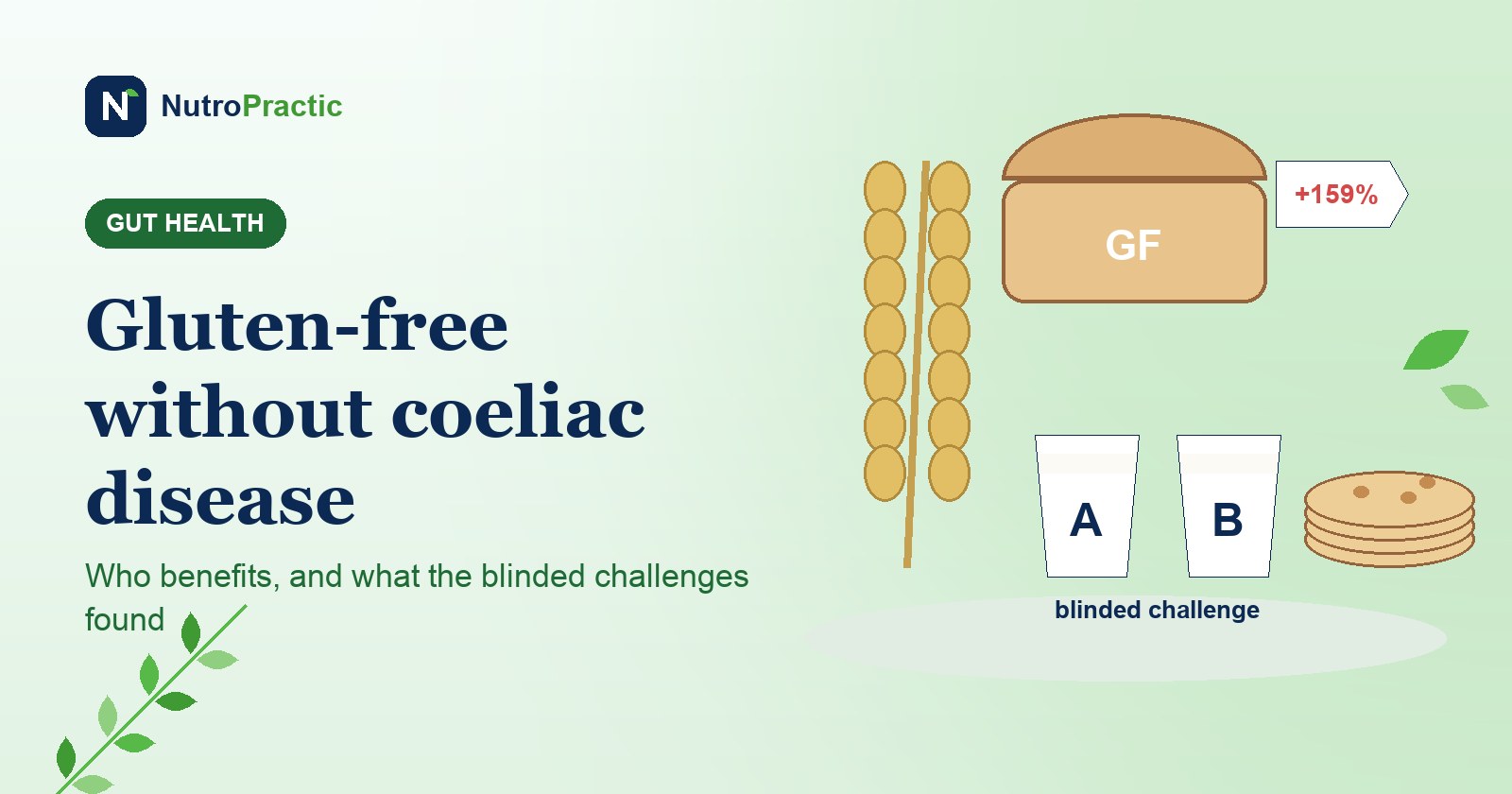
Gluten-free without coeliac disease: who actually benefits, and what the blinded gluten challenges found
In blinded trials only 16% of people who said gluten made them ill reacted to gluten rather than placebo, and in Oslo fructans caused more bloating than gluten. Who really needs to avoid it, how to get tested before you stop, how much gluten is in a slice of bread or a roti, and what gluten-free food costs (159% more in the UK) and lacks.
1 Nov 2026

Gut health
Lactose intolerance: how much milk most people can actually tolerate, and which dairy is easiest
Most adults who don't digest lactose well still handle about 12 g at once, roughly a 250 ml glass of milk, in blinded trials. What the 12 g studies found, a lactose table for milk, yoghurt, cheese, chai and dahi, how lactase tablets and A2 milk compare, why the famous 68% figure was retracted, and how to keep calcium up if you cut back.
25 Oct 2026
Newsfeed for your website
Want this feed on your website?
Add it to any site with one copy-and-paste snippet. No sign-up, and it updates itself every hour.
Start with a virtual consultation
Tell Dr. Triveni what you want to change. You will leave with a clear next step, whether you are in Toronto, London, New York or Chennai.