Sports supplements · October 21, 2026
Caffeine and taurine, the energy-drink pairing, tested in 11 small trials: a little more sprint power and a slightly easier-feeling workout, and still no way to tell whether the taurine does anything
Researchers in Beijing pooled every placebo-controlled trial they could find that gave people caffeine and taurine together before exercise: 234 people, most of them young men. Peak power came out a little higher and the effort felt a little easier. Heart rate did not change. Because no trial in the analysis was set against caffeine on its own, the review cannot say whether the taurine adds anything.
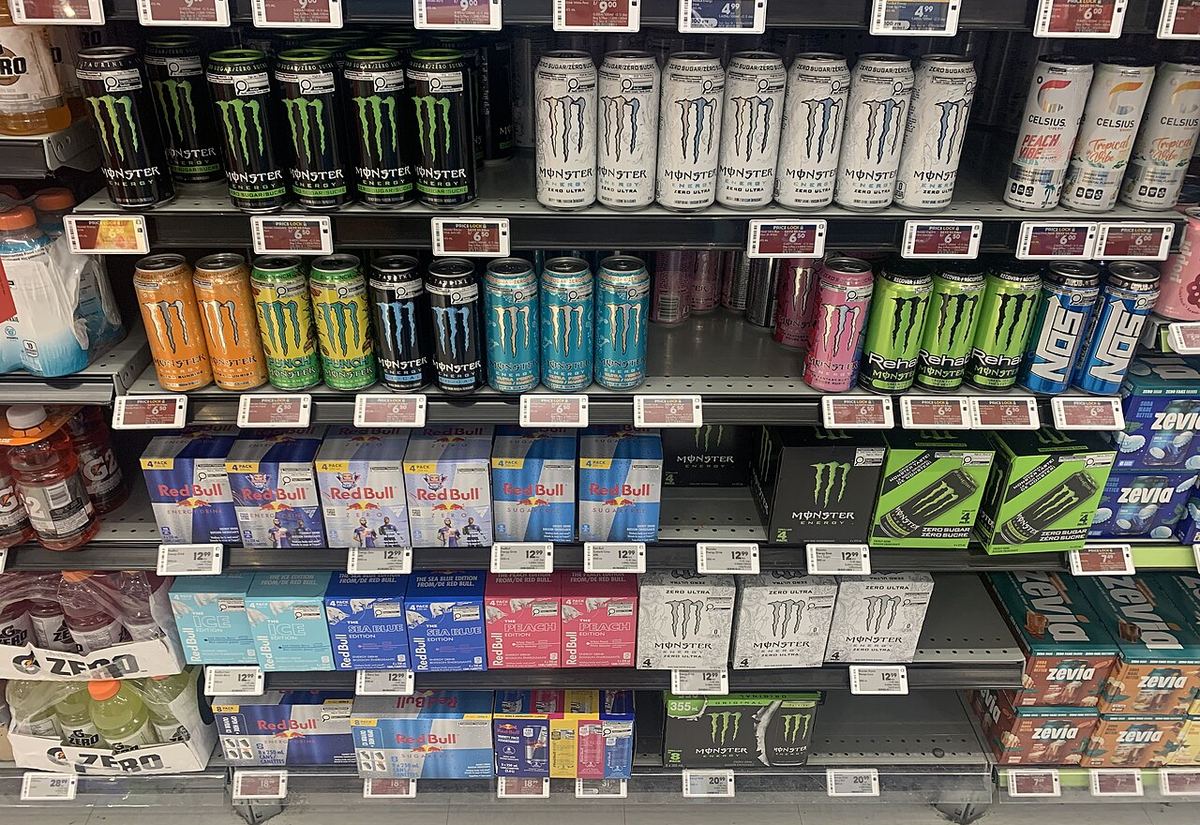
Caffeine and taurine sit side by side on the label of nearly every energy drink and on many pre-workout powders, sold on the idea that the two work better together. Caffeine has a long record in sports science. Taurine, a sulphur-containing compound found in meat and fish, has much less behind it. A team from Beijing Normal University, Beijing Sport University and Linyi University set out to pool the trials that tested the pair against a dummy, and published their review in Nutrients on 20 October.
They searched four large databases up to 1 June 2026 and kept 11 randomised trials with 234 participants in all. These were healthy, active young adults: average ages ran from about 20 to 24, most trials enrolled only men or mostly men, two enrolled only women, and they included university students, football players, team-sport athletes and elite boxers. Ten trials were crossovers, in which the same people did the exercise test once on the supplement and once on a placebo. Nine gave caffeine and taurine as plain powder in capsules. Doses varied widely, from 80 mg of caffeine with 1,000 mg of taurine to 5 or 6 mg of caffeine per kilogram of body weight with up to 3,000 mg of taurine or 50 mg of taurine per kilogram. One trial used a commercial energy drink powder with sugar, vitamins and other ingredients; the authors left it out of their main analysis and pooled it only in an extra check.
Because the trials measured performance in different ways, the results are given as standardised differences, where 0.2 is usually called small, 0.5 moderate and 0.8 large. Peak or maximal power in short all-out efforts came out 0.55 higher on the supplement (95% CI 0.21 to 0.89, five trials), and every trial leaned the same way. Put another way, someone performing at the group average on placebo would be at roughly the 71st percentile on the supplement, our arithmetic. Adding the commercial drink trial made the figure slightly smaller, 0.48. Time to exhaustion was 0.54 longer, but that rested on three trials, and when the authors tried other reasonable assumptions about how closely each person's two tests tracked each other, the result was no longer statistically clear. Effort felt slightly easier (−0.44 across seven trials), although the spread of results was wide enough that a future trial could find no benefit. Heart rate during exercise did not move: −0.11 beats a minute, with a range from almost six beats lower to almost six higher.
Reaction time is the result that looks most dramatic and deserves the least weight. The pooled figure of −1.49 counts as a large improvement, but the four trials disagreed sharply (I² 90.6%), and the range in which a new study's result would be expected to fall ran from a large benefit to a large harm. The authors rated the certainty of that evidence very low. They rated it low for power and time to exhaustion and moderate for heart rate and perceived effort.
The biggest gap is the one the authors state themselves: every comparison was caffeine plus taurine against a placebo, never against caffeine alone. Caffeine on its own is known to help endurance and power, so these results cannot show whether taurine adds anything, or whether the two together do more than either. Most trials were small, with 7 to 54 people, and several did not report how far apart their test days were or whether the order of the drinks was balanced. One trial was judged at high risk of bias. With fewer than ten trials per outcome, the authors could not check whether small trials with disappointing results had gone unpublished. They call for trials with four arms, placebo, caffeine alone, taurine alone and both, to settle the question. The review received no external funding and the authors declare no conflicts of interest.
Caffeine plus taurine against placebo before exercise: 11 randomised trials, 234 healthy active adults
11 trials, 234 people
Randomised trials up to 1 June 2026; average ages about 20 to 24; mostly men, two trials women only
+0.55
Peak or maximal power, standardised difference (95% CI 0.21 to 0.89, 5 trials, I² 0%); low certainty
+0.54
Time to exhaustion (95% CI 0.03 to 1.05, 3 trials); not statistically clear under other correlation assumptions
−0.44
Rating of perceived exertion, lower is easier (95% CI −0.83 to −0.04, 7 trials, I² 41.6%)
−0.11 bpm
Heart rate during exercise: no difference (95% CI −5.76 to 5.53, 5 trials)
−1.49
Reaction time (4 trials), but I² 90.6% and a prediction interval of −7.56 to 4.57; very low certainty
+0.48
Peak power when one trial of a commercial multi-ingredient energy drink is added (95% CI 0.19 to 0.78)
0
Comparisons in the analysis against caffeine alone, so taurine's own effect remains unknown
Study: He B, Zhou C, Zeng Z, Dong X, Huang D, Shi H, Li H, Gao K, Xie Y, Zhou A, Lang D, Zhang Q, 'Effects of Caffeine–Taurine Co-Supplementation on Exercise Performance: A Systematic Review and Meta-Analysis', Nutrients 2026, 18(20):3434, published 20 October 2026, doi 10.3390/nu18203434 (open access, CC BY; read in full). PROSPERO CRD420261432477, submitted 25 June 2026 after the search but before screening. PubMed, Embase, Web of Science and Cochrane CENTRAL searched to 1 June 2026; 548 records found. Random-effects models in Stata 19; heart rate as weighted mean difference in beats a minute, other outcomes as Hedges' g (positive favours the supplement for power and time to exhaustion, negative for reaction time and perceived exertion). For crossover trials without paired data the authors assumed a within-person correlation of 0.5; at 0.25 and 0.75 the time-to-exhaustion result became 0.44 (−0.08 to 0.95) and 0.47 (−0.01 to 0.95). Prediction interval for perceived exertion −1.45 to 0.58. Leaving out either of two reaction-time trials gave −0.64 (−1.12 to −0.16) and −0.77 (−1.19 to −0.34). Caffeine-only and taurine-only arms of the included trials were excluded; one trial's phosphatidylserine arm was excluded. GRADE: moderate for heart rate and perceived exertion, low for time to exhaustion and peak power, very low for reaction time. The 'about 71st percentile' is our conversion of 0.55 standard deviations on a normal curve, not a figure from the paper. No external funding; no conflicts declared.
- Four of the trials dosed taurine at 50 mg per kilogram of body weight. For a 70 kg adult that is 3,500 mg in one go, our arithmetic, against a usual intake from an omnivore diet of well under 400 mg a day.
- Caffeine at 5 mg per kilogram, the dose in several of these trials, comes to 350 mg for a 70 kg adult. The European Food Safety Authority considers single doses up to 200 mg, including within two hours before hard exercise, of no safety concern for healthy adults, and up to 400 mg spread over a day.
- Taurine was first isolated from ox bile in 1827, which is where the name comes from: taurus is Latin for bull or ox. Despite often being called an amino acid, it is not used to build proteins.
- Plant foods contain essentially no taurine; it comes from meat, fish and especially shellfish. The body also makes its own.
- Ten of the 11 trials tested the same people twice. The odd one out, a Polish trial of 54 footballers, compared separate groups given capsules for 10 days; it was the one judged at high risk of bias, because it was single-blind and the researchers knew who was taking what.
- Effects of Caffeine–Taurine Co-Supplementation on Exercise Performance: A Systematic Review and Meta-AnalysisNutrients, October 2026 · The paper: full text, open access
- CaffeineEuropean Food Safety Authority · Safe single and daily caffeine intakes for healthy adults, including before exercise
- TaurineWikipedia · Background on taurine, its food sources and usual intake
- Energy Drink DisplayWikimedia Commons · The photo, CC0 (Coolgurl5555)
General information, not medical advice. These trials tested short-term use in healthy, active young adults, mostly men, and say nothing about older people, people with heart conditions, or anyone who is pregnant. High-dose caffeine can cause a racing heart, anxiety and poor sleep; anyone with a medical condition, or thinking of using caffeine or energy-drink supplements for sport, should check with their doctor or a registered dietitian first.
Analysis by NutroPractic from the sources listed. Written for general readers; it does not replace advice from your own doctor.
From our articles
Our guides on this subject
Plain-language guides on nutrition and wellness, backed by research.

Food and nutrition
L-theanine and caffeine: what cognitive trials measured on sustained attention, and milligrams in matcha vs green tea
Combining L-theanine with caffeine produces clean focus without caffeine jitters. Here is what randomized trials measured on attention-switching, EEG alpha brain waves, and the exact milligrams across ceremonial matcha, culinary powder, gyokuro, and sencha.
20 Nov 2026
Women's health
Eating while breastfeeding: extra calories, iodine, caffeine, fish and alcohol, with the actual numbers
Breastfeeding usually adds about 330–400 kcal a day, but the smaller numbers can matter more: 290 mcg iodine, 400 IU vitamin D for baby, 8–12 oz fish a week, and a caffeine total you can actually add up.
6 Nov 2026
Lifestyle
Energy drinks: caffeine, sugar and taurine per can, and what the emergency-visit and heart-rhythm studies found
From 80 mg to 300 mg of caffeine, and up to 55 g of sugar in one can. The numbers by brand, what they mean for a 50 kg teenager, what the QT and blood pressure trials measured, the old emergency-visit data and England's coming under-16 ban.
4 Nov 2026
Newsfeed for your website
Want this feed on your website?
Add it to any site with one copy-and-paste snippet. No sign-up, and it updates itself every hour.
Start with a virtual consultation
Tell Dr. Triveni what you want to change. You will leave with a clear next step, whether you are in Toronto, London, New York or Chennai.