Exercise and caffeine · October 23, 2026
Caffeine plus your favourite playlist: in one small trial exercise felt far easier, in another it felt slightly harder. Five experiments, 88 people, and a review that refuses to promise you anything
Lots of people drink a coffee and put their headphones in before a workout. A team in Beijing found every experiment that tested the two together. There were five, the biggest had 23 people, and the results swung from a large drop in how hard exercise felt to none at all. Enjoyment was the one thing that went the same way every time.
Caffeine and music are probably the two most popular workout aids that need no gym membership. Caffeine works on the nervous system: people feel more alert and the effort seems smaller. Music works on attention and mood: a good song pulls your mind away from burning legs. Put them together and it seems obvious they should add up. A team from Beijing Sport University, Beijing Normal University and four other universities set out to check whether anyone has actually shown that. Their review was published in Nutrients on 20 October.
They searched four medical databases up to 10 June 2026 and found 1,111 records. Only five experiments qualified: studies where the same people exercised more than once, on different days, with caffeine and music together and with at least one of placebo and silence, caffeine alone or music alone. Between them they had 88 people, from 16 to 23 a study, and they were a mixed lot: 16 Saudi women in their late fifties given a fixed 100 mg caffeine capsule with music they liked, 17 French teenage girls on a large dose of 6 mg per kilogram with self-chosen motivational music, two groups of 16 Tunisian teenage athletes, one male and one female, and 23 young Chinese men, the last three groups on 3 mg per kilogram with their own warm-up music. The researchers looked at four things: how hard the exercise felt, how much people enjoyed it, how good or bad they felt, and heart rate.
How hard it felt is where the five studies disagreed most. Because each study used its own scales, the review compares them in standardised units, where 1 means a difference as big as the usual spread between people. Against placebo and silence, the drop in effort ranged from 4.05 units in the Saudi women and 3.20 in the Tunisian young men, both very large, to 0.76 in the Tunisian girls, almost nothing in the French girls (0.05) and a small change the wrong way in the Chinese men, who rated exercise 0.40 units harder. Averaged, the drop came to 1.45 units, with a margin of error running from 2.88 down to 0.02, barely clear of zero. Against music alone, adding caffeine made no clear difference to effort (0.46 units, with zero inside the margin of error).
Enjoyment was the one result that pointed the same way in every study that measured it, all three with 16 people. Against placebo and silence the gain ran from 1.63 to 6.95 units, and against music alone it was strikingly steady, 2.18, 2.35 and 2.77, so caffeine seemed to add enjoyment on top of the music. The authors themselves are wary of numbers that big: with only 16 people, a small spread in scores can make an ordinary difference look huge, and people who know whether music is playing may report more fun because they expect to. How good or bad people felt, and heart rate, showed no clear difference, with studies again pulling in opposite directions.
The review is unusually blunt about its own limits. In each of the four main comparisons the differences between the studies were above 90% on the usual heterogeneity scale, and the authors graded the certainty of the evidence as very low for all four outcomes. They did not test whether caffeine and music boost each other, as opposed to simply adding up, because none of the experiments was designed to show that. Dose, music choice, age, sex, fitness and the exercise itself all differed at once, so nobody can say which mattered. The review was registered in advance, had no outside funding, and the authors say they used ChatGPT to polish the English. Their conclusion is that no firm advice can be given; what the small experiments hint at is that the pairing may make a workout more enjoyable, not that it reliably makes it easier. We read the full open-access paper.
Caffeine plus music during exercise: what five crossover trials found (systematic review)
5 trials, 88 people
Every experiment that qualified out of 1,111 records searched (16 to 23 people each)
−4.05 to +0.40
Change in how hard exercise felt vs placebo and silence, study by study (standardised units; minus is easier)
−1.45
Average change in effort vs placebo and silence (margin of error −2.88 to −0.02)
+2.18 to +2.77
Gain in enjoyment vs music alone in the three studies that measured it
Over 90%
How much the studies disagreed with each other in all four main comparisons (I²)
Very low
Certainty of the evidence for all four outcomes (GRADE)
Study: Zhang Q, Xu H, Mo J, Wang F, Gao X, Zhou C, Zeng Z, Dong X, Huang D, Shi H, Li H, Gao K, Xie Y, Zhou A, Lang D, He B, 'Effects of Combined Music and Caffeine on Psychophysiological Responses During Exercise: A Systematic Review and Exploratory Meta-Analysis', Nutrients 18(20):3441, published 20 October 2026 (received 1 August), doi 10.3390/nu18203441, open access (CC BY). PROSPERO CRD420261431625. Search of PubMed, Embase, Web of Science and Cochrane Library to 10 June 2026: 1,111 records, 10 full texts assessed, 5 crossover studies included (Alsaeed 2024, Saudi Arabia, 16 women aged 57 ± 1.8, 100 mg fixed dose, preferred music, single-blind; Bougrine 2025, France, 17 girls aged 16.7 ± 0.4, 6 mg/kg, self-selected motivational music; Delleli 2023, Tunisia, 16 males aged 18.25 ± 0.75, 3 mg/kg, preferred warm-up music; Delleli 2024, Tunisia, 16 females aged 16–18, 3 mg/kg, preferred warm-up music; Qiu 2025, China, 23 males aged 21.0 ± 1.6, 3 mg/kg, self-selected warm-up music). Effects are paired standardised mean differences (SMD) with small-sample correction; random-effects pooling, which the authors present only as secondary exploratory summaries. Caffeine + music vs placebo + no music: RPE study SMDs −4.05 (−5.32 to −2.79), −3.20 (−4.28 to −2.11), −0.76 (−1.49 to −0.04), −0.05 (−0.73 to 0.62), 0.40 (−0.18 to 0.99); pooled −1.45 (−2.88 to −0.02), I² 93.8%. PACES (enjoyment) 6.95, 2.67, 1.63; pooled 3.56 (1.26 to 5.87), I² 91.9%. Feeling Scale pooled 1.56 (−0.57 to 3.69), I² 95.1%. Heart rate pooled −1.35 (−4.39 to 1.70), I² 96.2%, 2 studies. Vs music alone: RPE −0.46 (−1.11 to 0.18), I² 77.2%; PACES 2.18, 2.77, 2.35, pooled 2.41 (1.87 to 2.95), I² 0%. Vs caffeine alone: RPE −1.32 (−2.84 to 0.20); PACES study estimates 9.80, 0.66, 1.42, pooled 3.46 (0.70 to 6.22). GRADE certainty very low for RPE, PACES, FS and HR (risk of bias, very serious inconsistency, serious or very serious imprecision). No subgroup analysis, meta-regression or publication-bias tests (fewer than 10 studies). The 'standardised units' explanation and the coffee-cup comparisons in 'did you know' are ours, not the authors'. Funding: none. Conflicts: none declared. The authors disclose using ChatGPT (GPT-5) for language editing.
- For a 70 kg adult, the 3 mg per kilogram dose used in three of the studies comes to 210 mg of caffeine, and the 6 mg per kilogram dose in the French study to 420 mg. The US FDA lists 113 to 247 mg for a 12-ounce cup of brewed coffee, so the larger dose is roughly two such cups at once.
- Europe's food safety agency, EFSA, says single doses of up to 200 mg, about 3 mg per kilogram, and up to 400 mg spread over a day raise no safety concerns for healthy adults; for pregnant women the daily figure is 200 mg.
- Three of the five studies enrolled only women or girls. The review notes that menstrual cycle phase, hormonal contraception and habitual caffeine use can all change how women respond to caffeine, and the studies did not report these consistently.
- A standardised difference of 1 means two groups differ by as much as people usually differ from one another. The authors warn that with 16 people a narrow spread in scores can turn a modest difference into a very large standardised one.
- The 16 Saudi women got the same 100 mg capsule whatever they weighed, while every athlete group got a dose scaled to body weight.
- Effects of Combined Music and Caffeine on Psychophysiological Responses During Exercise: A Systematic Review and Exploratory Meta-AnalysisNutrients · The paper, open access
- CaffeineEuropean Food Safety Authority (EFSA) · Safe single doses and daily intakes for adults and in pregnancy
- Spilling the Beans: How Much Caffeine is Too Much?US Food and Drug Administration · Caffeine in a 12-ounce cup of brewed coffee and the 400 mg a day figure
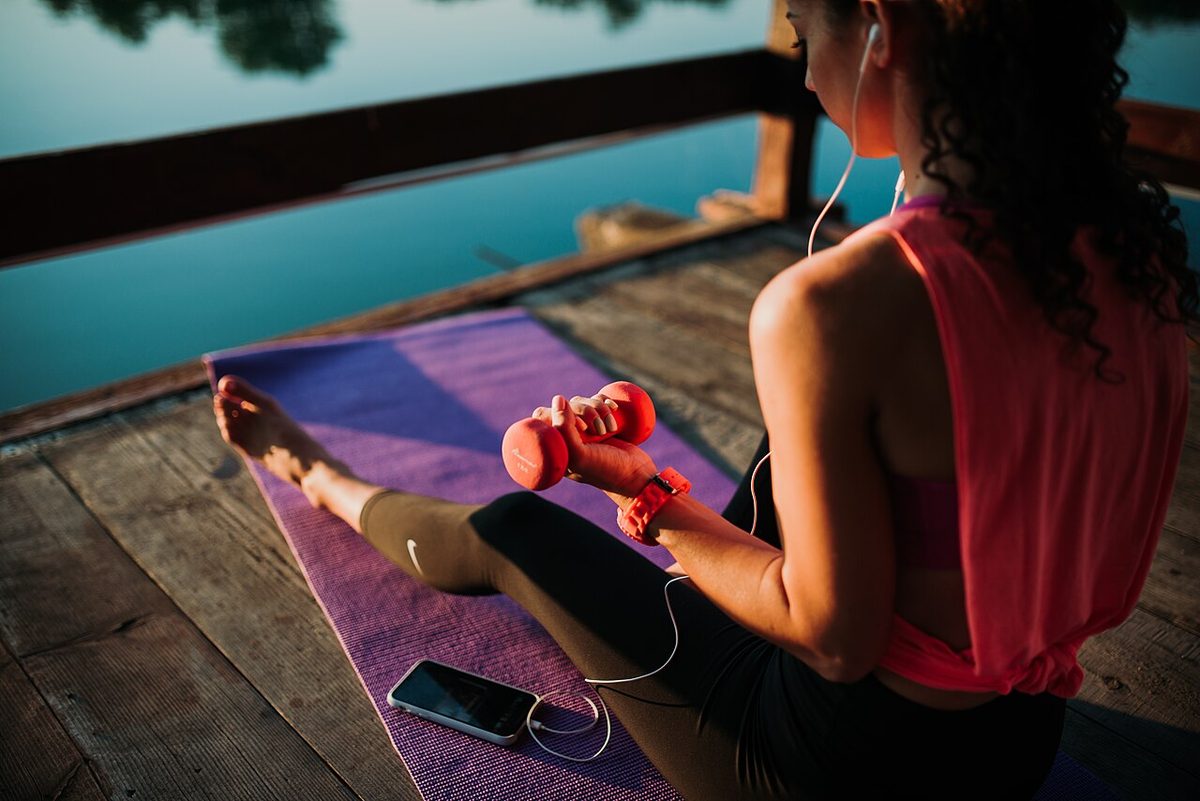
- Woman listening music while working outWikimedia Commons · The photo, CC BY 2.0 (Shixart1985)
General information, not medical advice. Caffeine affects people differently; it can raise heart rate and blood pressure, disturb sleep and interact with some medicines. If you are pregnant, have a heart condition, high blood pressure or anxiety, are under 18, or take regular medication, talk to a doctor or registered dietitian before using caffeine to help with exercise.
Analysis by NutroPractic from the sources listed. Written for general readers; it does not replace advice from your own doctor.
From our articles
Our guides on this subject
Plain-language guides on nutrition and wellness, backed by research.

Food and nutrition
L-theanine and caffeine: what cognitive trials measured on sustained attention, and milligrams in matcha vs green tea
Combining L-theanine with caffeine produces clean focus without caffeine jitters. Here is what randomized trials measured on attention-switching, EEG alpha brain waves, and the exact milligrams across ceremonial matcha, culinary powder, gyokuro, and sencha.
20 Nov 2026
Women's health
Eating while breastfeeding: extra calories, iodine, caffeine, fish and alcohol, with the actual numbers
Breastfeeding usually adds about 330–400 kcal a day, but the smaller numbers can matter more: 290 mcg iodine, 400 IU vitamin D for baby, 8–12 oz fish a week, and a caffeine total you can actually add up.
6 Nov 2026
Lifestyle
Energy drinks: caffeine, sugar and taurine per can, and what the emergency-visit and heart-rhythm studies found
From 80 mg to 300 mg of caffeine, and up to 55 g of sugar in one can. The numbers by brand, what they mean for a 50 kg teenager, what the QT and blood pressure trials measured, the old emergency-visit data and England's coming under-16 ban.
4 Nov 2026
Newsfeed for your website
Want this feed on your website?
Add it to any site with one copy-and-paste snippet. No sign-up, and it updates itself every hour.
Start with a virtual consultation
Tell Dr. Triveni what you want to change. You will leave with a clear next step, whether you are in Toronto, London, New York or Chennai.