Men's health · October 19, 2026
929 men trying for a baby tested their own semen at home and logged every coffee, tea, soda and energy drink. Two or more cups' worth of caffeine a day made no clear difference
Men hoping to become fathers are often told to cut back on coffee. A Boston University team looked at 1,668 semen samples from men in a US pregnancy-planning study and compared them with how much caffeine each man drank. The heaviest drinkers did not come out clearly worse on any measure. Here's what the study can and can't tell you.

When a couple starts trying for a baby, the advice tends to land on the woman: folic acid, no alcohol, go easy on coffee. Men get less guidance, and what they do hear about caffeine is mixed, because earlier studies of caffeine and sperm have pointed in different directions. Few of them looked at men who were actually trying to conceive. A study published online on 12 October in the journal Andrology set out to fill that gap.
The data come from Pregnancy Study Online (PRESTO), a long-running Boston University study that follows couples in the United States from the time they start trying for a pregnancy. Men aged 21 and over were invited to test their semen at home, and 929 of them sent in results from 1,668 samples. Each man also reported how much caffeinated coffee, tea, soda and energy drinks he had drunk over the past month, and the researchers added these up into a daily caffeine figure.
The middle man in the study took in about 138 mg of caffeine a day, roughly what you'd get from one and a half ordinary cups of brewed coffee; a quarter took in 270 mg or more. The team then compared five standard measures: how much semen there was, how concentrated the sperm were, the total sperm count, the share of sperm that were moving, and the total number of moving sperm.
None of the four drinks showed a pattern of semen getting steadily worse as intake went up. Comparing men who took in 200 mg of caffeine or more a day with those under 100 mg, semen volume was almost identical (0.2% higher), and the share of moving sperm was 2.4% higher. Sperm concentration came out about 9% lower and the total count about 10% lower, but the ranges around those numbers ran from roughly a quarter lower to several percent higher, so the study can't tell them apart from no difference at all. The authors' conclusion: moderate caffeine intake has little effect on semen quality.
There are limits. This is a snapshot, not a trial: nobody was asked to drink more or less coffee, so other differences between heavy and light drinkers could hide or mimic an effect, even after the researchers adjusted for the ones they measured. Intake was self-reported for the past month, and sperm take a couple of months to develop. Most men drank moderate amounts, so the study says little about very heavy intake, such as several energy drinks a day. And semen quality is only one step on the way to a pregnancy; this paper does not report whether the couples conceived.
For men trying to become fathers, the practical reading is reassuring rather than a licence: a few cups of coffee or tea a day did not stand out as a problem for sperm in this group. The European Food Safety Authority's general limit for healthy adults, up to 400 mg a day spread across the day, still applies, and partners who become pregnant are advised to keep to 200 mg.
Caffeine intake and semen quality in 929 US men from couples trying to conceive (PRESTO study)
929
Men aged 21 and over who tested their semen at home
1,668
Semen samples analysed
138 mg
Median daily caffeine intake (middle half: 51 to 270 mg)
0.2%
Difference in semen volume, 200 mg or more a day vs under 100 mg (range −8.2% to +8.6%)
−9.1%
Difference in sperm concentration, same comparison (range −23.2% to +7.5%, not statistically clear)
+2.4%
Difference in the share of moving sperm, same comparison (range −3.5% to +8.3%)
Study: Julián-Serrano S, Geller RJ, Koenig MR, Kuan KE, Pentz EP, Sommer G, Eisenberg ML, Rothman KJ, Hatch EE, Wesselink AK, Wise LA, 'Association Between Caffeinated Beverage Intake and Semen Quality in a Preconception Cohort', Andrology, published online 12 October 2026, doi 10.1111/andr.70415. Department of Epidemiology, Boston University School of Public Health, and co-authors. Cross-sectional analysis within Pregnancy Study Online (PRESTO), a US preconception cohort; past-month intake of caffeinated coffee, tea, soda and energy drinks was converted to daily caffeine, and outcomes (semen volume, sperm concentration, total sperm count, percent motility, total motile sperm count) were compared with multivariable linear regression as mean percentage differences with 95% confidence intervals. Also for the 200+ vs under 100 mg comparison: total sperm count −10.1% (−23.7% to +6.0%) and total motile sperm count −7.9% (−23.5% to +11.0%). Funding: Eunice Kennedy Shriver National Institute of Child Health and Human Development (grants R01HD086742, R01HD105863, R21HD094322). Figures here are from the published abstract. The 'one and a half cups' comparison assumes about 95 mg of caffeine in an 8-ounce cup of brewed coffee, which varies widely with the brew. Intake limits: European Food Safety Authority, 2015.
- Caffeine in a cup varies a lot: an espresso, a mug of filter coffee and a cup of tea can differ several-fold, depending on the beans or leaves, the brew time and the size of the cup.
- EFSA judged that single doses of up to 200 mg of caffeine, about 3 mg per kilogram of body weight, raise no safety concerns for healthy adults.
- Making a mature sperm cell takes roughly two to two and a half months, so anything that affects sperm production shows up in a semen test weeks later, not the next day.
- The World Health Organization's laboratory manual for semen testing, now in its sixth edition (2021), sets out the standard ways labs measure sperm count, movement and shape.
- Association Between Caffeinated Beverage Intake and Semen Quality in a Preconception CohortAndrology, October 2026 · The study: abstract, authors and funding
- CaffeineEuropean Food Safety Authority · Safe intake levels for healthy adults and during pregnancy, from EFSA's 2015 scientific opinion
- WHO laboratory manual for the examination and processing of human semen, 6th editionWorld Health Organization, 2021 · The standard methods for semen testing
General information, not medical advice. This observational study found no clear link between moderate caffeine intake and semen quality; it does not show that caffeine is safe at any dose or that it affects the chance of a pregnancy. If you and your partner are having trouble conceiving, or you have a health condition, talk to your doctor.
Analysis by NutroPractic from the sources listed. Written for general readers; it does not replace advice from your own doctor.
From our articles
Our guides on this subject
Plain-language guides on nutrition and wellness, backed by research.
Women's health
Eating while breastfeeding: extra calories, iodine, caffeine, fish and alcohol, with the actual numbers
Breastfeeding usually adds about 330–400 kcal a day, but the smaller numbers can matter more: 290 mcg iodine, 400 IU vitamin D for baby, 8–12 oz fish a week, and a caffeine total you can actually add up.
6 Nov 2026
Women's health
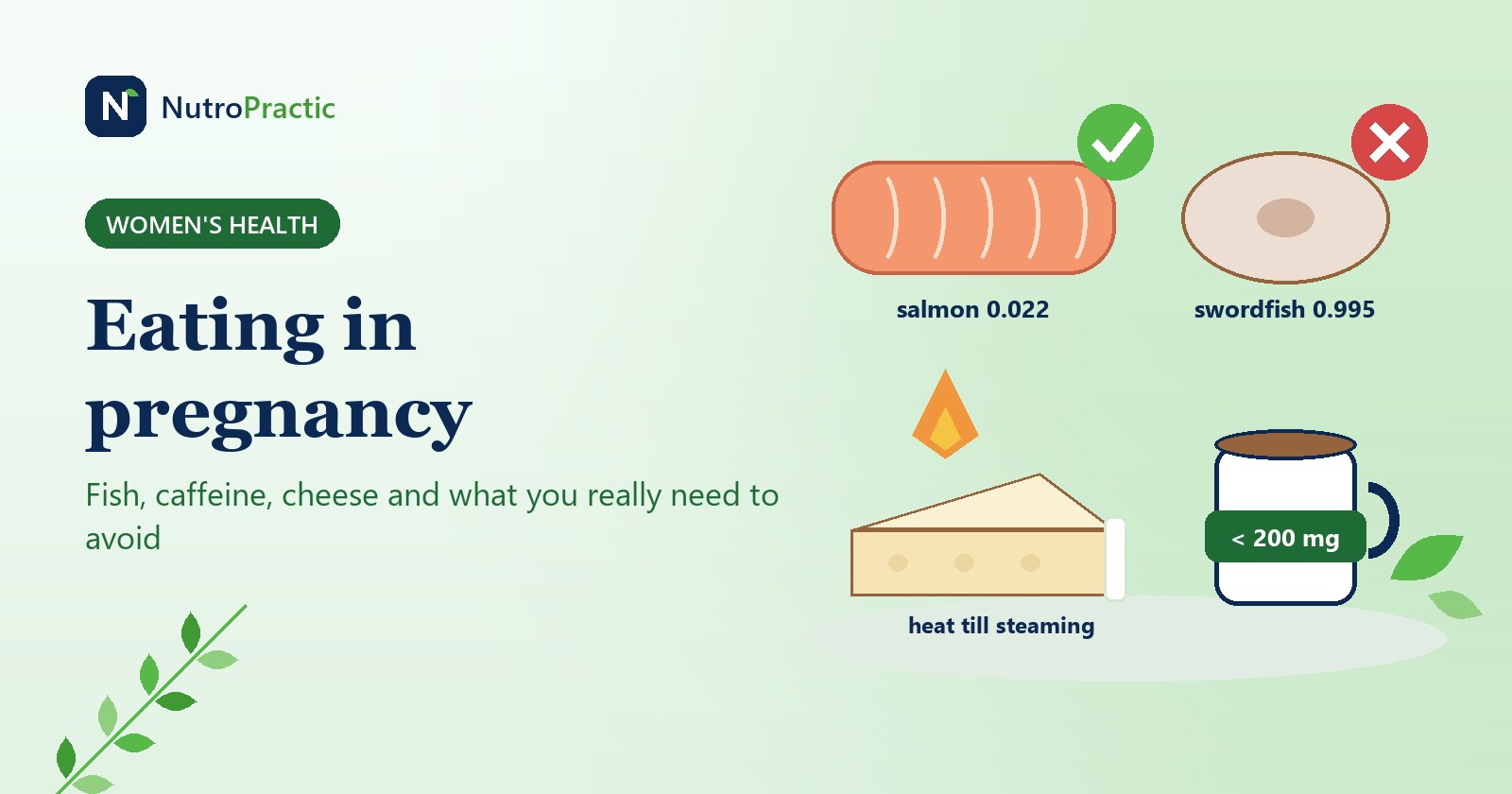
Eating in pregnancy: fish, caffeine, cheese and what you really need to avoid
Most fish is encouraged in pregnancy, not banned: 8-12 oz a week from the low-mercury list. The mercury numbers per fish, what 200 mg of caffeine looks like in real cups, which cheeses carry the listeria risk and how many cases there actually are, why liver is on the list, and how much weight to gain for your BMI.
29 Oct 2026

Food and nutrition
L-theanine and caffeine: what cognitive trials measured on sustained attention, and milligrams in matcha vs green tea
Combining L-theanine with caffeine produces clean focus without caffeine jitters. Here is what randomized trials measured on attention-switching, EEG alpha brain waves, and the exact milligrams across ceremonial matcha, culinary powder, gyokuro, and sencha.
20 Nov 2026
Newsfeed for your website
Want this feed on your website?
Add it to any site with one copy-and-paste snippet. No sign-up, and it updates itself every hour.
Start with a virtual consultation
Tell Dr. Triveni what you want to change. You will leave with a clear next step, whether you are in Toronto, London, New York or Chennai.