Weight and activity · November 3, 2026
Vegetarian girls came out lighter in a survey of 8,799 Austrian pupils. But across all the girls there, underweight was more common than overweight
Exercise often, skip the meat, and you're less likely to be overweight: that's the tidy version. The paper's first table holds a number its authors never follow up, and it changes what lighter means.

Here's the tidy version of a paper published in Nutrients on 30 October: teenagers who exercise often, and teenagers who skip meat, are less likely to be overweight. Both claims come from a large nationwide survey of 8,799 Austrian secondary school pupils. Both hold up less neatly once you read the tables, and the first table contains a number the authors don't go on to analyse.
The survey, called From Science 2 School, invited all 2,688 secondary schools in Austria. About 1.1% of the country's pupils took part, aged 9 to 22, and 63.1% were girls. They typed in their own height and weight, which were converted to percentiles against German reference curves for age and sex. Diet was a label, confirmed by control questions on specific foods: 92.8% omnivorous, 5.6% vegetarian, 1.6% vegan. And the data aren't new. Some 98% of answers came in before 10 March 2020, so this is a picture of pupils more than six years ago.
Exercise gives the steadier result. Against pupils with no regular leisure exercise, those active one to three days a week had 26% lower odds of overweight or obesity, and those active four to seven days had 48% lower odds. The link held in boys (odds ratio 0.40) and girls (0.53). The strongest figure was in 10 to 12 year olds, at 0.25, though by our arithmetic only about 90 children that age reported no exercise, so the comparison group is small.
Then comes the odd part. Average BMI percentile barely differed between pupils who exercised and those who didn't: 49.5 against 50.6, p = 0.205. That test compared any exercise with none, while the odds split pupils by days a week, so the two results don't directly clash. The authors suggest exercise may guard against the top end of the weight range rather than shift everyone down, and they note that BMI can't tell muscle from fat. They also concede the arrow could point the other way: a heavier child may simply be less likely to take up sport.
Now the vegetarians. Their average percentile was 40.5 against 50.3 for omnivores, with 41% lower odds of overweight or obesity. But look at who they were. By our count from the paper's table, 87% of vegetarians were girls, against 61% of omnivores, and girls overall sat well below boys, at 45.3 against 57.3. So part of that 10-point gap may just reflect who goes vegetarian. Among girls alone it narrows to 7.5 points. Among boys it wasn't significant, and the odds ratio pointed the other way, at 1.21, though with only 64 vegetarian boys that's very uncertain. No single age group reached significance on those odds either. Vegans looked similar at 0.57, but the range ran from 0.30 to 1.09. The authors put that down to the small group, which is plausible but unproven, and their conclusion still speaks of plant-based diet types.
Here's the number from that first table. In this survey, 15.4% of girls were underweight and 9.7% were overweight or obese, or 855 girls against 534. Boys ran the other way, at 240 against 503. The paper calls its results more favourable body weight outcomes and never reports underweight by diet or exercise. So we can't say vegetarian girls were more often underweight, and they may not have been. We also can't assume a lower number is all good news. Teens often under-report weight and over-report height, as the authors note, which could inflate the underweight count and shrink the overweight one.
An older survey of 2,516 young people in Minnesota is a useful companion. There, young adult vegetarians were less likely to be overweight or obese, but current vegetarians of both ages more often reported binge eating with loss of control, and adolescents who had given up vegetarianism more often reported extreme weight-control behaviours. It's only an association, and the Austrian survey didn't ask about any of this, but it's a reason not to read lighter as simply healthier in this age group.
How much do diet and exercise explain here? Very little, on the paper's own figures. The models accounted for only 1.3% to 4.5% of the variation in weight status by a rough statistical measure, and diet type for 0.6% of the variation in BMI percentile. The analysis describes no adjustment for family income or parental education, and it doesn't capture what vegetarian pupils actually ate. It's a snapshot, so it can't show cause. What's left is still worth having: being active most days goes with lower odds of overweight in boys and girls alike, as you'd expect from other work. A well-planned vegetarian diet can suit teenagers, according to the Academy of Nutrition and Dietetics. But this survey doesn't make going vegetarian a way to manage a teenager's weight, and a sudden diet change alongside weight loss is worth a conversation with a doctor.
Associations Between Leisure-Time Physical Activity, Diet Type/Kind of Diet, and Body Weight Status Among Austrian Secondary School Pupils (Nutrients, 2026)
8,799
Pupils aged 9 to 22 in the final sample, 63.1% girls, with self-reported height and weight
0.52
Odds ratio for overweight or obesity with exercise on 4 to 7 days a week against none (95% CI 0.43 to 0.62)
49.5 vs 50.6
Average BMI percentile for pupils with and without leisure exercise, p = 0.205
0.59
Odds ratio for overweight or obesity, vegetarian against omnivorous, all pupils (95% CI 0.42 to 0.83)
0.57 vs 1.21
The same vegetarian odds ratio in girls and in boys. Only the girls' result was significant (boys' 95% CI 0.64 to 2.30)
15.4% vs 9.7%
Girls who were underweight against girls who were overweight or obese. For boys: 7.4% against 15.4%
87%
Share of vegetarians who were girls (429 of 493, our arithmetic), against 61% of omnivores
1.3% to 4.5%
Variation in weight status explained by the models, as Nagelkerke's R squared across subgroups
Figures come from the paper's Tables 1 to 5. The paper's abstract writes of a 48% and 41% lower likelihood or risk, but these are odds ratios, and it doesn't publish overweight rates by diet or exercise group, so the risk difference can't be worked out. Significance was set at p < 0.01, which is why results such as 4 to 7 days of exercise in 13 and 14 year olds (0.63, 95% CI 0.42 to 0.93) aren't counted as significant. Our arithmetic: about 90 children aged 10 to 12 reported no exercise (1,239 minus 1,149). Overweight or obese is 5.9% plus 3.8% in girls and 9.2% plus 6.2% in boys. The authors' sensitivity analysis adjusted for urban or rural living and changed little.
- Exercising on at least four days a week fell steeply with age, from 50.8% of 10 to 12 year olds to 27.2% of the oldest group. Vegetarian diets moved the other way, from 2.8% to 7.6%.
- Across the whole survey, 46.6% of boys exercised at least four days a week, against 29.5% of girls.
- Veganism doesn't follow the vegetarian pattern. It was most common in the youngest group, at 3.1% of 10 to 12 year olds, or 38 children, against 1.3% to 1.5% in older groups. The paper doesn't explain this.
- Club sports showed a different split from general exercise. They went with lower BMI percentiles in boys (54.7 against 59.2) and in pupils aged 10 to 14, but not in girls or older pupils.
- One explanation the authors offer for the low overweight count is that pupils interested in exercise and nutrition may have been likelier to volunteer. At 11.8%, it's below the 17% from an Austrian national survey they cite.
- The work was funded by a Tyrolean science fund, and the authors declare no conflicts of interest.
- Associations Between Leisure-Time Physical Activity, Diet Type/Kind of Diet, and Body Weight Status Among Austrian Secondary School PupilsNutrients, published 30 October 2026 · The paper's DOI. Open access, CC BY. Design, tables, limitations, funding.
- Adolescent and young adult vegetarianism: better dietary intake and weight outcomes but increased risk of disordered eating behaviorsJournal of the American Dietetic Association, 2009 · The Minnesota survey of 2,516 people aged 15 to 23.
- Position of the Academy of Nutrition and Dietetics: Vegetarian DietsJournal of the Academy of Nutrition and Dietetics, 2016 · Appropriately planned vegetarian diets across life stages, including adolescence.
- Physical education classWikimedia Commons · CC BY 2.0 photo by Alan Kotok.
General information, not medical advice. This survey can't show that a vegetarian diet or exercise changes a young person's weight. If you're worried about a child's or teenager's weight, eating or a sudden change in diet, talk to their doctor.
Analysis by NutroPractic from the sources listed. Written for general readers; it does not replace advice from your own doctor.
From our articles
Read, then eat a little better
Plain-language guides on nutrition and wellness, backed by research.

Everyday eating
Food label claims decoded: 'no added sugar', 'multigrain', 'natural' and 'high protein'
A no-added-sugar biscuit with only 13% fewer calories. A 7-grain loaf with refined flour listed first. A 'high protein' bar that clears the legal line at 21%. What each claim legally requires in the EU/UK, US and India, with worked reads of real packs.
2 Nov 2026

Gut health
Probiotic capsules: which ones have trial evidence, what they can do, and when to skip them
Children on antibiotics: 8% got diarrhoea with a probiotic, 19% without. Older hospital patients: 10.8% with, 10.4% without. Which capsules have evidence, what three guidelines say about IBS, what a course costs per case prevented, and who shouldn't take them.
2 Nov 2026
Gut health
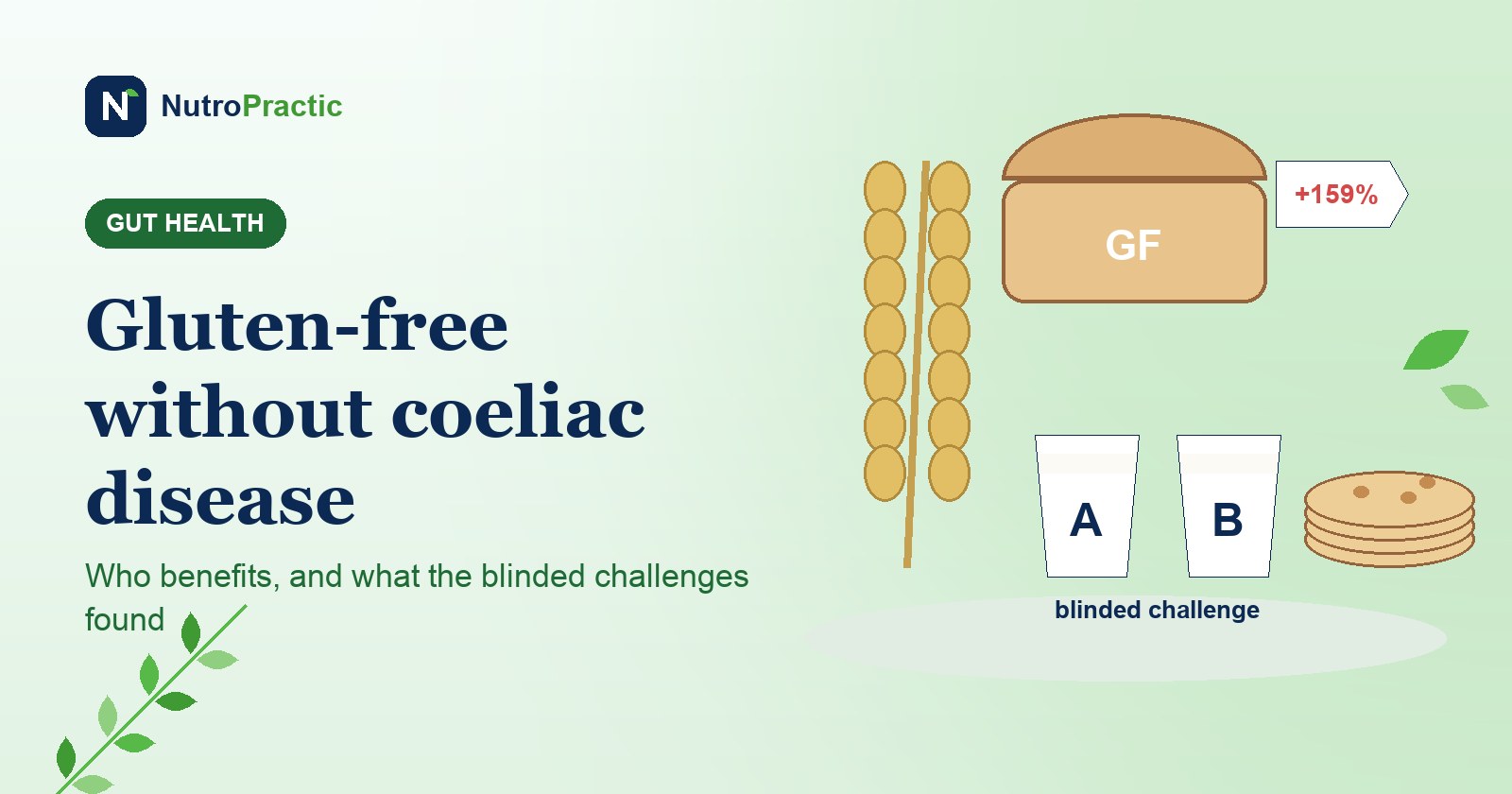
Gluten-free without coeliac disease: who actually benefits, and what the blinded gluten challenges found
In blinded trials only 16% of people who said gluten made them ill reacted to gluten rather than placebo, and in Oslo fructans caused more bloating than gluten. Who really needs to avoid it, how to get tested before you stop, how much gluten is in a slice of bread or a roti, and what gluten-free food costs (159% more in the UK) and lacks.
1 Nov 2026
Newsfeed for your website
Want this feed on your website?
Add it to any site with one copy-and-paste snippet. No sign-up, and it updates itself every hour.
Start with a virtual consultation
Tell Dr. Triveni what you want to change. You will leave with a clear next step, whether you are in Toronto, London, New York or Chennai.