Food labels · November 3, 2026
Chile already puts black stop signs on junk food. Adding one that says 'ultraprocessed' still moved 3,519 parents, most of all on crisps with no warnings at all
In an online trial, parents looked at three bags of sour cream and onion crisps, all of them ultraprocessed. Half saw only Chile's usual nutrient warnings; half also saw a white octagon reading 'ultraprocessed'. The extra label lowered how healthy the crisps seemed and how keen people were to buy them, and it worked best on the bag that otherwise looked clean.
Since 2016, packaged food in Chile has carried black octagons, shaped like stop signs, that say a product is high in sugar, salt, saturated fat or calories. The idea has spread across Latin America. But a bag can be ultraprocessed without being high in any of those, and makers can tweak a recipe to drop a warning without making the food any less industrial. After Chile's sugar warnings arrived, for example, fewer products qualified as high in sugar while the use of non-sugar sweeteners went up. So countries are now asking whether to add a separate label for ultraprocessing: Colombia's health ministry has proposed one and Chile's Senate is debating it. A randomised trial published in Frontiers in Nutrition on 2 November tested what such a label adds on top of the warnings Chileans already know.
Researchers from the University of North Carolina at Chapel Hill and the University of Chile recruited parents of children aged 2 to 14 through an online panel in July and August 2025, with half the places reserved for people with a high-school education or less. After quality checks, 3,519 were analysed: average age 39.6, 70% women. Everyone was first given a short government-style explanation of what 'ultraprocessed' means. Then each saw three made-up bags of sour cream and onion potato crisps, all of them ultraprocessed: one with no warnings, one 'high in sodium', and one high in sodium and saturated fat. Half the parents, chosen at random, saw only those nutrient warnings, as on Chilean shelves today. The other half also saw a white octagon reading 'ultraprocessed'.
For each bag, parents said whether they thought it was ultraprocessed, how likely they were to buy it in the next week and how good or bad it would be to eat it every day. The new label raised the share who correctly called the warning-free bag ultraprocessed by 12 percentage points, and the one-warning bag by 4 points. For the bag that already carried two black octagons it made no clear difference.
It also nudged buying intentions and health ratings down for all three bags, on 1 to 5 scales: by about a third of a point for the warning-free bag, and by smaller amounts as the black octagons piled up (0.23 and 0.20 for buying, 0.17 and 0.11 for health ratings). A third of a point sounds small, but across a sample this size the ranges were tight and every one of those drops was well clear of chance.
Why would a label about processing work less well on a bag that is also salty and fatty? Part of it is probably a ceiling: a product already wearing two warnings looks unhealthy, so there is less room to fall. But the authors note that even the plain question 'is this ultraprocessed?' followed the same pattern, which suggests many parents were simply counting labels rather than reading them. Earlier interviews with Chilean mothers found exactly that habit. The authors' own unpublished count suggests that more than 40% of ultraprocessed products in Chile carry no nutrient warning at all, which is where a new label would have the most to say.
The limits matter. People answered on a screen, not in a shop, and looked at one kind of snack, so real-world buying may differ. The sample was a convenience sample of parents, not a picture of all Chileans. The bags differed slightly in colour, name and pictures as well as warnings. And telling everyone first what 'ultraprocessed' means may have strengthened the effect, although that mirrors the public information campaign that would likely come with a real label. The authors also flag a possible side effect: a shopper might pick a sugary 'natural' product over a less sugary one that is ultraprocessed only because of a sweetener. The trial was registered in advance, funded by Bloomberg Philanthropies with support from the US National Institutes of Health, and the authors declared no conflicts of interest.
Adding an 'ultraprocessed' warning to Chile's nutrient warning labels: online randomised trial in 3,519 parents (Frontiers in Nutrition, 2 November 2026)
3,519
Chilean parents of children aged 2 to 14 analysed (126 removed by quality checks); mean age 39.6, 70% women, 44% with a high-school education or less
3 bags
Made-up sour cream and onion potato crisps, all ultraprocessed: no nutrient warning, 'high in sodium', or high in sodium and saturated fat
+12 / +4 / +1 pts
Change in the share who correctly called each bag ultraprocessed when the white 'ultraprocessed' octagon was added (no, one and two nutrient warnings); the last was not significant (p = 0.10)
−0.32 / −0.23 / −0.20
Drop in purchase intention on a 1 to 5 scale for the same three bags (all p < 0.001)
−0.33 / −0.17 / −0.11
Drop in how healthy eating the product every day seemed, 1 to 5 scale (all p < 0.001)
49%
Parents who said they use front-of-pack labels often or all the time (34% often, 15% all the time); 6% never
59%
Parents who described themselves as overweight or very overweight
Over 40%
Share of ultraprocessed products in Chile with no nutrient warning label, according to the authors' unpublished data
Figures are from the abstract, Table 1 (participants), Table 2 (average differential effects of the ultraprocessed label against nutrient labels only), Table 3 (comparisons between products) and the discussion. Effects are differences between randomised groups in predicted probability (percentage points) or predicted mean score. The label effect on identifying the product and on purchase intention was smaller for products with more nutrient warnings. An exploratory analysis found that, for the two-warning bag only, the label helped parents with more education identify it but not those with a high-school education or less. Online experiment with hypothetical choices; one product type; convenience sample.
- Chile was the first country to make interpretive front-of-pack warnings compulsory, in 2016, and its black octagon design has since been taken up by several other Latin American countries.
- The paper counts 14 countries that require interpretive front-of-pack labels. Most warn only about nutrients; a few also flag non-sugar sweeteners.
- Ultraprocessed is defined by how a food is made and what goes into it, such as flavourings, colourings and other cosmetic additives, not by its sugar, salt or fat. That is why a product can be ultraprocessed and still carry no nutrient warning.
- An earlier study in Brazil used a rectangular 'ultraprocessed' label to match that country's labels. It helped people spot ultraprocessed products but did not change how healthy they seemed. The authors suspect the bolder octagon here drew more attention.
- To keep brand loyalty out of the results, the researchers invented all three crisp brands and gave them the same flavour, so that apart from the warnings the bags differed only in background colour, name and picture.
- Front-of-package ultraprocessed warning labels: a randomized controlled trial with Chilean parentsFrontiers in Nutrition, 2 November 2026 · Open access (CC BY 4.0). Introduction, methods, Tables 1 to 3, results, discussion, limitations, funding and conflict of interest statements.
- Trial registration NCT06842680ClinicalTrials.gov · Registered design, measures and analysis plan; the paper lists the changes made after registration.
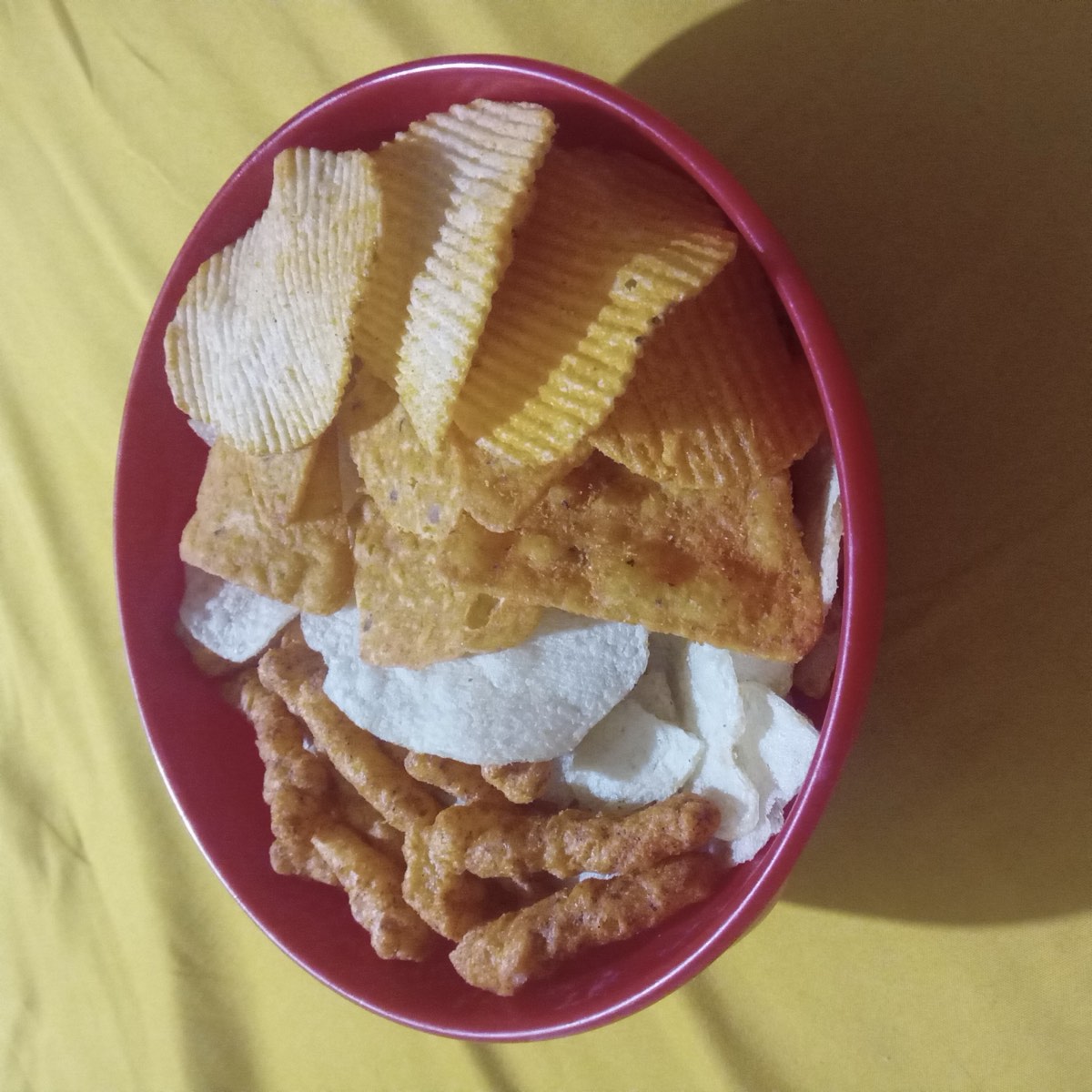
- A bowl of snacksWikimedia Commons · CC0 image by Toby Scratch Fanatic.
General information, not medical or policy advice. This online experiment measured what parents said they would buy, not what they bought or ate. For help planning everyday meals and snacks for your family, talk to a qualified dietitian or your doctor.
Analysis by NutroPractic from the sources listed. Written for general readers; it does not replace advice from your own doctor.
From our articles
Our guides on this subject
Plain-language guides on nutrition and wellness, backed by research.
Nutrition science
Ultra-processed foods: what the evidence says, and a realistic way to eat fewer
Ultra-processed foods now make up more than half of the calories eaten in the US and the UK. What counts as ultra-processed, what a landmark NIH trial and a 2024 BMJ review found, where the science is still uncertain, and simple swaps that don't require cooking everything from scratch.
3 Oct 2026
Everyday eating
Food label claims decoded: 'no added sugar', 'multigrain', 'natural' and 'high protein'
A no-added-sugar biscuit with only 13% fewer calories. A 7-grain loaf with refined flour listed first. A 'high protein' bar that clears the legal line at 21%. What each claim legally requires in the EU/UK, US and India, with worked reads of real packs.
2 Nov 2026
Gut health
Probiotic capsules: which ones have trial evidence, what they can do, and when to skip them
Children on antibiotics: 8% got diarrhoea with a probiotic, 19% without. Older hospital patients: 10.8% with, 10.4% without. Which capsules have evidence, what three guidelines say about IBS, what a course costs per case prevented, and who shouldn't take them.
2 Nov 2026
Newsfeed for your website
Want this feed on your website?
Add it to any site with one copy-and-paste snippet. No sign-up, and it updates itself every hour.
Start with a virtual consultation
Tell Dr. Triveni what you want to change. You will leave with a clear next step, whether you are in Toronto, London, New York or Chennai.